
What Does a Commercial Backflow Preventer Test Actually Check?
The notice lands on your desk — annual backflow preventer test required. Your device is probably in a mechanical room somewhere, bolted behind the meter, and nothing's gone wrong with the water in years. So the question makes sense: what does this test actually check, and what happens if it fails?
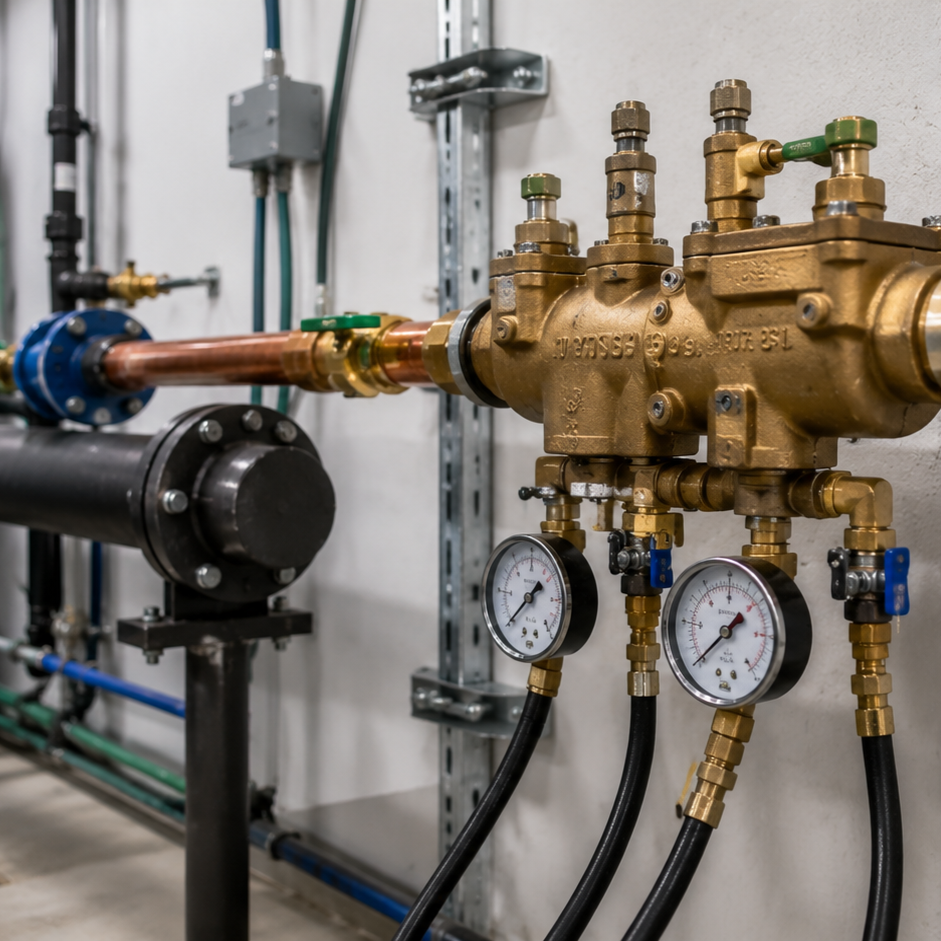
The device has internal valves that stop contaminated water from flowing backward into the municipal supply. The test confirms those valves still seal under pressure. When they don't — when a rubber disc has hardened, or a valve seat has scaled over — the device fails silently. Water from your boiler, your irrigation line, or your fire suppression loop can reverse direction into the potable supply, and nothing alerts you to it.
That's what the test catches.
Why water flows backward in the first place
Most people assume water only flows one way — from the main, through the meter, into the building. It does, until the pressure conditions shift.
Two situations reverse the flow. The first is backsiphonage. When a water main breaks or a fire hydrant gets flushed nearby, street pressure drops fast. That pressure drop creates a suction effect that pulls water from inside your building back toward the main — same as a straw when you lift your finger off the end. If your building has a boiler, a chemical feed line, or an irrigation connection tapped into the potable supply, that water gets pulled along with it.
The second is backpressure. Some commercial systems run at higher pressure than the municipal main — booster pumps, recirculating loops, and elevated storage tanks. When your building's internal pressure exceeds street pressure, water gets pushed back through the connection rather than pulled. Either way, it moves in the wrong direction.
The backflow preventer sits at the point where the potable supply enters the building. Its job is to stop that reversal before it reaches the main.
The two main device types — and what each one checks
The type of device on your property determines what the tester is specifically looking for.
| Device Type | Configuration | Common Applications |
|---|---|---|
| Reduced Pressure Zone (RPZ) | Two check valves + pressure-differential relief valve | High-hazard: labs, car washes, irrigation, boilers |
| Double Check Valve Assembly (DCVA) | Two check valves, no relief valve | Standard commercial water service, fire systems |
| Air Gap | Physical separation between supply and receiving vessel | Highest-risk applications requiring no mechanical device |
An RPZ is the more complex of the two. Between its check valves sits a middle zone that's intentionally kept at lower pressure than the supply side. If either check valve starts leaking, that middle-zone pressure rises. When it climbs past a set threshold, a relief valve opens and discharges water to the floor drain — a visible signal that something's failing inside the assembly. The annual test verifies the pressure differential is being maintained, both check valves seat correctly, and the relief valve opens at the right pressure and closes cleanly afterward.
A DCVA has two check valves in series but no relief valve. The test checks that each check valve holds a measurable pressure differential — typically at least one pound per square inch — without bleeding. Both have to pass independently.
And if your property has any high-hazard connection — irrigation that contacts fertilizers or pesticides, a recirculating hot water or boiler system, a laboratory — you're almost certainly required to have an RPZ, not a DCVA.
What the tester is actually measuring
The tester shows up with a differential pressure gauge kit: hoses and gauges that attach to the small test cocks built into the device body. Those threaded ports on the side of the assembly — the ones that look like small plugs — exist specifically for this procedure.
With the gauges connected, the tester isolates each section of the device and reads the pressure differential across the check valves. Think of it like checking whether a deadbolt is actually throwing — the gauge shows whether the valve is holding under pressure or bleeding across the seat.
For an RPZ, the tester also exercises the relief valve. That means deliberately dropping pressure on the downstream side until the relief valve should open, confirming it activates at the correct differential, then verifying it closes cleanly when pressure's restored. Hard water in older commercial buildings — especially where mineral deposits build up in pipe walls and around valve seats — can scale over a relief valve until it no longer opens and closes fully. That condition shows up during testing.
For a DCVA, it's the same idea: isolate each check valve, measure the differential, and confirm neither one leaks when pressurized.
All water service to the building gets shut off for the duration. About an hour, usually. Longer if the device needs repair.
What a passing result looks like — and what failure means
A device passes when every component performs within spec. Both check valves hold their minimum pressure differential. For an RPZ, the relief valve opens at the right threshold and closes cleanly. The tester records the readings, signs the report, and submits it to the local water authority. You get a copy.
Failure means at least one component didn't hold. The most common failure is a check valve that lets pressure bleed across it — usually because the rubber seal has hardened from years of thermal cycling, or because debris has lodged against the valve seat. In older assemblies, that debris is usually mineral scale. An assembly that's been in place for ten or more years, in a building with hard water, is a real candidate for this.
When a device fails, the tester notifies you and the water authority. The device gets repaired and retested. Not flagged for next year's inspection. If repair isn't possible, replacement is required.
When the annual test isn't the only test required
The yearly requirement covers routine certification. But a few situations trigger an additional test outside the normal schedule — and it's easy to miss them.
Removing and reinstalling a device requires a retest after it goes back on the pipe. This catches most commercial irrigation systems in eastern Pennsylvania, where backflow preventers get pulled in the fall for winterization and reinstalled in the spring. The reinstallation itself is the trigger — even if the same device goes back on the same pipe, unchanged.
Any repair to the device also requires a retest. A plumber who replaces a worn check valve seat or a failed relief valve has changed the condition of the assembly. The follow-up test confirms it performs within spec before it's back in service.
Three backflow devices commonly found on commercial properties
Commercial properties often have more than one backflow preventer — each protecting a different water system, each needing its own annual test.
The domestic water service has a device at the main entry point. That's the one the annual notice most often references. It protects the entire interior plumbing system from the municipal main.
A fire suppression system has its own separate device. Fire suppression water sits stagnant in pipes for months and may contain chemical additives. Without a dedicated backflow preventer, that water can reverse into the potable supply.
An irrigation system connected to the potable line needs its own device too. Irrigation water contacts soil, fertilizers, and pesticides — one of the higher-hazard connections on most commercial properties, which is why irrigation systems typically require an RPZ rather than a DCVA.
Three systems means three devices, three tests, three certifications submitted to the water authority. Every year.
What happens after the tester leaves
The tester submits the test form to the local water authority — in Pennsylvania, that's your municipal water provider. You get a copy. Most water authorities require those records to be kept for several years, and they use them to track which properties are current on compliance.
If the device passed, nothing else is required until next year. If it failed and the tester made an on-site repair, they run a second test before leaving and submit both sets of results. If repair wasn't possible that day, the property owner typically has 30 days after notification to complete repairs and arrange a follow-up certification.
Skipping the test entirely puts the property in violation. Water authorities can disconnect service to properties with unprotected cross-connections — and unlike a missed deadline you can smooth over later, water shutoff hits every tenant, employee, and customer in the building the same day.
Inconsistent Water Temperature
A heater that swings between scalding and lukewarm, or that takes noticeably longer to recover after a draw, is usually showing a failing heating element (electric) or a thermostat drifting off its setpoint. On gas units, burner issues or a weakening thermocouple cause similar symptoms.
Inconsistent temperature rarely arrives as the first sign of trouble. It usually shows up alongside something else — shorter hot water duration, longer recovery times, or noise during the heating cycle. When it shows up alone on a newer unit, it points to a component failure worth repairing. On a tank already showing two or three other symptoms, it's one more data point toward replacement.
Frequently Asked Questions
Most tests wrap up in about an hour when the device is in good shape. If a valve fails and the tester can make an on-site repair, expect two to three hours for the work and follow-up test. Replacing the entire assembly takes longer, and water stays off during that process.
Yes. The tester closes shutoff valves on either side of the assembly to isolate it. For roughly an hour, all water service to the building is off. For a restaurant, medical office, or any operation that can't easily pause, it's worth scheduling during off-hours or before anyone opens.
An RPZ has three components that have to pass: two check valves and a relief valve. A DCVA has two. More components, more ways to fail. The relief valve is under constant spring tension and direct water exposure, and the rubber seat degrades with repeated heating and cooling. In buildings with hard water, mineral scale on that valve seat is one of the more common failure causes the annual test turns up.
Yes, and you should. A good tester will show you what they're reading at each step. If a component fails, ask to see the gauge reading and which valve didn't hold. That's useful information when deciding whether to repair the existing assembly or replace it — especially on older devices where one failed component often means others aren't far behind.
Yes. Reinstallation triggers a new test requirement — same device, same pipe, doesn't matter. Any commercial irrigation system in Pennsylvania that gets winterized annually needs a test in spring after it goes back in service, regardless of when the prior annual test was done.
The water authority tracks compliance through submitted test records. Properties that fall behind get notices. Repeated non-compliance can result in disconnection. And beyond the regulatory issue, an untested device that's quietly failing provides no actual protection — a backflow event that reaches the public supply creates liability that dwarfs the cost of an annual test.
The procedure itself is simple: a certified tester connects a differential pressure kit, reads the pressure across each internal component, and confirms every valve performs within the required threshold. But "tested" and "passed" aren't the same thing. An assembly that's been in place for a decade, in a building with hard water and seasonal temperature swings, may have seals and valve seats that were fine last year and marginal today. That's exactly what the annual test is for.
