
Your restaurant equipment supplier calls with a delivery date. Two commercial ranges, a new hood system — your kitchen expansion is finally happening. Then a question lands in that first plumber conversation that you weren't ready for: the meter outside is the same one that was there when the building was a dry cleaner.
That's where most commercial gas projects actually start. Not with pipe and fittings, but with a discovery. The building has gas. It just doesn't have the infrastructure to support what you're planning.
The process is predictable once you know what to expect. Here's what it actually looks like.
What Triggers a Commercial Gas Line Installation
Three situations drive most commercial gas work. First is new construction — gas gets run from the street into the building and distributed to appliances. Second is a tenant improvement: a retail space becoming a restaurant, or an office adding a commercial kitchen. Third is equipment expansion inside an existing system, where the building already has gas service but the piping wasn't sized for the added load.
That third category catches property owners off guard more than the others. Adding one commercial range to a kitchen that already runs a range, two water heaters, and a rooftop HVAC unit doesn't feel like a major project. But gas pipe is sized for what it currently carries. Add a high-BTU appliance at the end of a line that's already near capacity, and you create a pressure drop that affects every appliance upstream. The new range underperforms. So does everything else.
The First Step: Load Calculation and System Assessment
Before any pipe is measured or any permit gets filed, a licensed master plumber adds up the total gas demand the system will need to carry. Every gas appliance has a BTU/hour rating — a commercial range might draw 160,000 to 200,000 BTU/hr, a commercial water heater around 199,900 BTU/hr, a rooftop gas unit heater another 100,000 BTU/hr or more. The plumber totals all of it, then checks whether the existing service can deliver adequate pressure to everything running at once.
That calculation also determines pipe sizing. Think of it like the water supply feeding a row of fixtures: the further from the meter, and the more demand at the end of the line, the larger the pipe has to be to maintain pressure. A 1-inch main might branch into ¾-inch and ½-inch runs — but only if the numbers support it. If the total load has grown beyond what the current main can carry, the pipe diameter has to increase from the meter forward, not just where the new appliance connects.
The assessment also covers routing. In older commercial buildings — the kind common across this region, built in the 1950s and '60s — new pipe sometimes has to travel through drop ceilings packed with ductwork and conduit, or below a concrete slab where trenching becomes part of the job. You find that out in the assessment. Not mid-installation.
Pipe Materials Used in Commercial Gas Installations
Three materials show up in commercial gas work. Each has a role.
| Material | Where it’s used | What to know |
|---|---|---|
| Black iron (steel) pipe | Exposed runs, most commercial interiors | Code-standard for decades; threaded connections; doesn't flex |
| CSST (corrugated stainless steel tubing) | Retrofits, tight routing, areas needing flexibility | Faster to install; must be bonded to electrical ground in commercial settings |
| Galvanized steel | Rarely used for new installs | Common in pre-1980 buildings; corrodes internally; often found during the renovations |
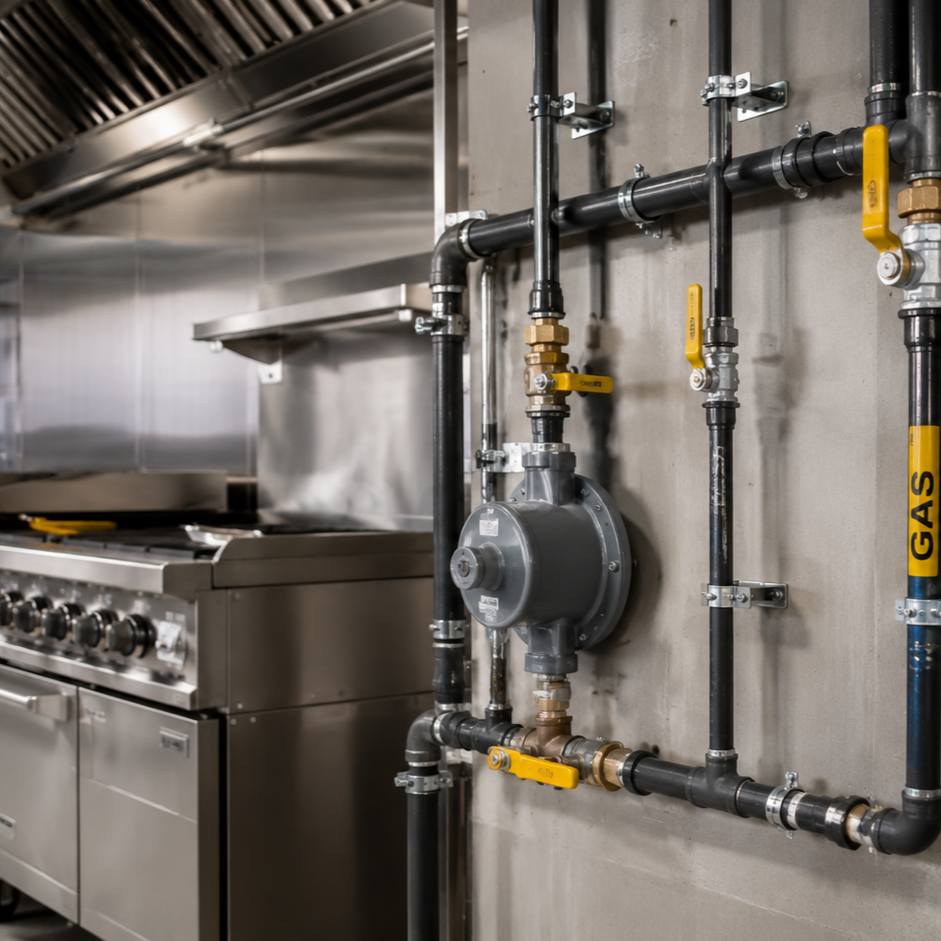
Black iron is what most people picture — rigid, threaded, supported by hangers every few feet along the run. It's the standard for commercial kitchen areas and exposed mechanical spaces. CSST became common in the 1990s because it routes through tight spaces without the threading labor of black iron. But it carries bonding requirements: the tubing has to be electrically bonded to the building's grounding system to prevent damage from nearby lightning strikes. In commercial work, inspectors check for that bonding documentation.
And then there's galvanized. It shows up inside walls during renovations in older buildings — especially buildings that haven't been substantially updated since the '70s. It looks like a gas pipe, and it was once used as a gas pipe, but it corrodes from the inside. A plumber pulling permits on a tenant improvement in a 60-year-old building has probably opened a wall and found galvanized that had to be cut out and replaced before any new work could connect to it.
How the Permit Process Actually Works
A commercial gas permit involves more than signing a form. For most commercial projects, the permit application requires a set of drawings — a floor plan showing where the gas line runs, what appliances it serves, and how it ties into the existing system. The municipality's building department reviews those drawings against the applicable fuel gas codes before issuing the permit.
That plan review step is what separates commercial from most residential permits. A residential gas permit for a new water heater is often a straightforward application with minimal documentation. A commercial permit for a new kitchen gas system requires drawings showing the work was designed by someone who understands load calculations and pipe sizing — not just someone willing to install pipe.
Once the permit issues, work can proceed. But it doesn't close until an inspector shows up, watches a pressure test, confirms the installation matches the approved drawings, and signs off. No certificate of occupancy, no activated gas service, until that inspection passes.
The sequence — drawings, plan review, permit, installation, inspection, approval — also protects the property owner. If unpermitted work later causes a fire or a leak, the insurance carrier looks for documentation that the work was inspected. Without it, coverage can be disputed.
What Pressure Testing Involves
The pressure test is physical proof that the system holds before any gas goes into it. The plumber pressurizes the line — air or inert gas, not natural gas — to a test pressure above the system's operating pressure. For commercial fuel gas systems, that's typically 3 PSI or higher, depending on jurisdiction, held for a minimum of 15 minutes while an inspector observes.
A gauge drop during that window means there's a leak. Every joint and fitting on the run gets checked until the source is found and corrected. Then the test runs again. Only when the system holds pressure for the full required time does the inspector approve the work.
Same principle as a water pressure test on new plumbing. Higher stakes.
The Meter and Utility Coordination Piece Most Property Owners Miss
The building permit covers the plumber's work inside the property. It doesn't cover the utility's infrastructure. If the total calculated load after the new installation exceeds what the existing meter can deliver, the utility needs to be contacted — and that's a separate process with its own timeline.
The plumber submits load calculations to the gas utility showing total BTU demand after the work is done. The utility reviews it, determines whether the existing meter is adequately sized, and schedules an upgrade if it isn't. Depending on the utility's workload and service area, that utility-side process can add two to four weeks to a project timeline that the property owner wasn't expecting.
Know this early. A project that looks like a two-week installation can stretch to six weeks if the meter upgrade wasn't on anyone's radar at the start. A plumber with commercial gas experience flags this in the initial assessment — not after the permit is already in hand.
Why Skipping the Permit Creates Bigger Problems Later
The temptation of unpermitted gas work is speed. No drawings, no plan review, no waiting — the pipe goes in when it's convenient. But the problems surface later, under deadline pressure, and they cost more to fix than the permit ever would have.
Property sales trigger disclosure requirements. A buyer's inspector who finds gas piping installed without permits — or gas lines that don't match the permitted configuration — creates a seller problem that can blow up a closing. Commercial tenants denied occupancy because the build-out's gas system has no final inspection and have even less recourse.
Insurance is the other exposure. Most commercial property policies require that covered systems be installed to code. Unpermitted work is outside that standard, by definition. A claim arising from unpermitted gas piping gives a carrier an argument for denial that's difficult to counter.
Frequently Asked Questions
Almost always, yes. New gas lines, extensions, modifications to existing piping, and new appliance connections all require permits in commercial occupancies. The permit is what triggers the inspection — and the inspection is what confirms the work was done correctly.
Plan review for commercial work typically takes one to two weeks, though that varies by jurisdiction and project complexity. Larger commercial projects with multiple gas appliances and extensive pipe runs take longer than a straightforward tenant improvement with a single appliance connection.
Commercial permits generally require submitted drawings showing the gas system layout, load calculations, and appliance specs. Residential permits for simpler work are often approved based on a description without detailed drawings. Commercial inspections are also more rigorous — the inspector typically witnesses the full pressure test rather than just checking installation after the fact.
No. Tenant improvements that add gas appliances require a permit in the tenant's name — the landlord's building permit doesn't cover tenant gas work. If new gas lines are being run, that scope needs to be on the drawings.
The plumber submits updated load calculations to the utility. The utility reviews them and schedules a meter upgrade. The building permit work can proceed, but gas service can't be activated until the utility's side is complete. That utility coordination process has its own timeline, independent of the building permit.
For most commercial tenant improvement gas installations, the physical work takes one to three days. Larger projects involving significant pipe runs through a building, new service entry points, or trenching take longer. The total project timeline — permit, installation, utility coordination if needed, and final inspection — is typically three to six weeks from the initial assessment.
Commercial gas work moves deliberately because the stakes of getting it wrong are immediate. A licensed master plumber with commercial gas experience handles the load calculations, the drawings, the utility coordination, and the pressure test — so the property owner isn't catching surprises halfway through a tenant fit-out or equipment upgrade.
