
The health inspector walked in on a Tuesday morning, and before she even reached your kitchen, she could smell it. The grease trap under the prep sink hadn't been pumped in four months, the unit was past capacity, dish water had been draining slowly for two weeks, and the odor had pushed out into the dining area. The restaurant was still serving lunch. It shouldn't have been.
Most commercial kitchen operators know grease traps need service. The question that actually trips people up is how often — because the answer isn't the same for every kitchen, and getting it wrong in either direction costs money.
What a grease trap actually does (and why it fills up)
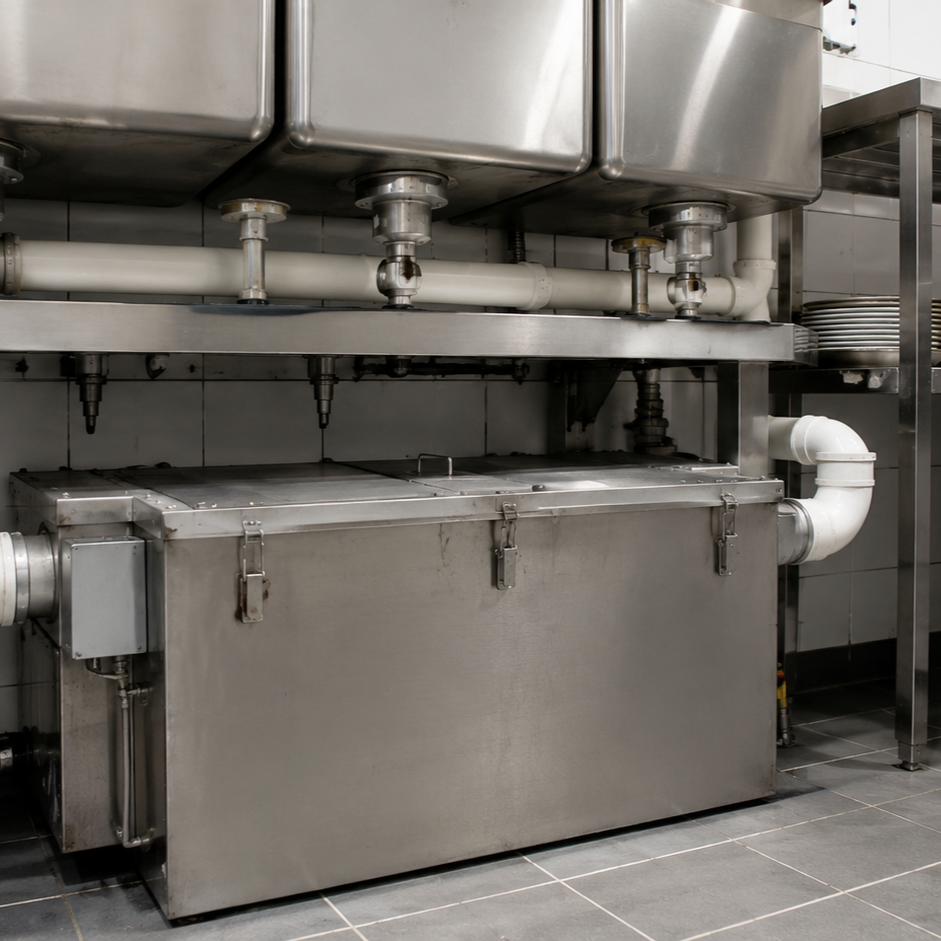
A grease trap intercepts wastewater from your sinks, dishwashers, and prep stations before it hits the main drain line. As hot, greasy water enters the trap, it slows down. The fats, oils, and grease — FOG in plumbing shorthand — cool and separate. Grease floats to the top. Food solids sink. The water in the middle flows out through the outlet baffle into the municipal sewer.
That separation works exactly as designed. The problem is what happens next. Every service cycle adds another layer of congealed grease at the top and compacted solids at the bottom. As both layers thicken, the usable water column in the middle shrinks. A trap that was separating effectively at full capacity starts letting FOG pass through into the drain line once those layers get deep enough.
Think of it like a coffee filter that's been sitting in the pot all day — it still looks like a filter, but it isn't filtering much anymore. The grease has to go somewhere. And it goes into your pipes.
The 25% rule: the measurement that matters most
Most municipalities that regulate grease trap maintenance use a threshold called the 25% rule: when the combined depth of the grease layer on top and the solids layer on the bottom reaches 25% of the trap's total liquid depth, it's time to pump.
That sounds technical. In practice, a licensed technician measures both layers with a probe during inspection and compares them to the trap's rated capacity. Many jurisdictions require pump-outs any time that 25% threshold is reached, regardless of what's on the calendar.
This is why calendar-based thinking alone can mislead you. A high-volume breakfast-and-lunch diner with a standard-sized trap might hit 25% in six weeks. A low-volume café doing mostly cold prep might not reach it for three months. The trap itself keeps score.
Pumping frequency by kitchen type
| Kitchen type | Typical pumping interval |
|---|---|
| High-volume fried food (wings, burgers, fish) | Every 4–6 weeks |
| Full-service restaurant, varied menu | Every 6–8 weeks |
| Café, sandwich shop, light prep | Every 2–3 months |
| School cafeteria | Every 2–3 months |
| Seasonal/event kitchen (peak season) | Every 3–4 weeks during peak |
| Low-volume office kitchen or break room | Every 4–6 months |
These ranges assume standard trap sizing. An undersized trap — common in older commercial spaces that were retrofitted rather than purpose-built — will fill faster than any frequency table predicts.
Indoor grease traps vs. outdoor grease interceptors
Not every commercial kitchen has the same setup. The difference matters when you're figuring out how often to schedule service.
Indoor grease traps are compact, under-sink units — typically 50 to 150 gallons. They're common in smaller restaurants, cafés, and commercial spaces converted from retail or office buildings. Because they hold less volume, they fill fast. Many municipalities require indoor traps to be serviced every 30 days regardless of the 25% threshold.
Grease interceptors are the large, high-capacity systems installed underground outside the building — often 500 to 1,500 gallons or more. High-volume restaurants, hotels, and institutional kitchens typically use interceptors. They hold far more FOG, so pumping intervals can stretch to every 90 days under normal conditions. But they need specialized vacuum equipment and licensed waste haulers to service properly. Big doesn't mean you can ignore them.
The distinction matters because owners of larger restaurants sometimes see "every 1–3 months" as a general guideline and assume they're fine anywhere in that range. If you've got a small indoor trap and a frying-heavy kitchen, the front end of that range — or shorter — is your real number.
What pushes your frequency shorter
Several things move the pumping interval toward the front of any range. Knowing them lets you calibrate instead of guess.
Frying volume is the biggest driver. A kitchen doing wings, French fries, fried seafood, or breaded cutlets is pushing saturated cooking oil into the wastewater stream with every batch. That oil heads straight for the trap. A fryer-heavy kitchen can fill a standard-sized unit in half the time a roasted-protein kitchen would.
Menu changes catch operators off guard. Adding a fish fry on Fridays, launching a brunch with eggs benedict, or bringing in a deep fryer for a limited-time item all increase FOG output without changing the service schedule. But the trap doesn't know the menu changed.
Seasonal volume spikes are easy to overlook. A restaurant that does 200 covers on a Tuesday in January might do 350 on a Friday in December. If your pumping schedule was set in a slow month, it may not hold through a busy season.
Staff habits affect the rate too. If employees rinse fat from sheet pans directly into the prep sink without scraping first, a meaningful portion of that grease ends up in the trap. Scraping plates and pans into the trash before they hit the dish station makes a real difference in how fast the trap fills — I've seen kitchens cut their pump frequency in half just by tightening that one habit.
Signs your trap needs pumping before the scheduled date
A trap that needs service will tell you. The signals start subtle and escalate fast.
Slow drainage is almost always the first sign. The prep sink takes longer to empty. The dishwasher basin holds standing water for a few extra seconds. These delays mean the outlet flow is restricted — and that restriction is FOG that's reached the baffle.
Odor comes next. A functioning grease trap holds odor inside the unit. When the grease layer gets thick enough that the trap can't separate effectively, decomposing organic matter starts venting through the sink drains. The smell is distinct: rancid fat mixed with sulfur. Once it's pushed out into the dining room, the trap has been overdue for a while.
Visible grease around drain openings or floor drains means the trap has overflowed or is close to it. At that point, you're not ahead of the problem anymore. Call a plumber when you smell it — that's always cheaper than calling one when you've got two inches of standing water in the prep area.
What happens during a pump-out
A professional pump-out isn't the same as a kitchen staff cleaning the trap with a bucket. Licensed grease waste haulers arrive with a vacuum truck and pull the entire contents of the trap — grease cap, water column, solids layer — into a sealed tank. Then the technician scrapes the baffles, checks the inlet and outlet for damage or buildup, and records the grease and solid depths before and after service.
That before-and-after measurement is your compliance record. It tells a municipal inspector that the trap was pumped when the 25% threshold required it, not just on a convenient calendar date. Many Pennsylvania municipalities require this documentation to be kept on-site and available for inspection on request.
And the hauler must hold the appropriate permits. Grease from a commercial kitchen is classified as industrial waste. The kitchen operator is responsible for verifying that the company they use is licensed to transport and dispose of grease waste at an approved facility.
Between pump-outs: what staff can do
Professional pump-outs service the trap. What staff does between pump-outs slows the rate it fills.
The highest-impact habit is dry-wiping. Before any pan, pot, or plate goes into the sink or dishwasher, wipe excess grease into the trash with a disposable towel or scraper. This one step can noticeably reduce the FOG volume reaching the trap each shift.
Don't run hot water through the trap to flush grease. It works short-term — the grease stays liquid long enough to pass the trap's outlet — and fails long-term, depositing solidified grease further down the drain line where a vacuum truck can't reach it.
Enzyme-based drain treatments can suppress odor and partially break down organic matter between pump-outs, but they don't replace pumping. They work on the biological layer, not the grease cap. Use them alongside a regular schedule. Not instead of one.
The cost of skipping service
Emergency pump-outs — the ones you schedule because you've got standing water in the prep area — typically cost two to three times what routine service costs. Add a plumber's time if the drain line downstream of the trap has built up its own grease layer. That's a separate service call.
Health department citations for a grease trap in violation can run from a written warning to several hundred dollars per incident, depending on the jurisdiction and how many times you've been flagged before. Repeat violations escalate.
The hardest cost to calculate is lost hours. A kitchen that shuts down prep for two hours because the dishwasher station is backed up loses that revenue. A kitchen that gets a temporary closure notice loses more than that — and the reputation hit sticks longer than the fine does.
Regular, calendar-driven pump-outs calibrated to your actual kitchen volume are less expensive than any of those outcomes. Not by a little. By a lot.
Frequently Asked Questions
Most full-service restaurants should plan on pumping every six to eight weeks. High-volume kitchens with heavy frying — wings, seafood, fries — often need service every four to six weeks. The 25% rule (pump when grease and solids combined reach 25% of the trap's liquid depth) is the threshold that matters most, regardless of what the calendar says.
The 25% rule states that a grease trap should be pumped when the combined depth of the grease cap on top and the solids layer on the bottom equals 25% or more of the trap's total liquid capacity. Many local municipalities use this as the legal threshold for required service.
Small under-sink traps can be cleaned in-house by trained staff with proper PPE and a grease disposal plan. Larger systems — especially outdoor grease interceptors — must be serviced by a licensed grease waste hauler. The hauler's documentation and waste disposal records are required for compliance.
An overfull trap stops separating FOG. Grease passes through into the drain line, builds up, and eventually causes backups. You'll see slow drainage first, then foul odors, then standing water or sewage backup. Health code violations and fines follow if the problem reaches inspection.
A standard pump-out at a restaurant takes one to two hours, depending on trap size and condition. The technician pumps the full contents, scrapes the baffles, and records the service data. Larger outdoor interceptors may take longer and need specialized equipment.
Yes. Kitchens with high frying volume fill traps faster than kitchens focused on baked, steamed, or fresh-prep items. Adding high-FOG items to a menu without adjusting the pump schedule is one of the more common reasons restaurants end up with an emergency service call.
The restaurants that handle this well tend to do two things consistently: they set a pump schedule based on actual kitchen volume, and they adjust it when the menu or season changes. That calibration is what keeps a routine maintenance item from turning into a Tuesday morning with an inspector in the dining room.
