
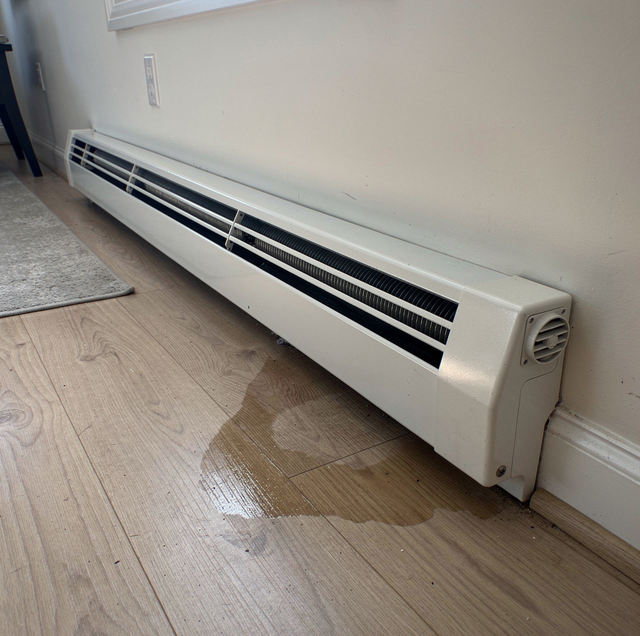
A hot-water baseboard unit is a length of copper tube with aluminum fins pressed onto it, running along the base of a room inside a thin metal cover, fed by a loop of pipe that carries hot water out from the boiler and back again. Every part of that assembly is metal, and metal does not stay at a constant length. It grows a measurable amount the moment hot water fills the tube, then pulls back in as flow slows and the loop cools between heat calls. Add water itself moving past valves, fittings, and anything that is not simply water, and a baseboard system has several separate reasons to make sound; some are ordinary movement, and some are worth a call.
Ticking, popping, trickling, and the rest happen at different points in a heat cycle, and only some of them call for a service visit:
| Sound | Where It Comes From | Calls for a Service Visit? |
|---|---|---|
| Ticking or clicking along the run as heat comes up | The copper tube expanding and sliding against its mounting hangers or the inside of the cover | No, ordinary expansion |
| A sharp pop or tick again as the loop cools | The same tube pulling back to its resting length as flow slows | No, the same movement in reverse |
| A trickling or running-water sound inside the cover | Air moving through the loop past the water already filling the tube | Yes, if it keeps returning or never clears after purging |
| Gurgling at the start of a heat call | Air collecting near the top of the piping run ahead of the water pushing it along | No, unless it repeats every single heat call |
| A steady hiss or whoosh | Water forced through a partly closed valve or a narrowed section of pipe | Yes, worth a look |
| A banging that follows the circulator starting or stopping | A pressure pulse sent through the loop as the pump cycles | Yes, if it happens on every cycle |
Expansion and Where the Tube Rubs
The copper tube inside a baseboard unit lengthens as hot water fills it and pulls back as the loop cools, and that movement has to go somewhere. Units ride on metal hangers that let the tube slide as it grows, and a tick or a click can be the sound of the tube moving against a hanger that has gone slightly tight or is angled. Where the pipe passes through a hole drilled in a floor plate or a joist on its way from one room to the next, the same expansion can bring the copper into contact with the wood or the framing at that single point, and a tick from that location repeats at the same spot every cycle rather than moving around the run.
The cover itself and its end caps are a second point of contact. A cover panel resting against the fin-tube element, or an end cap that has worked loose enough to brush the fins as they expand, adds its own small tap to the same warm-up and cool-down rhythm the tube is already producing. None of this is a defect in the metal; it is the ordinary behavior of a rigid piece of copper changing length every time a heat call starts and ends, and it repeats the same way for as long as the unit runs.
Noting when a sound comes, during warm-up, steady running or cool-down, and at which unit, gives the plumber the timing that separates a hanger tick from trapped air or a circulator pulse.
Trickling and Trapped Air
A trickling or running-water sound inside the cover is air moving through the loop; a leak shows as water, not sound. Air trapped in a pipe that is otherwise full of water makes a sound of its own as it works past the water ahead of it. That air flows toward the highest points in the piping until it reaches a vent.
Clearing that air through the loop's air vents and purge valves is plumbing work. Some baseboard units carry a small manual air vent at one end, and radiators have their own bleed routine. A trickle that fades after a fill or a repair is that air working out; one that keeps returning can mean a failing air vent, low loop pressure, or air getting in, each a separate repair.
Circulator, Flow and Pressure Sounds
A circulator pump that starts or stops abruptly can send a short pressure pulse through the loop, felt or heard as a single bang right at the moment the pump cycles rather than during steady running. A bang that lines up with a faucet or a washing machine shutting off comes from the house's supply piping and is a separate problem from the heating loop. A valve that is only partly open can force water through a narrowed opening, producing a steady hiss or whoosh that continues as long as the flow remains restricted at that point. A zone that has been rebalanced, or a new zone added onto the same loop, can change how much flow reaches a given baseboard run and shift which section carries the flow sound after the change.
When a Noise Is a Repair Item
A baseboard loop's ordinary sounds repeat the same way every cycle. A few changes are worth a call. A sound that is new, one that was not there the last time the system ran regularly, deserves a look rather than an assumption that it will settle on its own. One baseboard section that does not heat, even while the rest of the run reaches temperature, is a sign of a flow or air problem confined to that run rather than a problem with the whole system.
A pressure gauge reading that has drifted outside its normal range is a boiler-side issue, and it calls for a service visit rather than any adjustment at the boiler yourself. Water showing at the boiler's relief valve, or a boiler that keeps losing pressure, means switching the boiler off at its service switch and calling. A drip or a stain on the floor beneath a baseboard cover is a leak, whatever the loop sounds like, and it calls for a plumber. A gas or fuel smell anywhere near the boiler is a different situation: the right response is to leave the house and call from outside.
Water in an operating boiler loop is hot enough to scald, and the sealed system holds pressure. The relief valve, the fill valve, and the covers on a running loop are left to a licensed plumber, who shuts the boiler down first.
Where Baseboard Repair Work Focuses
Baseboard repair work covers the hangers and floor or joist pass-throughs along a noisy run, air removal at the loop's vents, the loop's fill and pressure, and the circulator when a sound lines up with pump cycling. Each of those is a different mechanism behind a similar sound, and pinning down which one is active is what separates a hanger adjustment from air removal, a fill and pressure correction, or work on the circulator itself.
Frequently Asked Questions
It can, if the cover has worked loose from its clips. Baseboard covers sit on spring clips or slotted tabs rather than being screwed down tight, and a loose cover can pick up vibration from foot traffic and rattle on its own, separate from anything the tube inside is doing as it heats and cools.
It can. A longer continuous run of tube has more total length moving back and forth between a heat call and the cool-down after it, so all that motion has to pass through whichever hanger is tightest along the run. A shorter run moves less in total, so the same tight hanger produces less tapping.
Some models do. A hydronic baseboard cover can include a small damper or a movable panel near the top that adjusts how much heated air the unit releases into the room, and a damper that is closed partway lowers that unit's output without changing anything in the loop, so the room can run cooler while the water stays just as hot.
No. A run that stays quiet can simply be shorter or not rub against a hanger at its tightest point. A silent run is not evidence that anything is wrong with it, and a noisy one is not automatically the bigger concern either; the two symptoms do not rank against each other.
Yes. The tube keeps contracting as long as the loop is still cooling, so a tick can come sometime after the last heat call ends; how long depends on how quickly that run loses heat.
Not by itself. A lower setting shortens the total time the loop spends hot, but each heat call still takes the tube through its full expansion, so a tick sounds the same when it comes.
Bring in hydronic baseboard maintenance and repair — hanger and pass-through adjustment, air removal from the loop, and a check of the circulator and loop pressure. East Coast Plumbing serves Barto, Boyertown, and Pottstown. Call (610) 944-2998.