
It happens fast. The storm rolls in around midnight — the kind with sideways rain and the whole neighborhood flickering off at once. You hear the sump pump running in the basement, then the power cuts out, and the pump goes quiet. For a few seconds you're not sure what you just heard. Then you listen to the rain still hammering outside and realize the water down there has nothing stopping it.
That scenario plays out regularly across southeastern Pennsylvania, where spring storms and nor'easters can knock power out for hours — sometimes longer. The problem isn't that sump pumps are unreliable. The problem is that your pump is completely dependent on the same grid that just went dark. Without a backup system in place, the moment the lights go out is exactly the moment your basement becomes vulnerable.
Here is what to do when it happens, and how to make sure it never catches you off guard again.
Why Your Pump Stops the Second Power Fails
A submersible sump pump sits at the bottom of a pit — the sump basin — cut into the lowest point of your basement floor. As groundwater rises around your foundation, it seeps into that pit. A float switch rides the water level. When the water gets high enough, the float trips the switch, the pump turns on, and water gets pushed out through a discharge line to drain away from your house.
The entire mechanism depends on one thing: a live 120-volt circuit. Cut the power and the pump is dead weight sitting in a hole. It doesn't matter that the water is still rising. The float trips, nothing happens.
This is the worst possible timing. The same storms that flood basements — sustained heavy rain, rapid snowmelt during a March thaw — are also the most likely to knock power out. The two problems arrive together.
Step 1: Don't Go Into the Basement Yet
This is the one most people skip, and it's the most important.
If there's already water in the basement, treat it as energized until proven otherwise. An appliance, an outlet, or a subpanel that comes into contact with standing water can make that water dangerous. The risk of electrocution is real, not hypothetical.
Before you go downstairs, go to your main electrical panel — usually in the garage or utility room — and shut off power to the basement circuits. Better still, shut off the main breaker. If you're not sure which circuits cover the basement and you don't want to take chances, shutting off everything is the right call. Once the power is confirmed off, you can safely go down and assess how much water has collected.
Step 2: Check What You Actually Have Down There
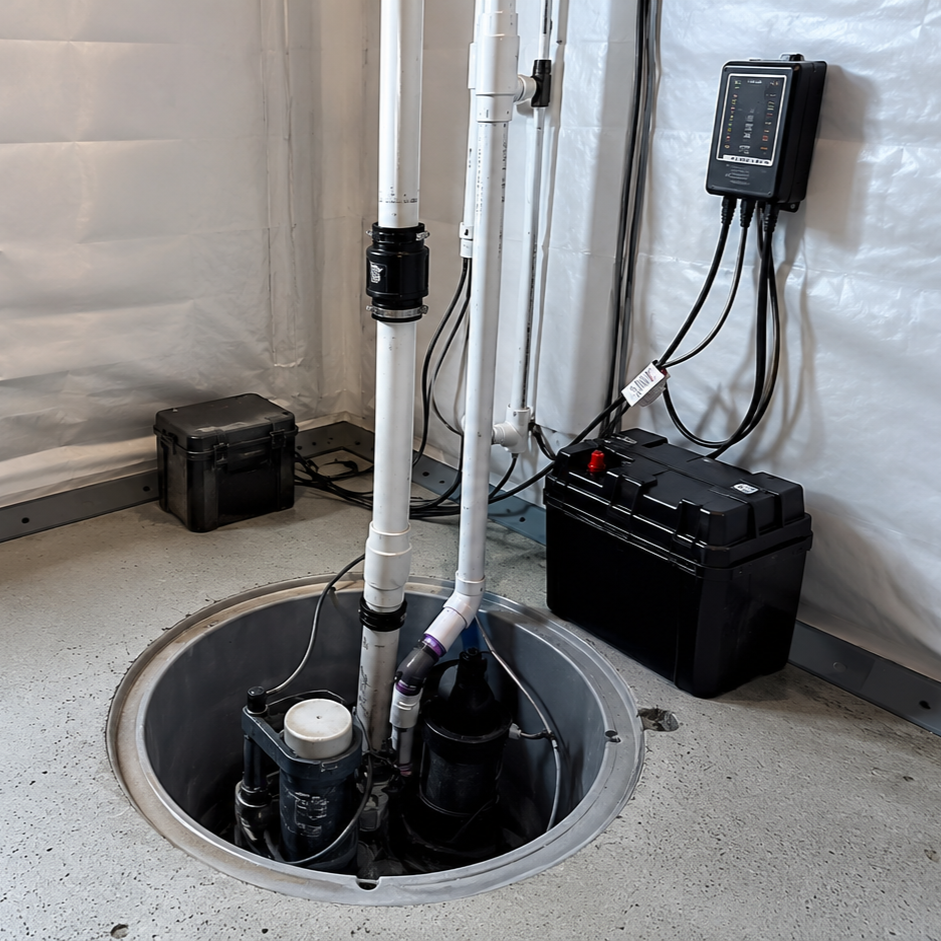
Stand at the edge of the sump pit and look for a second pump or battery box mounted next to or above the primary unit.
| What you see | What it means |
|---|---|
| A secondary pump with a separate float switch | You likely have a battery backup — check the battery indicator light |
| A black or beige box wired to the pump | Battery backup unit — test by pressing the alarm/test button |
| A separate pump connected to the water supply line | Water-powered backup — it should still be working |
| Only one pump, no other equipment | You have no backup — manual removal is your only immediate option |
If you have a battery backup, it may already be running. Some units emit an audible alarm when they've switched to battery mode. That's normal — it means it's doing its job.
Step 3: Manual Water Removal as a Last Resort
No backup system means buckets. It's laborious and slow, but in a short outage it can keep water from rising over the pit edge and spreading across the floor.
Use a five-gallon bucket to scoop water from the pit and carry it up the stairs to dump outside, away from the foundation. A wet/dry shop vac can help move water faster if you have one that runs on a generator or battery. Neither approach can match what a pump does, but they can buy time.
If the outage is expected to last more than a few hours and water is rising faster than you can remove it manually, that's a situation where professional emergency service becomes worth the call.
The Three Backup Systems That Actually Work
Once you're past the immediate emergency, the conversation shifts to making sure this doesn't happen again. There are three real options.
Battery Backup Sump Pump
A battery backup system connects to your existing sump pit, either powering the main pump or running a secondary pump through its own float switch. When power drops, the unit switches to battery automatically — usually within a second or two.
Most systems use a sealed AGM battery that charges off your home power while the grid is up. Battery run time depends on how hard the pump is working. In moderate groundwater conditions, expect five to eight hours of continuous protection. During a heavy storm where the pump cycles every few minutes, that may drop to three or four hours.
The battery needs to be tested annually and replaced roughly every three to five years. Think of it the way you'd think of a smoke detector battery: it only matters when something goes wrong, which is exactly when you can't afford to find out it's dead.
Installation typically runs $1,500 to $2,100, including the backup unit and battery. That cost covers a lot of ground compared to what a flooded basement costs to remediate.
Water-Powered Backup Pump
A water-powered backup uses municipal water pressure — not electricity — to create suction that pulls water from the sump pit and pushes it out the discharge line. No battery. No motor. No electrical connection.
The advantage is simplicity. Nothing degrades. No annual maintenance beyond a quick visual check. These systems activate automatically when the main pump shuts off.
The limitations are real, though. Water-powered pumps only work on homes with city water — not wells. And they're less powerful than electric pumps. In a moderate storm they can keep up with rising groundwater. In a major storm with the pump cycling hard, they may fall behind. They also use municipal water to operate, which adds to your water bill during an extended outage.
For many southeastern Pennsylvania homes on municipal water, a water-powered backup is a solid second layer of protection alongside a battery backup — not a replacement for one.
Standby Generator
A standby generator powers the whole house, including the sump pump, automatically when grid power fails. The transition happens in seconds. The pump never knows the grid went down.
This covers the whole house, not just the sump pump — the highest upfront cost of the three options, with generator installation for a whole-house unit generally running well into four figures. But if you're in an area with frequent outages, or if your basement is finished and flooding would mean replacing flooring and drywall, the math changes.
A portable generator can also work in a pinch, but it requires you to be home, awake, and ready to run an extension cord to the sump pump — which is exactly the wrong thing to count on at two in the morning during a storm.
What Happens When the Power Comes Back On
Power restoration after an outage carries its own risk that most people don't think about.
When the grid comes back up, the surge of current returning to your home can spike voltage at the pump motor. A pump that survived the outage fine can sustain motor damage from the surge when power is restored. A surge protector or uninterruptible power supply (UPS) on the pump circuit provides protection against this.
It's also worth checking the discharge line after any storm. If the line runs through an exterior wall or along an outside surface, it can freeze during cold snaps. A frozen discharge line means the pump runs but water has nowhere to go — the motor keeps cycling against back pressure until it burns out. That failure mode is common enough in southeastern Pennsylvania winters that it's worth asking about when you schedule any pump maintenance.
How Often to Test Your Backup System
The answer most plumbers give is: at least once a year, before storm season begins. In practice, that means late March or early April in this part of Pennsylvania.
Testing a battery backup takes about ten minutes. Turn off the main pump at the breaker, then pour water into the pit until the backup float trips and the secondary pump activates. Confirm water is actually discharging, not just the pump running in place. Plug the main pump back in and verify normal operation resumes.
If the backup unit shows a red fault indicator, or the battery doesn't hold a charge through the test, replace the battery before the next storm. Battery backup units are inexpensive to maintain. The battery replacement is typically under $200. That's the component most homeowners neglect until the system fails during actual use.
Frequently Asked Questions
Most standard battery backup systems provide five to eight hours of operation under moderate conditions. During a heavy storm where the pump is cycling frequently, run time shortens — sometimes to three or four hours. High-capacity battery systems can extend that significantly. If you're in an area that sees multi-day outages, a generator is worth considering alongside or instead of a battery backup.
Yes, but it requires you to connect the generator correctly and be present to do so. Never run a generator indoors or in the garage — carbon monoxide buildup is deadly. Run the extension cord from the generator outside through a window or door. A 3,500-watt generator is sufficient to run a standard 1/3- or 1/2-horsepower sump pump.
No. Water-powered backup systems require municipal water pressure to operate. If your home uses a well, a battery backup or generator is your only reliable option during a power outage.
Yes. Most battery backup units sound an alarm when they switch from grid power to battery, to alert you that the primary pump is down and the system is running on reserve. The alarm continuing for an extended period means the outage is ongoing and the backup is still active. If the alarm sounds and there is no outage, check whether the primary pump's float switch is stuck or the circuit breaker has tripped.
After power is restored, run a bucket test: fill the pit until the float trips and watch whether the pump starts, moves water effectively, and runs smoothly. A pump with surge damage may run loudly, vibrate more than usual, move water slowly, or fail to start at all. If you notice any of those symptoms, have the pump inspected before the next storm.
Most sump pumps last seven to ten years. If your pump is already past that range, adding a backup to an aging primary unit just protects the backup system — the weak link is still the main pump. A pump that's been running more than eight years, has required recent repairs, or struggles to keep up during heavy rain is usually worth replacing alongside installing a backup, rather than sequentially.
Yes. Beyond limited run time, batteries themselves have a lifespan of three to five years, even if never used. They must be tested annually and replaced on a schedule, regardless of how often the power goes out. Neglecting the battery means relying on a component that may be internally dead when you finally need it.
Not always. Space is the primary constraint. You need enough room in the pit for the primary pump, the secondary backup pump, and both float switches without them tangling or hitting the sides of the pit. In cramped pits, you may need to install a secondary, separate pit or switch to a high-end integrated system that combines both pumps into one unit.
A power outage during a storm is the exact moment your sump pump needs to work. Planning for that scenario in advance — with the right backup system, tested and maintained — is the difference between a dry basement and a remediation bill.
