
5 Signs Your Rental Property's Main Sewer Line Is Failing
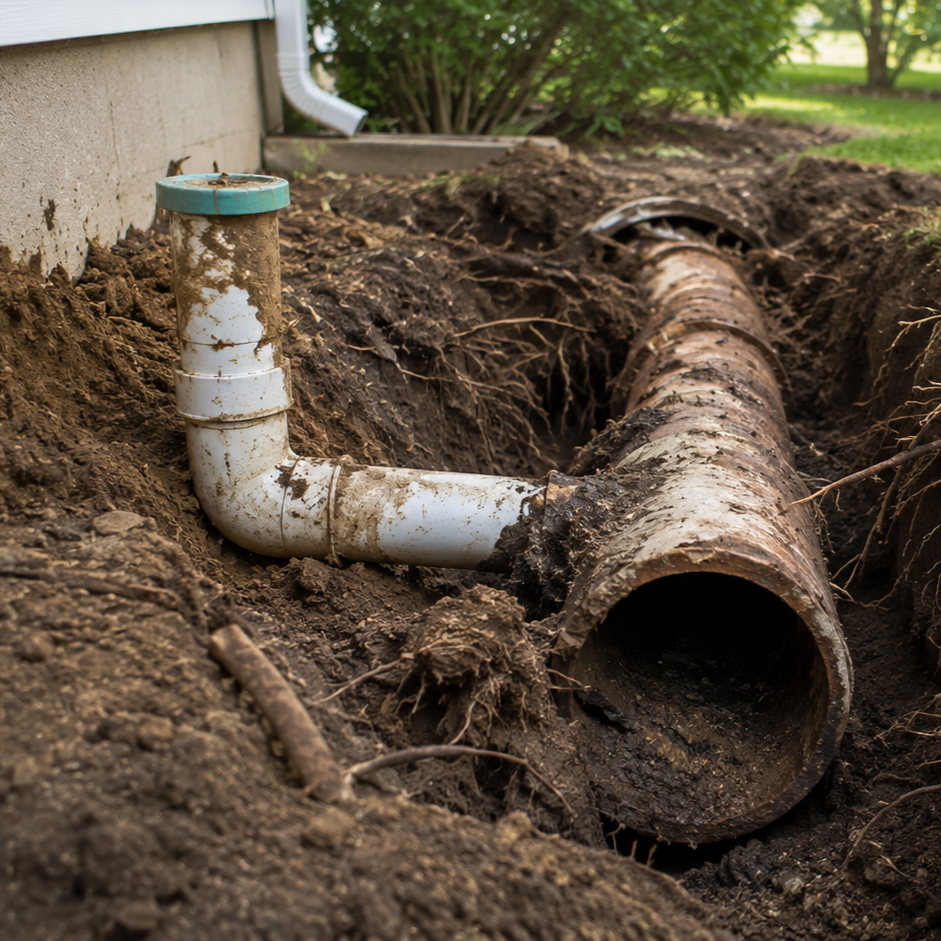
The call comes in on a Sunday evening. The tenant says two toilets won't flush, the basement floor drain is gurgling, and there's a smell they can only describe as "sewer." You send someone to snake the kitchen drain. Nothing comes out. You snake the toilet. Still won't clear. By Monday morning, you have an emergency on your hands, a displaced tenant, and an excavator in your yard.
Main sewer line failures rarely come out of nowhere. They show up for weeks or months before they become emergencies — usually through a pattern of small symptoms that get written off as individual clogs. Knowing those signs early is what separates a planned repair from a crisis.
When It's More Than One Drain, It's Probably the Main Line
A single slow drain is usually a localized problem. Hair in the trap, grease built up in the P-trap under the kitchen sink. Easy to clear, easy to isolate.
When multiple fixtures back up at the same time — or when clearing one drain causes another to gurgle — the problem is downstream of all of them. The main sewer lateral is the single pipe that carries waste from every fixture in the house out to the municipal main (or a septic system). If that line is compromised, every fixture connected to it starts misbehaving.
The classic pattern: you flush a toilet and the floor drain in the basement burbles. You run the washing machine, and the bathtub drain backs up. You plunge one drain, and it clears briefly, then backs up again in a day or two. None of those symptoms points to a single fixture. They all point to a restriction or failure further down the line.
What Causes a Sewer Line to Fail in a Rental Property
Not all main line failures have the same cause, and the cause matters because it determines whether you're dealing with a clearable blockage or a structural repair.
Tree roots
Tree roots are the most common culprit in established neighborhoods. Roots are drawn to the moisture and nutrients inside a sewer pipe. They find hairline cracks at clay-tile joints — the kind of seam that exists every few feet in pipes laid before the 1970s — and push through. Once inside, they fan out into a fibrous mesh that catches every piece of toilet paper and debris that passes by. A root intrusion doesn't fail all at once. It throttles slowly, getting worse with each growing season, until flow stops entirely.
Pipe belly and settling
When the soil beneath a sewer line shifts, a section of pipe can sag downward. Waste that should flow downhill by gravity instead pools in the low spot. Solids accumulate. Eventually, the pipe acts as a catch basin instead of a drain, and the flow restriction gets progressively worse.
Pipe offset and separation
Adjacent pipe sections shift out of alignment from ground movement, nearby excavation, or freeze-thaw cycling of the soil. The joint between two sections cracks open, creating a ledge where solids snag and a gap where groundwater and soil can intrude into the pipe.
Age and material failure
Clay-tile and cast-iron pipes were the standard in residential construction for decades. Clay-tile joints are held by compression mortar that degrades with time. Cast-iron corrodes from the inside out, with rust buildup narrowing the pipe's effective diameter before the pipe wall finally cracks. Many properties in Montgomery, Bucks, and Berks Counties still have their original laterals — some of them installed before World War II.
The Signs a Landlord Needs to Know
Slow drains in multiple units or on multiple floors
Slow drainage in one fixture is a clog. Slow drainage in two unconnected fixtures — say, the upstairs bathroom and the basement utility sink — means the shared pipe below both of them is restricted. Pay attention to tenant complaints even when they sound routine. "The bathroom sink drains slow" may be nothing. Three tenants saying the same thing in the same week is something else.
Gurgling sounds when fixtures aren't in use
Gurgling happens when air is being pulled through a partially blocked drain to equalize pressure. When you hear a toilet gurgling after the washing machine finishes its spin cycle, or a floor drain bubbling for no apparent reason, the air being pulled through that fixture is trying to find a path the water can't easily take. That's a sign of restriction somewhere in the main line.
Sewage odors in the basement or yard
Sewer gas — hydrogen sulfide and other gases produced by decomposing waste — should stay inside the pipe and vent out through the roof stack. When a pipe cracks, separates at a joint, or develops a belly where gases accumulate, that gas finds its way out through the path of least resistance. A persistent rotten-egg or sewer smell in a basement, even one with no obvious backup, often means the pipe has a structural gap somewhere below floor level.
A smell in the yard is more serious. It typically means a break or separation in the underground lateral, and that sewage is already leaching into the soil.
Lush green patches or soft spots in the yard
A leaking sewer line is essentially a slow-release fertilizer pump. Grass and plants above an active leak grow noticeably greener and faster than the surrounding lawn. Soft spots or sunken areas in the yard where no one has dug recently can indicate that soil has been washing into a cracked or separated pipe, leaving a void underneath.
Think of it like a slow leak in a garden hose fitting that's been buried underground. The immediate area stays wet, the soil erodes inward, and eventually the surface above it sinks.
Sewage backing up into the lowest fixtures
The lowest point in any plumbing system is where a failing main line shows up first. In a house with a basement, that's the floor drain or any basement fixtures. In a two-story rental without a basement, it's the first-floor toilet or shower. If a tenant reports that sewage — not just water, actual sewage — is coming up through the floor drain or backing up in the shower when no one is using those fixtures, the main line is already compromised, enough that waste has nowhere to go but backward.
Repeated clogs that return quickly
A main line that's been snaked clear should stay clear for a reasonable period. If the same line is backing up every few weeks despite clearing, the snake is cutting through a restriction but not removing its cause. Root intrusions and pipe belly both exhibit this pattern — the cable passes through, flow temporarily improves, and the problem returns as roots regrow or solids re-accumulate in the sag.
Quick-Reference: Signs and What They Suggest
| Sign | Most Likely Cause | How Urgent |
|---|---|---|
| Multiple drains slow at once | Main line restriction | Schedule an inspection within days |
| Gurgling from unused fixtures | Partial blockage, air pulling through | Inspect soon |
| Sewage smell in the basement | Pipe crack or joint separation | Inspect within the week |
| Sewage smell in yard | Active break in lateral | Inspect immediately |
| Lush/soft patches in the yard | Lateral leak into soil | Inspect immediately |
| Sewage backing up from the floor drain | Main line blocked or collapsed | Emergency |
| Same clog returns within weeks | Root intrusion or pipe belly | Schedule camera inspection |
Why a Sewer Camera Inspection Is the Right Next Step
A snake confirms there is a blockage. It doesn't tell you what caused it, where the problem originates, or whether the pipe wall is intact. A camera does all three.
A plumber runs a waterproof camera through the lateral from the cleanout, and the footage shows exactly what's happening: root fans, belly sections, offset joints, cracks, or collapsed segments. That footage is also useful documentation for insurance purposes and gives you a basis for deciding between repair and replacement.
In a rental property, a pre-tenancy camera inspection is worth considering for any home with older pipe materials. Having baseline footage means that if a tenant later disputes responsibility for a blockage, you have documentation of the pipe's condition at move-in.
Repair vs. Replace: What Determines the Call
When a camera inspection finds the problem, the next question is whether to repair or replace.
Localized damage — a single root intrusion point, one offset joint, a short section of belly — can often be addressed with trenchless lining or a spot repair. A liner is a resin-saturated sleeve that's inserted into the damaged section and inflated, curing in place against the existing pipe wall and sealing cracks and joints from the inside. No excavation required.
When the damage is widespread — multiple root intrusions, extensive pipe belly across a long run, widespread corrosion — replacement of the lateral is usually the more reliable option. Modern plastic pipe doesn't corrode, isn't susceptible to root intrusion at joints (because there are far fewer joints and they're sealed differently), and will outlast the property.
The decision comes down to the scope of damage, the pipe material, and the age of the system. A camera inspection gives a plumber enough information to make that call with confidence.
Frequently Asked Questions
The reliable test is observing whether clearing one drain affects another. Run water in the upstairs bathroom sink and watch the basement floor drain. If it gurgles, bubbles, or rises, the problem is in the shared main line below. Isolated clogs don't cross fixtures.
For properties with pre-1980 pipe materials (clay-tile or cast-iron), every 3–5 years is a reasonable interval, or before any new long-term tenancy. For properties with plastic (PVC or ABS) pipe, every 5–10 years is generally sufficient unless there are mature trees with large root systems nearby.
Yes, for a while. A line that's 50–60% blocked will still pass liquids, just slowly. Tenants often don't notice until the restriction is severe enough to back up. By the time a partial collapse shows symptoms, the situation is usually closer to a full blockage than it appears.
Root intrusion is organic — roots have grown through cracks in the pipe wall and are restricting flow. The pipe wall itself may still be largely intact. A full or partial collapse means the pipe wall has failed structurally, with sections caved in or separated. Root intrusion can often be addressed without full replacement; collapse usually can't.
It depends heavily on the policy. Standard landlord insurance policies often cover sudden and accidental water damage but exclude gradual deterioration or tree root damage. Some carriers offer specific sewer or service-line endorsements. Check your policy specifically for "service line" or "underground pipe" coverage before you need it.
A straightforward lateral replacement from the house to the street can often be completed in one to two days using conventional excavation, or in one day using trenchless methods. More complex situations — deep lines, difficult access, heavy root damage — can extend that timeline. Your plumber should be able to give you a working estimate once the camera inspection is complete.
A failing sewer line in a rental property is one of those problems where early action is dramatically cheaper than waiting. A camera inspection and a spot repair while the damage is localized costs a fraction of what a full lateral replacement costs after the line has backed up completely. If the pattern of symptoms is there — multiple slow drains, gurgling, recurring clogs — the right call is to get a camera in the line before a Sunday-evening emergency makes the decision for you.
