
Your hand sink backed up again. Three weeks ago, you paid for a snake job. Ten minutes of work, the drain tech cleared it, and now you're watching water pool six inches deep before it slugs its way down. Same sink. Same problem. Every shift.
This isn't bad luck. It's a predictable failure with specific causes — and usually more than one running at the same time.
| What’s happening | Why it keeps coming back |
|---|---|
| Soap scum coating pipe walls | Snaking clears the blockage, not the coating |
| Calcium soap forming with hard water | Narrows the drain permanently until jetted |
| Staff using the sink for non-hand-washing tasks | Adds debris load on top of the soap residue |
| 1.5" drain line (smaller than floor sinks) | Less margin for buildup before it blocks |
| Downstream backpressure from shared lines | The hand sink isn't actually the problem |
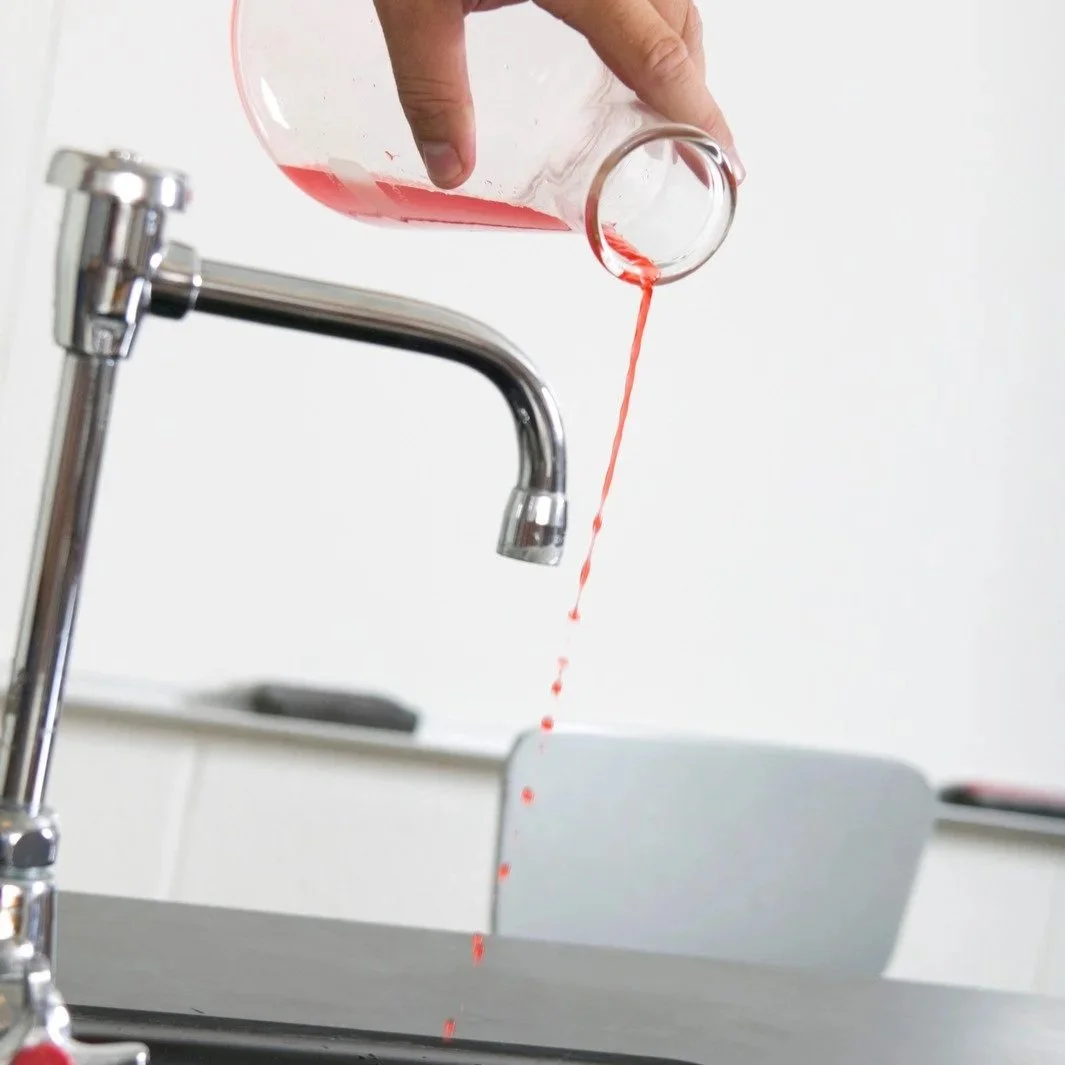
Why hand-sink drains fill up faster than other sinks in the building
A floor sink — the recessed basin that catches mop water and overflow — connects to a 3-inch drain line. A hand sink runs into a 1.5-inch or 2-inch P-trap. That's roughly a quarter of the cross-sectional area. Anything that cuts that opening down builds resistance fast. And a commercial kitchen sends a lot of material through that small pipe.
The P-trap is the curved section of pipe that holds a standing pocket of water to block sewer gas. It's also where everything slows down, makes a turn, and has the best chance of sticking. In a break room, that's soap and the occasional coffee rinse. In a restaurant, the mix is more aggressive.
What's actually coating the inside of that drain
Every hand wash in a commercial kitchen pushes commercial soap through the drain. Commercial hand soaps — especially the thick, moisturizing formulas most operators stock — contain fatty acids and glycerides. Those behave like cooking grease in a drain: liquid when warm, prone to sticking when they cool against the pipe wall.
The soap doesn't travel alone. Hands in a working kitchen carry cooking oils, flour, butter residue, meat proteins, and sanitizer residue. Each wash deposits a thin layer onto the pipe interior. It doesn't look like much. After a few weeks of service volume, that lining gets thick enough to catch everything that follows.
Think of scale inside a teakettle that's never been descaled. The first month, nothing visible. Six months in, the spout pours slower and the inside has a visible crust. A restaurant hand-sink drain goes through the same process — except it's soap, kitchen grease, and mineral deposits together, and a busy service runs that sink dozens of times a shift.
Hard water makes the buildup cycle faster
Hard water accelerates everything. Water in Berks and Montgomery Counties commonly runs 10 to 15 grains per gallon of hardness — calcium and magnesium that doesn't stay dissolved when it contacts soap.
When hard water mixes with the fatty acids in commercial hand soap, it forms calcium soap — a waxy, gray-white compound that bonds to pipe walls. It doesn't rinse off with more water. Enzyme treatments can slow it down but won't dissolve an established layer. The only thing that physically strips it out is pressure. Hydro jetting at 3,000 to 4,000 PSI scours the pipe interior the way a pressure washer clears a driveway — the accumulation cycle resets from zero.
The harder your supply water, the faster this builds. A hand sink that stays clear for two months in a soft-water location might need service every three weeks under the same usage conditions with hard water.
What employees put in the hand sink
Policy and actual behavior are two different things. Hand sinks are supposed to handle hand washing. In practice: sanitizer solution gets dumped into the nearest drain when breaking down a three-compartment sink. Ice scooped out of the machine goes into the hand sink because it's closer than the floor drain. Coffee pots get rinsed. Prep bowls get emptied.
None of it is catastrophic on its own. But combined with the soap coating already building on the pipe walls, every piece of debris that enters has something to grab. Soap-coated pipe acts like flypaper for debris. Once a calcium soap layer forms, every food particle that follows has a place to stick.
This doesn't mean staff are doing something reckless — it means the hand sink needs more frequent cleaning than it would otherwise, and the drain line takes more abuse than its size is designed for.
Why snaking it every few weeks doesn't fix it
A drain snake punches a hole through the blockage at the P-trap or the run just beyond it. Water drains again. Problem solved, until the next service.
What the snake doesn't do is clean the pipe wall. The coating stays. Two weeks later, the debris has rebuilt to blockage thickness because the interior of the drain never changed. You're not fixing the problem — you're buying time.
Hydro jetting changes the result. A commercial jetter delivers pressurized water at volume — typically 1,500 to 4,000 PSI on a hand-sink line — that scours the pipe wall rather than just piercing the blockage. After a proper jetting, the interior of the drain line is as clean as it gets. The accumulation cycle starts over from scratch.
For a repeatedly clogging hand sink, the sequence that actually holds: jet the line to remove the existing buildup, then deal with the conditions feeding the buildup. Snaking alone is maintenance on a problem that's growing.
When the problem is further down the line
Not every hand-sink backup is caused by what's entering the hand sink. The drain from a hand sink connects into a shared run that services other fixtures — the three-compartment sink, the mop sink, the dishwasher drain. If that shared line is partially blocked, backpressure shows up at the lowest-capacity fixture first. That's almost always the hand sink.
If the sink drains fine during prep but backs up every time the dishwasher runs a drain cycle, the hand sink isn't the issue. It's the shared line downstream. A camera inspection — running a small video head through the drain to the point of restriction — finds exactly where the block is and what's causing it. Root intrusion at an old joint, grease accumulation, a section of pipe with a belly — the camera shows it without guessing.
Keeping debris out from the start
The drain opening on most hand sinks is a standard chrome basket strainer. A lot of operations pull the basket because it slows drainage. That's the wrong call.
A properly seated strainer catches physical debris before it reaches the P-trap. It won't stop soap scum — liquid soap moves right through mesh — but it stops food particles and sediment that give the soap buildup something to grip. Clean the strainer basket each shift. It takes thirty seconds. Pulling a plumber for another snake costs forty times that.
For daily maintenance, a bio-enzymatic drain cleaner used at close each night helps break down soap residue and organic buildup before it hardens. It's not a substitute for professional jetting when the line is already coated, but it extends the interval between service visits noticeably. Don't use bleach — it won't help the clog, and it damages stainless steel connections over time.
How often should a commercial hand sink drain be cleaned professionally
It depends on your service volume, water hardness, soap products, and how well usage is managed. But a useful rule of thumb: if the drain is getting snaked more than once every six weeks, the line needs a hydro-jetting service, not another snake. One jetting service every four to six months keeps a high-volume hand sink running clearly. Less frequent if staff discipline is tight, more frequent if the drain is absorbing things it wasn't meant to handle.
Twice a year is a reasonable baseline for a full drain line inspection and cleaning in most commercial kitchens — enough to stay ahead of the buildup cycle without paying for service that isn't needed yet.
Frequently Asked Questions
Yes, with realistic expectations. Enzyme treatments slow accumulation in a drain that's already relatively clear. In a high-volume commercial environment, the soap and grease load typically outpaces what enzyme products can dissolve on their own. Use them at close each night to buy more time between professional cleanings — not as a replacement for jetting once the line is already coated.
From a plumbing standpoint, the concern is practical: quaternary ammonium sanitizers can interact with soap residue and add to buildup over time. A mop sink or floor sink is a better option for dumping sanitizer buckets. What your health code requires is a question for your inspector — the plumbing answer is simply that hand sinks handle the load better when they're only handling hand washing.
Bar hand sinks typically receive ice, citrus pulp, cocktail ingredients, and glass rinse water carrying post-mix syrup residue. Citrus oils and sugars stick to pipe walls differently than kitchen soap scum, but the mechanism is the same — sticky residue builds on the interior, then catches everything that follows. Same fix: strainer basket, bio-enzymatic cleaner at close, and periodic jetting.
A snake breaks through the blockage at one point in the line. Water flows again, but the pipe wall stays coated. Hydro jetting runs pressurized water through the full length of the drain, stripping the interior clean. On a 1.5-inch hand-sink drain, jetting costs more than a snake job, but it typically extends the time before the next service significantly. If you're calling for a snake every month, one jetting session and an honest look at staff habits will cost less over six months.
A new sink connects into existing main lines and existing venting. If a brand-new hand sink clogs in the first few weeks, suspect one of three things: a venting problem (insufficient air supply to move water efficiently), a pipe pitch issue (a low spot where water sits instead of draining), or a connection point where the new line joins an existing main that's already partially obstructed. A camera inspection from the P-trap outward finds the issue without tearing anything open.
Yes. If the original rough-in was sized for light-duty use and the kitchen has grown since, a 1.5-inch drain line may not handle the daily load. Upsizing to a 2-inch requires replumbing that section, but it can end a chronic clog problem entirely. Not every repeat-clog situation calls for replumbing — but if jetting and habit changes don't hold the line, drain sizing is worth looking at.
Chronic hand-sink clogs are not an indefinite maintenance problem you manage around. They're a signal — from the pipe wall, from staff habits, from the water chemistry — about what's entering the drain and how often the line is being cleaned. A camera inspection if it's recurring, and a hydro-jet cleaning instead of another snake job, usually resets the cycle and stretc
