
You got a quote for a tankless water heater and the number stopped you cold. Maybe it was $3,800. Maybe $4,500. You have seen ads suggesting you can buy the unit itself for $900, so the gap feels like unexplained markup. Before you start calling around for someone cheaper, it's worth knowing what you're actually paying for — because most of that difference is real work, and skipping it will cost you more down the road.
Tankless water heater pricing isn't a flat rate. Two houses on the same block can have installations that differ by $2,000 because of what's behind the walls — the size of the gas line, where the old heater vented, how hard the water runs. Your quote reflects the specific conditions your home presents, not some arbitrary number a contractor pulled out of thin air.
Here's what actually drives it.
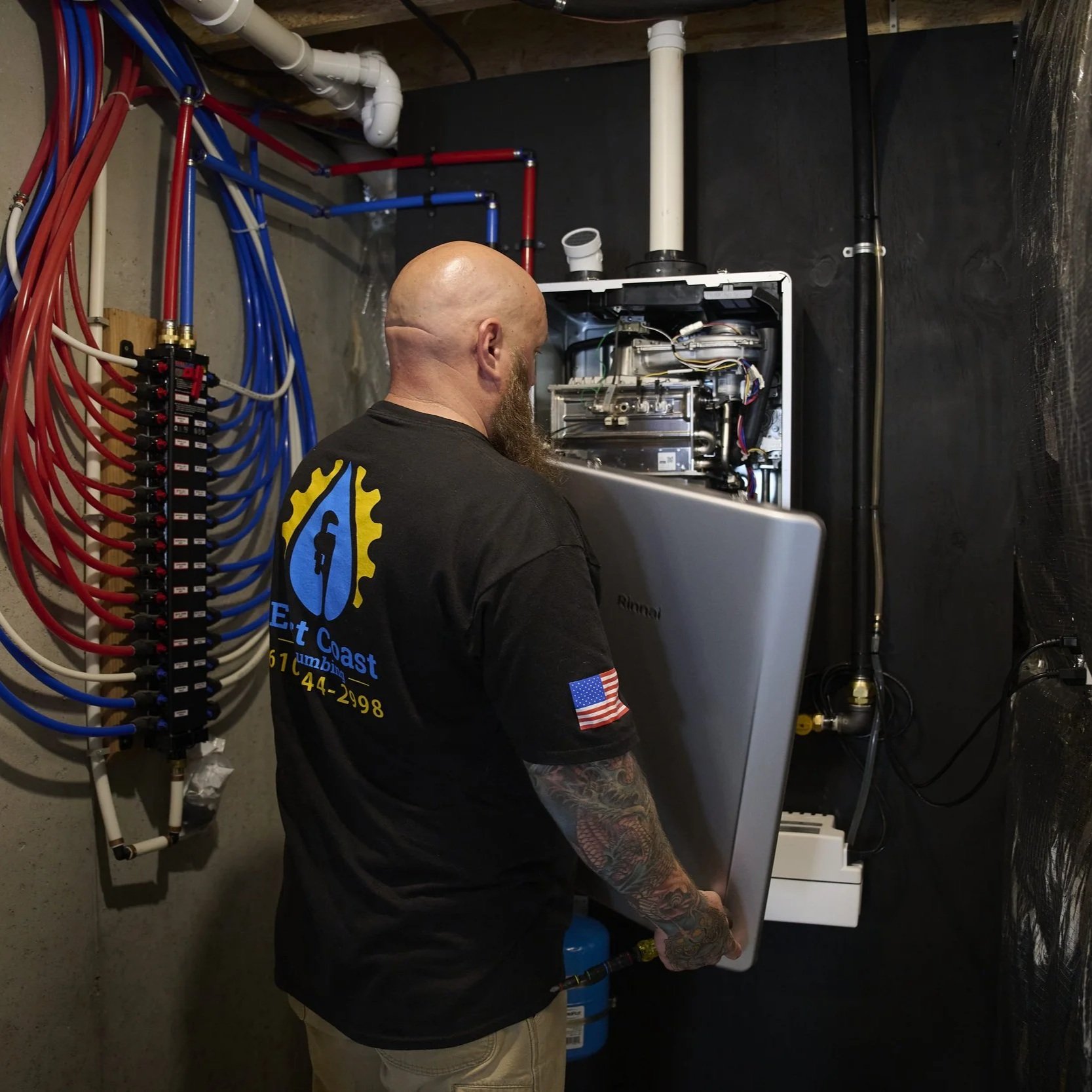
The unit itself: gas vs. electric, and how much output you actually need
The biggest variable is unit type. A gas-fired tankless heater costs more upfront than an electric one — typically $600–$1,500 for the unit versus $200–$900 for electric — but it heats water faster and handles simultaneous draws far better. An electric tankless unit big enough to serve a three-bathroom house usually needs a dedicated 240V circuit and often a panel upgrade, which erases most of the savings quickly.
For a family running the dishwasher while someone showers and someone else does laundry, a gas unit with 7–9 GPM output is typically the right spec. Flow rate is measured in gallons per minute at a given temperature rise. Pennsylvania groundwater in January runs around 40°F. Getting that water to 120°F while two fixtures are open simultaneously takes real BTU capacity. Undersizing by $300 on the purchase price means lukewarm water at the second fixture. Not worth it.
Higher-output gas units from Navien or Rinnai run $1,000–$1,800 for the unit. Entry-level Rheem and Ecosmart models start lower but wear faster under heavy daily use.
Venting: the cost most people don't expect
Your existing tank water heater uses a B-vent — the round metal pipe running straight up through the roof. A gas tankless unit can't reuse it. Tankless units run cooler flue gases, which means condensation forms inside the old B-vent and corrodes it from the inside. You need either Category III stainless-steel vent pipe or concentric PVC vent/intake pipe, depending on the model.
Running new vent pipe through finished walls, attic space, or a masonry chimney is where labor climbs fast. A simple exterior-wall installation where the vent goes straight out the side of the house adds $300–$500. Running a vertical vent up through two floors of finished living space can add $800–$1,200 — sometimes more. And if the old heater was in the basement but the new tankless unit needs to sit on an exterior wall, that relocation means new gas line extension, new water connections, and a new vent penetration all at once.
Plumbers who underbid jobs often price the unit and basic labor, then leave venting out of the estimate. That's how a $2,400 quote becomes a $3,600 invoice.
Gas line sizing: the hidden upgrade that surprises people most
Here's the thing most homeowners don't know walking in. A tankless water heater fires at full BTU capacity the moment you call for hot water — 150,000 BTU or more in many units. A conventional tank heater draws maybe 36,000–40,000 BTU on a slow recovery cycle. That's nearly a four-to-one difference in peak gas demand.
The gas line feeding your old water heater is probably 1/2-inch diameter. That line, sized for a 40,000 BTU draw, can't deliver enough gas volume to a 199,000 BTU tankless unit without pressure drop. Pressure drops and the burner cycles down, or the unit throws an error code. The fix is running a new gas line — either upsizing the existing run or pulling a dedicated 3/4-inch or 1-inch line from a point closer to the meter.
In a house where the gas meter is in the back and the water heater is in the far basement corner, that extension runs $400–$900 in materials and labor alone. In older homes in Berks and Montgomery Counties — where the original gas piping was black iron installed in the 1960s — a plumber will often find that the existing line needs partial replacement before upsizing can even happen. It's not an upsell. It's the building telling you what it needs.
Condensate drainage: small job, easily missed
High-efficiency condensing tankless units — which most gas models now are — produce acidic condensate as a byproduct of combustion. That condensate has to drain somewhere. Usually a floor drain or utility sink. If there's no floor drain near the installation point, someone has to route the condensate line to the nearest viable drain.
It's not a big-ticket item — $100–$300 depending on the run length. But it's the kind of thing that disappears from low-ball quotes and shows up as a change order the day of installation.
Electrical requirements, even for gas units
Modern gas tankless heaters still need 120V power for the control board, ignition, and any recirculation pump. If there's no outlet near the planned location, adding a dedicated circuit is part of the job.
For electric tankless units at the whole-house scale, the electrical requirement gets serious fast. A 36kW electric unit draws around 150 amps at 240V. Most residential panels top out at 200 amps total. Running a whole-house electric tankless unit often means a panel upgrade — and that upgrade typically runs $1,500–$3,000 with a licensed electrician. That's before a single pipe is touched.
And that's why gas is almost always the better call for whole-house service in an existing home. The gas infrastructure upgrade is cheaper than the electrical infrastructure upgrade needed to match it — usually by a significant margin.
Recirculation systems: if you want instant hot water at every tap
This one shows up as a surprise on some quotes. Tankless water heaters don't maintain hot water in the pipes between calls for water. That means the first 20–60 seconds after you turn on a faucet can run cold while the heater fires up and the hot water travels from the unit to the fixture. In a larger home, that wait is longer.
A recirculation pump or recirculation kit solves it. The pump keeps a slow loop of hot water moving through the supply lines, so hot water arrives instantly. The add-on typically runs $200–$600 installed, depending on the system. Some Navien and Rinnai units have built-in recirculation; others need an external pump and dedicated return line. If you are going through the expense of a tankless installation and the reason you're doing it is endless hot water, it's worth asking whether recirculation is included or needs to be added.
Permits, inspection, and old unit removal
Pulling a permit for a water heater replacement costs $75–$200 in most Pennsylvania municipalities. It's not optional. The inspection that follows verifies vent clearances, gas connections, and pressure relief valve placement. Some contractors skip the permit to offer a lower number — that quote is only cheaper until you need an insurance claim or a real estate transaction asks for documentation.
A licensed contractor pulls the permit, schedules the inspection, and hands you paperwork. That paperwork has real value.
Old unit removal is a separate item. Hauling away a 40- or 50-gallon tank heater adds $100–$300 to most jobs. It's not a lot, but it's the kind of thing that gets left out of a quote that looks surprisingly clean.
Hard water and scale protection
This matters specifically in Berks and Montgomery Counties, where water hardness runs 15–25 grains per gallon in many zones. Tankless water heaters are more vulnerable to scale buildup than tank heaters because the heat exchanger runs hotter. Calcium and magnesium deposit in the narrow passageways inside the exchanger and, given a couple years without maintenance, choke the flow and drop efficiency noticeably.
Many installers offer a scale guard or isolation valve kit at the time of installation — a $150–$300 add-on that makes annual descaling far easier and protects the heat exchanger warranty. If your home already has a water softener, this matters less. On hard well water or untreated municipal supply, it's not optional maintenance — it's the difference between a 20-year heater and a 10-year heater.
Think of the heat exchanger like a coffee maker in a hard-water household: leave it a year without descaling and you'll see the mineral crust building up inside the element. The tankless heat exchanger is just a much more expensive version of that same problem.
Installation location and access
A tankless unit mounted on an exterior basement wall with easy access to the gas supply, water lines, and a short vent path is the ideal setup. Costs stay predictable. Move the installation to a second-floor closet with a long vent run, limited access, and undersized gas service, and the same unit costs $800–$1,200 more to put in.
Plumber labor in southeastern Pennsylvania runs roughly $150–$250 per hour. A straightforward tankless replacement takes 4–6 hours. Add gas line work and vent rerouting on a more complex job and you're at 8–10 hours.
What a typical installed price looks like in practice
There's no single right number — here's a realistic range for southeastern Pennsylvania:
| Scenario | Unit Cost | Install & Materials | Estimated Total |
|---|---|---|---|
| Gas replacement, easy access, exterior wall vent | $900–$1,400 | $800–$1,200 | $1,700–$2,600 |
| Gas replacement, gas line upgrade needed | $900–$1,400 | $1,200–$1,800 | $2,100–$3,200 |
| Gas, new vent run through finished space | $900–$1,400 | $1,500–$2,200 | $2,400–$3,600 |
| Premium unit (Navien, Rinnai), full install | $1,200–$1,800 | $1,200–$2,000 | $2,400–$3,800 |
| Electric whole-house, panel upgrade included | $600–$1,200 | $2,000–$4,000 | $2,600–$5,200 |
These figures include labor, materials, and the permit. They don't include a water softener, filtration system, or recirculation pump. High-efficiency gas units with a UEF of 0.95 or higher may qualify for a federal residential energy tax credit — up to $300 — which is modest but worth asking your installer about.
Frequently Asked Questions
Most residential gas tankless installations in southeastern Pennsylvania run $2,000–$3,800 installed, depending on access, venting needs, and whether the gas line needs upsizing. Premium brands and complex vent runs push toward the higher end. Electric whole-house units with panel upgrades can exceed $4,000.
For a household that already has adequate gas service, usually yes. You'll save $100–$200 per year on energy compared to a traditional 40-gallon gas tank, the unit lasts 15–20 years versus 10–12 for a tank, and you won't run out of hot water mid-shower. The math works out over 7–10 years — faster if you're replacing a tank that's already failing.
The unit is one piece. Installation means decommissioning the old heater, hauling it away, running or upsizing the gas line, installing a new vent pipe, making new water connections, pulling a permit, and scheduling an inspection. Labor alone typically adds $800–$1,800 on top of the unit cost. What you saw online is the hardware price only.
Yes. Water heater replacement requires a mechanical permit in Pennsylvania municipalities. The permit triggers an inspection that verifies vent clearances, gas connections, and pressure relief valve placement. A contractor who skips it is cutting a corner that can affect your homeowner's insurance and complicate a future home sale.
Possibly not. Tankless gas units fire at 100,000–199,000 BTU peak, versus 36,000–40,000 BTU for a tank heater. If your existing line is 1/2-inch diameter or runs a long distance from the meter, it may not deliver enough gas volume without a pressure drop. Your installer should test operating pressure or calculate line sizing before finalizing the spec.
A straightforward replacement — accessible location, exterior wall vent, adequate gas service — takes 4–6 hours. Add a half-day for gas line work. Add a full extra day if the vent needs to run through finished space or if the installation location is changing.
Homes across Montgomery, Bucks, Berks, and Lehigh Counties run the full range — from newer construction with modern gas service to century-old farmhouses where every plumbing project turns up something unexpected. The cost of a tankless installation reflects exactly which kind of house you have.
