
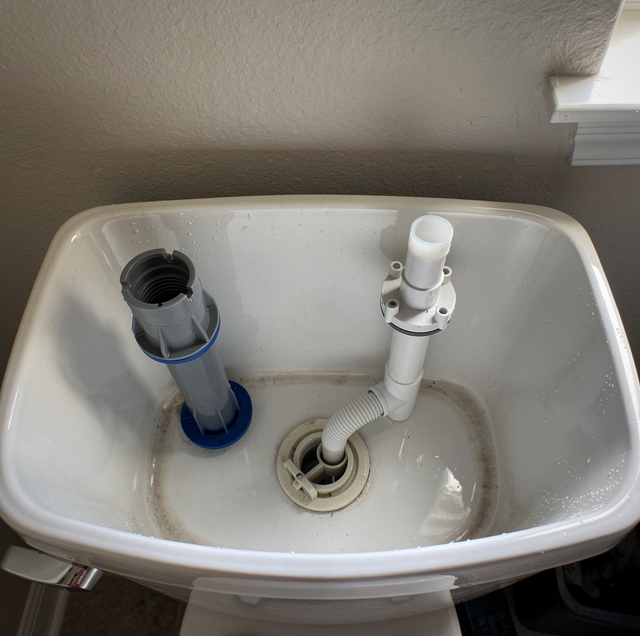
Lift the tank lid, and there are only about five moving parts in there, which is one reason a running toilet is one of the few plumbing problems you can reason through from start to finish without guessing. Nothing that controls whether the tank fills, holds, or releases water is hidden behind a wall or buried under the yard. Every part is sitting in plain view, and each one has exactly one job. When a toilet won't stop running, the sound is telling you that one of those jobs isn't getting done, and walking the water's path in order, from the supply line to the bowl, usually points straight at the part responsible.
The Fill Valve: What It Is Actually Sensing
The fill valve is the tower-shaped fitting on the left side of most tanks, connected to the water supply line coming up from the shutoff valve. Newer toilets almost always use a float-cup design, where a cup rides up and down a central shaft as the tank fills. Older toilets and some replacement parts still use a ballcock design, in which a float ball on a horizontal arm rises with the water and trips a valve at the top.
Either way, the fill valve isn't reading a timer or a pressure switch. It is only reading how high the float has risen. Once the float reaches its set point, an internal washer inside the valve presses shut against the water supply, stopping the flow. That washer is the actual seal doing the work, and it depends on a clean, complete closure. If debris from the supply line gets caught against it, or the washer has simply aged past the point where it seats fully, a thin stream of water continues to pass even after the float has already given the stop signal.
The Float: Where the Water Line Should Sit
The float, whether it's a cup on the fill valve body or a ball on an arm, has one function: turning water height into a mechanical signal. On a float-cup valve, a small clip or adjustment screw sets how high the cup has to rise before it trips the shutoff. On a ball-and-arm valve, the resting height is set by the angle of the metal arm, which a plumber bends to raise or lower where the ball trips the valve shut.
The water line should settle below the top opening of the overflow tube, not up into it. If the float is set too high, or if it has taken on water and become heavier than it should be, the fill valve doesn't get its stop signal until the tank level has already climbed past where it belongs. That extra water has to go somewhere, and where it goes is the next part of the process.
The Overflow Tube: What Water Spilling into It Means
The overflow tube is the open vertical pipe rising from the center of the flush valve assembly. Its only job is to act as a safety drain: if the tank level ever climbs too high, water spills down the inside of this tube and into the bowl instead of rising over the top of the tank and onto the floor. A thin, flexible refill tube usually clips to the top of the overflow tube and squirts a short stream of water down it after each flush to refill the bowl's water trap.
Hearing a steady trickle running down that tube, especially with the lid off and no one having flushed, is one of the clearest signals in the whole tank. It means water is climbing above where it should stop, which comes down to one of two things: the float is set too high, or the fill valve isn't shutting off completely at the correct height. Either way, the fix lives back at the fill valve or the float, not at this tube itself.
The Flapper or Canister Seal: How It Seats Against the Flush Valve
After a flush, the flapper is supposed to drop back down and cover the opening at the bottom of the tank, sealing the tank's water off from the bowl until the next flush. A rubber flapper does this with a hinge on one side, swinging down to rest over a round opening. A canister-style flush valve, common on many newer one-piece and dual-flush toilets, works a little differently: a cylindrical seal slides down a fixed center post and seats at its base rather than hinging shut.
Either design only works when the seal makes even contact all the way around the opening it covers, just like a sink stopper only holds water back when it sits flush against its seat on every side. Off-center by even a fraction, and the seal can look closed while water still finds a way past it, drop by drop. Rubber flappers harden and warp with age, losing the flexibility that lets them close the gap completely, which is usually the first part to check visually when a toilet runs.
The Flush Valve Seat: What Scale or a Warped Seat Does to That Contact
The seat is the ring the flapper or canister seal actually presses against, molded into the bottom of the tank. It's easy to blame a flapper for a leak when the seat itself is the real problem. In hard-water areas, mineral buildup can roughen that ring just enough that even a brand-new rubber flapper can't seat evenly against it. Age and heat can also warp the plastic seat itself, taking it slightly out of round.
This is why a fresh flapper sometimes doesn't stop a toilet from running. If a new flapper still leaks down within a day or two of being installed, the seat under it, not the part on top of it, is usually why.
The Chain or Lift Strap: The Slack It Needs
The chain, or a plastic lift strap on some canister systems, connects the flush handle's trip lever to the flapper or seal. Its length matters more than it might seem. Too little slack holds the flapper propped open a fraction after every flush, letting tank water bleed into the bowl continuously. Too much slack means the flapper doesn't lift high enough to trigger a full flush, and the extra chain can dangle and get pinned under the flapper as it tries to close.
The right amount of slack leaves a small, visible droop in the chain once the flapper is fully seated, with no tension pulling on it and no loose loop for it to catch on.
Three Symptoms, Three Different Problems
Almost every running toilet announces itself as one of three distinct sounds, and each one points toward a different part before you check anything else.
| Sound in the tank | Likely part | How to confirm it |
|---|---|---|
| Tank refills in short bursts, with no one having flushed | A flapper or canister seal leaking down between fill cycles | Color from a dye test shows up in the bowl without a flush |
| Water runs continuously and never fully shuts off | The float level or the fill valve itself failing to close | Water audibly spilling into the overflow tube |
| Running starts right after a flush and doesn't stop | The chain or strap holding the flapper open a crack | With the lid off, the flapper is visibly not fully seated |
A tank that refills in short bursts with nobody using the toilet means the seal at the bottom is letting water down into the bowl a little at a time. The fill valve is doing its job correctly there; it's just being asked to top off a tank that keeps quietly draining. A fill valve that runs and never shuts off is the opposite fault: the tank never receives the signal to stop, either because the level itself is incorrect or because the valve's seal has failed. Running that starts right after a flush and never settles down usually means the chain or strap is holding the flapper propped open a fraction, so it never fully reseats; lifting the lid right after a flush and watching whether the flapper drops flush against its seat confirms it.
Drop a few drops of food coloring or a dye tablet into the tank, wait about ten minutes without flushing, and check the bowl. Color in the bowl water confirms a seal is leaking even when nothing sounds like it is running.
When It Is Not the Tank at All
Not every running or leaking sound traces back to the parts inside the tank. The tank-to-bowl gasket, a large sponge-like seal sandwiched between the tank and the bowl and held tight by a set of bolts, can loosen or wear over time. When it does, water drips out from underneath the tank rather than draining through the flush valve, which can look like a running toilet but behaves more like a slow, steady puddle at the base.
The fastest way to stop a toilet from running while a repair is arranged is to turn the shutoff valve at the wall behind the toilet clockwise until the water supply stops.
A shutoff valve that hasn't turned in years can seize; forcing it risks snapping the stem, leaving a spray with no way to shut off. Left running for days above a finished ceiling, water can reach the structure below. Call a plumber.
Anything involving the supply line itself, replacing a fill valve, or removing the tank from the bowl is worth handing to a plumber rather than taking further apart.
Frequently Asked Questions
A tank lid that's slightly askew, or a replacement lid that doesn't match the original shape, can rest directly on the flush handle or the trip lever underneath it. That constant downward pressure keeps the flapper open, producing a running sound unrelated to the chain, the flapper, or the seat.
Chlorine or bleach tablets dropped directly into the tank remain in constant contact with the rubber flapper and can chemically break it down faster than plain water exposure would, shortening the seal's usable life independent of ordinary age and use.
Mostly, yes, but dual-flush toilets add an extra stage: a button-and-cable linkage that operates the canister seal instead of a simple lever and chain. Intermittent running on these models often traces back to the linkage sticking or not fully resetting, rather than to the canister seal itself.
It can be. The trip lever arm, the metal or plastic piece inside the tank that the handle rotates, has its own pivot point, and that pivot can bend or bind with age. When it does, it can hold the flush valve open even when the flapper and the chain are both set correctly.
A canister flush valve releases water through a ring of small holes around its base rather than a single opening, so a failing seal there tends to show up as a slow, steady drop in tank level rather than an audible trickle, making it one of the easier leaks to miss on a quick glance.
Many float-cup fill valves have a small clip or ring on the refill tube itself that controls how much water is diverted down it, independent of the float's height setting. If that clip has slipped or was set incorrectly during a past repair, water can overshoot into the refill tube even though the float and water level are otherwise right where they should be.
Get a running toilet traced to the exact part and fixed for good — not just muffled for a few days. East Coast Plumbing serves Barto, Boyertown, and Pottstown. Call (610) 944-2998.
