
The first sign is usually something small. The shower goes cold four minutes earlier than it used to. The hot tap runs faintly orange in the morning before clearing. You hear a low rumble from the utility closet when the burner kicks on. None of it feels urgent. Then one day you open the door and find the floor wet.
By the time a water heater fails visibly, the problem has usually been building for months. Most of the warning signs are readable well before anything dramatic happens — they are just easy to explain away.
Here is what those signs actually mean, and how urgent each one is.
Quick Reference: What You're Seeing and Why
| Symptom | Likely Cause | Urgency |
|---|---|---|
| Rusty or orange-tinted hot water | Depleted anode rod or internal tank corrosion | High — get eyes on it this week |
| Sulfur or rotten-egg smell in hot water | Anode rod reacting with sulfur compounds in the water | Medium — rod swap may solve it |
| Popping or rumbling during heating | Mineral sediment layer on the tank floor | Medium — reduces efficiency and lifespan |
| Hot water running out faster than before | Sediment displacing usable tank volume | Medium — nearing end of useful life |
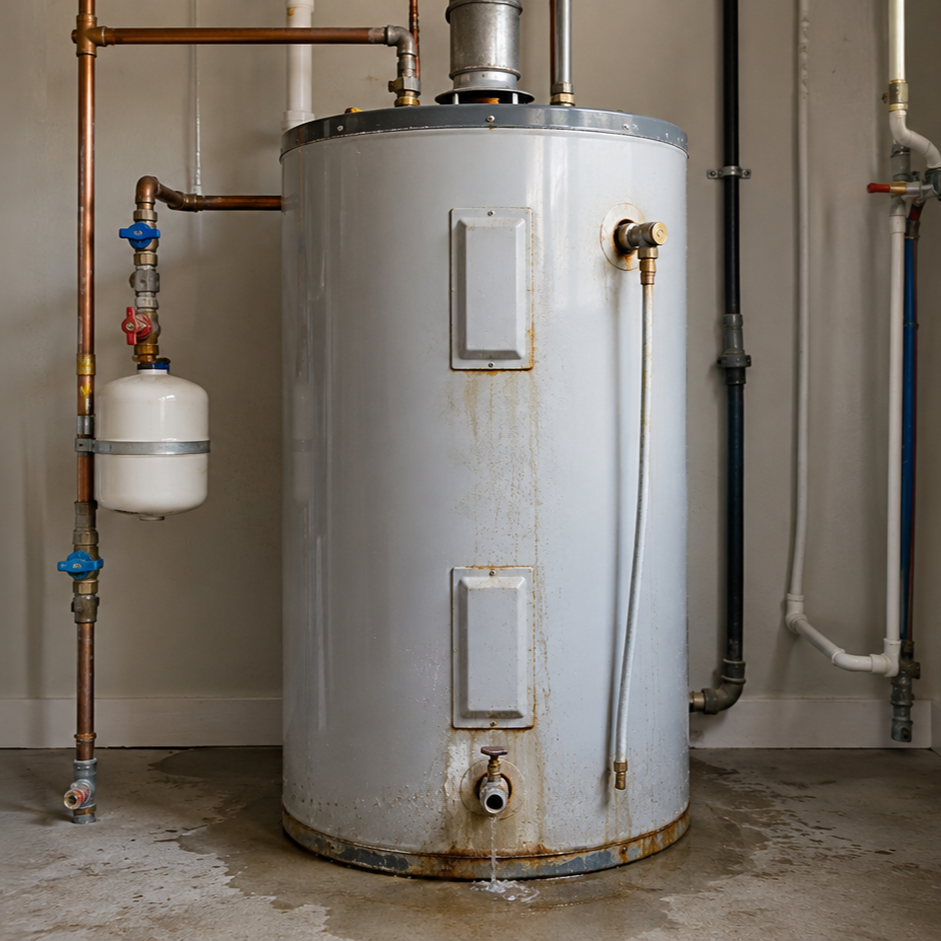
| Water pooling around the base | Tank seep or pressure relief valve discharge | Immediate — shut off supply and call |
| Unit older than 10–12 years | Past median tank lifespan | Proactive — schedule an assessment |
| Inconsistent or fluctuating temperatures | Failing thermostat or heating element | Medium-high — diagnose now |
| Rising energy bills with no usage change | Sediment forcing longer burner run times | Medium — efficiency loss is measurable |
| Low hot water pressure at fixtures | Scale on inlet valve or clogged dip tube | Medium — may be serviced without replacement |
Rusty, Discolored, or Foul-Smelling Hot Water
When hot water comes out orange or rust-colored, most people assume it's the pipes. Sometimes it is. But if the discoloration only appears on the hot side — the cold tap at the same fixture runs clear — the tank itself is the more likely source.
Water heater tanks are steel. To keep them from corroding internally, manufacturers install a sacrificial anode rod — a magnesium or aluminum rod that corrodes preferentially, drawing oxidation away from the tank wall. When the rod is depleted, corrosion shifts to the tank. The water picks up iron oxide as it sits inside, and that's the rust tint you are seeing.
Magnesium anode rods also react with naturally occurring sulfur compounds in some water supplies, producing hydrogen sulfide — the rotten-egg smell that shows up only when you run the hot tap. If the smell disappears when you run cold water instead, the anode rod is almost certainly the source. Switching to an aluminum-zinc rod often eliminates this, though it's worth having a plumber confirm the water chemistry first.
A persistent sulfur smell that doesn't clear after an anode rod swap sometimes points to bacterial growth inside the tank rather than rod chemistry. Sulfate-reducing bacteria thrive in tanks where the water temperature sits below 120°F — a common condition in older units whose thermostats have drifted. Setting the tank to 120–130°F kills most of the bacteria. If the smell returns, the tank needs to be drained, treated, and inspected.
A reddish tint that clears after a minute or two suggests the anode rod is depleted, but the tank isn't leaking yet. Persistent discoloration that doesn't clear means the tank wall has started corroding. At that point, the tank isn't far from developing a seep.
In areas with hard water — water high in calcium and magnesium — anode rods deplete faster than the manufacturer estimates. A rod rated for eight years in soft water may last four years in hard water conditions. The rod was doing its job quietly the whole time, but nobody knew to check it.
The Popping and Rumbling During Heating
The low rumble or popping you hear when the burner fires is sediment. Specifically, it's mineral scale — calcium and magnesium that precipitate out of the water over years of heating cycles and settle at the bottom of the tank as a hard crust.
Think of the inside of a kettle that's never been descaled. The element still heats. The water still gets hot. But it takes longer every year, and the crust at the bottom cracks and pops as water trapped underneath it vaporizes during each heating cycle.
The same thing happens in a water heater. The sediment layer forces the burner to run longer to heat the water above it — that extra run time adds up on the energy bill and on the burner's lifespan. A heater with heavy sediment runs hotter at the tank floor, which stresses the glass liner and accelerates the internal corrosion it was designed to prevent.
Sediment can be flushed if caught early, before the layer mineralizes completely. Once it hardens into concrete-dense scale, flushing doesn't clear it. At that point, the tank is working harder every cycle with no realistic way to reverse it.
A heater fighting heavy sediment also shows up on the utility bill. The burner runs significantly longer each cycle to push heat through the insulating crust. If your gas or electric bill has crept up with no change in usage, the water heater's efficiency loss is worth checking — especially if it's also making noise or producing shorter showers.
Hot Water Running Out Faster Than It Used To
This is the most common complaint before a heater fails. Nothing in the household has changed — same number of people, same morning routine — but the second shower consistently goes cold now.
The reason is simple: sediment has displaced usable tank volume. A 50-gallon tank with four or five inches of settled mineral crust on the floor may only hold 38 usable gallons of hot water. The thermostat still reads "set temperature met" because the sensor measures water at the top of the tank, not the cooler water sitting above the sediment layer at the bottom.
If your hot water capacity has gotten noticeably shorter in a tank that's seven or eight years old, sediment is almost always what happened. If the tank is 10 or more years old and the shortfall is worsening, it is past its useful life, regardless of what a flush might temporarily improve.
Low Hot Water Pressure at the Fixtures
When the hot side runs noticeably weaker than the cold at the same faucet or showerhead, the water heater is often the first place to look — not the fixture itself.
Two things cause this specifically in older tanks. The first is scale accumulation on the cold-water inlet valve. Mineral deposits narrow the valve opening over years of heating cycles, restricting how fast incoming water can replenish the tank and how strongly it delivers at the tap. The second is a deteriorating dip tube — the plastic pipe that routes cold water to the bottom of the tank so it doesn't mix with the heated water at the top. Dip tubes crack or disintegrate in older units, sometimes shedding fragments that work their way into fixture aerators or partially block the outlet. Either way, the tank is heating water fine. The problem is in the plumbing that feeds or delivers it.
The test is straightforward: check hot pressure at multiple fixtures. If every hot tap in the house runs weak, the restriction is at the heater. If it's limited to one fixture, the issue is more likely that fixture's aerator or cartridge. A plumber can pinpoint the source quickly — and in many cases, a dip tube replacement or inlet valve service fixes it without touching the tank itself.
Water Around the Base of the Tank
Water on the floor near the heater has two explanations — neither one is minor.
The first is discharge from the pressure relief valve. The PRV opens when pressure or temperature inside the tank exceeds safe thresholds. A small puddle under the PRV discharge pipe one time may just mean the valve released briefly during a pressure spike. Recurring puddles mean the valve is cycling repeatedly, which points to excessive line pressure, a failing valve that no longer reseats cleanly, or a thermostat running the tank too hot.
The second explanation is a seep or pinhole in the tank wall itself — the steel has corroded through. This kind of leak starts as a slow weep and can escalate without much additional warning.
Age — The Number That Changes How You Read Everything Else
Tank water heaters have a median lifespan of 8–12 years. That range isn't arbitrary — it's where the failure curve concentrates. A tank approaching 10 years isn't necessarily failing, but it's in the window where any of the symptoms above deserve attention rather than a shrug.
The anode rod is the most easily serviced part in a conventional tank heater, but almost no one touches it. Manufacturers recommend inspection every 3–5 years and replacement when more than half the rod has corroded away. Most rods are never checked until the tank gets replaced entirely.
If a heater is under eight years old and showing early signs — a faint orange tint, minor noise, sulfur smell — an anode rod swap and a flush is a reasonable first step. If it's over 10 and showing those same signs, replacement is the more defensible decision. The rod fix doesn't address the tank walls, which have been corroding for a decade.
Repair frequency is a related signal worth tracking. If the same water heater has needed a plumber twice in 18 months — a new element, a failing valve, a thermostat replacement — the repair-versus-replace math has usually shifted. Each fix addresses one failure mode, but none of them improves the condition of the tank itself.
Inconsistent Water Temperature
A heater that swings between scalding and lukewarm, or that takes noticeably longer to recover after a draw, is usually showing a failing heating element (electric) or a thermostat drifting off its setpoint. On gas units, burner issues or a weakening thermocouple cause similar symptoms.
Inconsistent temperature rarely arrives as the first sign of trouble. It usually shows up alongside something else — shorter hot water duration, longer recovery times, or noise during the heating cycle. When it shows up alone on a newer unit, it points to a component failure worth repairing. On a tank already showing two or three other symptoms, it's one more data point toward replacement.
Frequently Asked Questions
Tank water heaters typically last 8–12 years with normal use. Past 10 years, internal corrosion and mineral accumulation tend to accelerate beyond what maintenance can offset. If your tank is over 10 and showing one or more of the symptoms above, replacing it on your schedule — before it fails — is almost always cheaper than an emergency swap after a failure.
You can, and it's worth doing annually on newer units. Attach a garden hose to the drain valve and flush until the water runs clear. The catch: if the tank hasn't been flushed in several years and the sediment has hardened, the drain valve itself may not close properly after opening it, or the sediment simply won't flush out. On older heaters, have a plumber assess the tank before attempting it.
Run the cold tap and the hot tap separately. If both run discolored, the source is likely the supply line or incoming water. If only the hot side runs orange, the water heater is the more probable source — either a depleted anode rod or the beginning of internal tank corrosion. A plumber can confirm quickly.
Popping and rumbling from sediment aren't a safety hazard on their own — they indicate reduced efficiency and wear, not an imminent failure. A loud bang or sustained hissing from the pressure relief valve is a different situation entirely and should be addressed immediately.
Age is the deciding factor. Under seven years old, a component repair — anode rod, thermostat, heating element — is usually worth the cost. Over 10 years old, repairs tend to buy a short extension before the next problem. The tank walls have been corroding for a decade; fixing one part doesn't change what's happening everywhere else inside.
A planned swap for a standard 40–50 gallon tank typically runs $900–$2,000 installed, depending on fuel type and access. An emergency replacement after the tank lets go — especially one that floods the utility area — adds water damage cleanup, potential flooring work, and the premium of a same-day emergency call. The planned version is almost always the less expensive outcome.
The Window Between Warning and Failure
Water heaters don't usually fail without notice. They give warnings that are easy to dismiss as minor annoyances. Discolored water, shorter hot showers, noise during the heating cycle — these aren't unrelated quirks. They're the same tank that ran without complaint for nine years telling you it's getting close to done.
The practical window is usually six months to two years between the first real symptoms and outright failure. Using that window to plan a replacement on your schedule — rather than calling for an emergency swap on the coldest night of January — makes the whole process less expensive and a lot less stressful.
