
What a Commercial Plumbing Inspection Actually Covers (And What Gets Missed)
The property manager schedules it once a year, sometimes less. A plumber comes in, pokes around for an hour, hands over a report, and leaves. Most building owners aren't sure what actually happened. They know what they paid. They're less clear on what they got.
A commercial plumbing inspection done properly covers a lot of ground — supply lines, drain systems, fixtures, backflow devices, water heating equipment, and anything that touches water or gas on the property. Done quickly, it covers almost nothing. Knowing the difference matters when you're deciding whether a one-page report from a two-hour visit is worth the paper it's printed on.
Here's what a real commercial plumbing inspection covers, and where the gaps usually show up.
Supply-Side: Water Coming In
The supply side starts at the water meter and follows the building's cold and hot water lines through every floor, chase, and mechanical room. A plumber inspecting this side is looking for pressure, condition, and material.
Water pressure at the main should fall between 60 and 80 PSI for most commercial buildings. Below 45 PSI and fixtures on upper floors struggle; above 80 PSI, and fixture seats, supply valves, and water heater connections wear out faster than they should. A pressure test takes five minutes and tells you a lot about the condition of the whole supply system.
Pipe material matters because different materials have different lifespans and different failure modes. Galvanized steel — common in buildings constructed before the 1970s — corrodes from the inside out. The pipe looks fine from the outside until a pinhole opens or a fitting cracks. Copper lasts 50 years or more under normal conditions, but is vulnerable to aggressive water chemistry, especially soft water or water with low pH. CPVC and PEX in newer buildings hold up well but can be brittle when improperly installed or exposed to temperature extremes.
A good inspection identifies what materials are in use, notes any visible corrosion or joint weeping, and flags areas where different materials were joined together without proper transition fittings — a common source of slow leaks in older buildings that have been piecemeal-repaired over the decades.
Shut-off valves get checked for operation. A valve that hasn't moved in fifteen years may not close fully when you actually need it to. In a building with multiple tenants, a stuck isolation valve during an emergency can mean flooding a floor instead of just a suite.
Drain and Waste: Water Going Out
The drain side is where most of the surprises live. Supply problems announce themselves with leaks and pressure loss. Drain problems hide — grease layers, root intrusion, and deteriorating cast-iron lines can build for years before a backup makes them obvious.
| What Gets Inspected | What the Plumber Is Looking For |
|---|---|
| Floor drains | Dry trap seals, debris accumulation, slow drainage |
| Stack vents | Blockages, bird nests, frost closures in cold climates |
| Cleanout access | Location, condition, whether covers are accessible |
| Grease interceptors (food service) | Grease layer depth, inlet/outlet baffles, pumping frequency |
| Sewer lateral (main drain to street) | Root intrusion, sags, joint separation — requires camera |
| Trap conditions at fixtures | Proper trap depth, no trap-by-pass, no dry traps |
The sewer lateral — the underground line that carries building waste to the municipal main — is the one component most inspections skip unless a camera is specifically requested. It's also the one most likely to cause a catastrophic backup. Cast-iron laterals in buildings from the 1940s through 1970s are at or past their functional lifespan in many cases. Clay-tile laterals, common in that same era, are even more susceptible to root intrusion at the joints.
For food-service tenants, the grease interceptor is inspected on its own schedule — typically monthly visual checks and professional pumping every one to three months depending on kitchen volume. An interceptor that's been neglected is a code-violation waiting to happen.
Fixtures and Tenant-Side Equipment
Each fixture gets a functional check: flush cycle, flow rate, shutoff response, visible seal condition. A running toilet in a commercial building wastes far more water than a residential one — a flapper that doesn't seat properly can run 200 gallons a day or more, invisible on a bill that's already high.
Faucet aerators, which restrict flow to meet water conservation requirements, get inspected for mineral accumulation. Hard water in particular deposits calcium at aerators and showerheads fast enough that a unit installed two years ago may be running at half its rated flow. This shows up as low pressure at the tap, which tenants report as a plumbing problem — and it is, just not the one they think it is.
Commercial sensor faucets and automatic flush valves get checked for response accuracy and battery condition. A sensor fixture that fires randomly runs up water and sewer costs continuously.
Water Heating Equipment
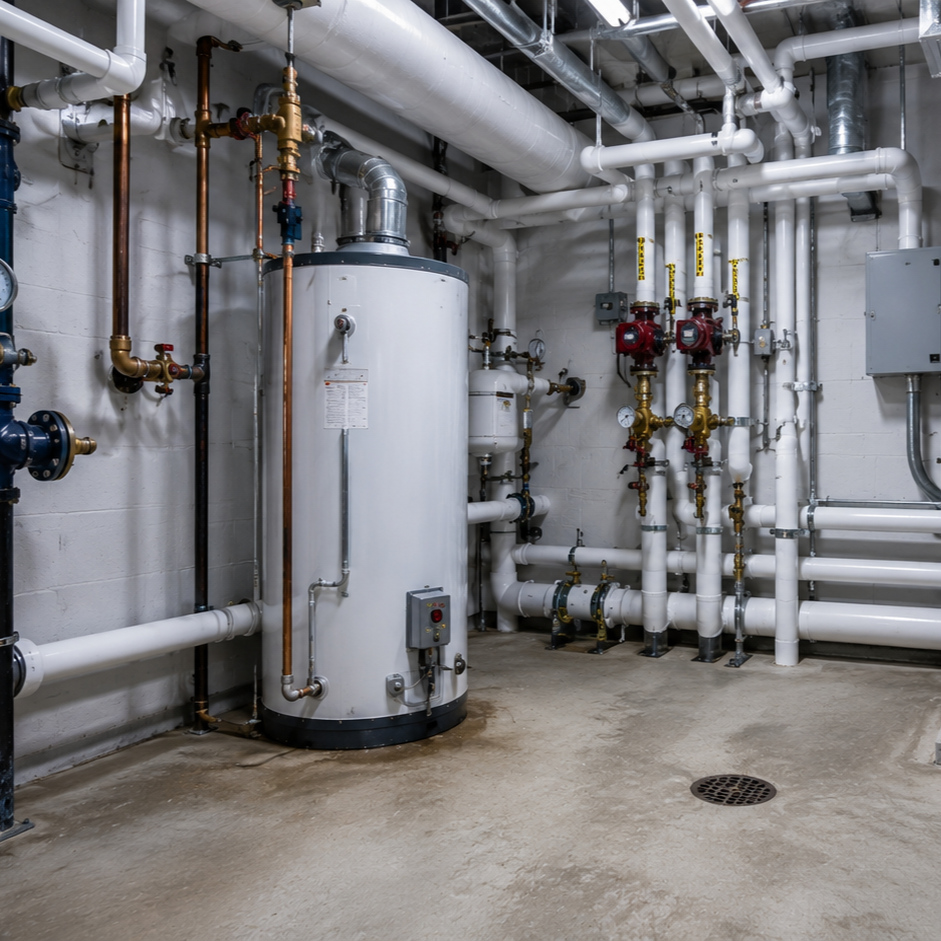
Commercial water heaters — whether tank storage units, tankless systems, or boiler-based indirect systems — get inspected for temperature output, pressure relief valve condition, anode rod status on tank units, and visible corrosion at connections.
Temperature is inspected for two reasons: legionella risk and scalding risk. Water stored below 120°F in a building with complex recirculation loops is a bacterial growth environment. Water delivered above 120°F to public fixtures in a commercial setting creates a scald liability. Both are addressed through proper setpoint management and mixing valves at the point of use.
The pressure relief valve — the safety device that prevents a water heater from becoming a pressure vessel — gets manually tripped to confirm it opens and reseats cleanly. A PRV that's never been tested may be seized in the closed position. That's the component standing between a malfunctioning thermostat and a dangerous pressure event.
Backflow Prevention
Commercial properties in Pennsylvania are required to have their backflow prevention devices inspected and tested annually by a certified tester. Backflow preventers keep contaminated water from flowing backward into the public supply — critical in buildings with irrigation systems, boilers, chemical injection systems, or fire suppression.
The inspection confirms the device opens and closes at the correct differential pressure, the check valves seat cleanly, and the relief valve opens within the required pressure range. The tester files results with the water authority. A failed device needs repair or replacement before the water authority will accept the report.
Buildings with multiple water uses — a restaurant on the ground floor and offices above, for example — may have multiple backflow devices on separate service lines, each requiring its own test.
What a Real Report Looks Like
A complete commercial plumbing inspection produces a written report that identifies findings by system and location, notes whether each finding requires immediate attention, monitoring, or no action, and documents the inspection date for the building's maintenance records.
A report that says "plumbing system inspected, no issues found" on a building you've never had looked at is worth very little. A finding log that says "2nd-floor men's room, right-side urinal — flush valve cycling intermittently, recommend rebuild" tells the property manager exactly what to budget for.
The difference between a useful inspection and a sign-off-and-leave visit usually comes down to the plumber's time on-site and whether they're pulling covers, flushing fixtures, and testing devices — or simply walking a hallway and observing.
Frequently Asked Questions
Most commercial properties should schedule a full inspection annually. Buildings with food-service tenants, older pipe infrastructure, or high occupancy benefit from twice-yearly checks. The backflow preventer test alone is required yearly by most municipal water authorities in Pennsylvania.
A standard inspection covers visible drain lines, cleanouts, and floor drains. The underground sewer lateral is not included unless you specifically request a camera inspection. For buildings over 20 years old, adding a camera run every few years is a sound practice — root intrusion and pipe sag are invisible until they cause a backup.
An inspection documents the condition of the system. A maintenance visit performs work — cleaning drains, rebuilding flush valves, flushing water heaters, testing backflow devices. Many properties schedule both together. The inspection identifies what needs attention; the maintenance visit handles it.
A tenant can request one, but the building owner or property manager typically authorizes it and receives the report. In commercial leases, responsibility for plumbing maintenance is usually split — landlord owns the building systems, tenant owns fixtures they installed. The inspection scope should match that split.
It depends on building size. A single-story retail or office space of 5,000 square feet typically takes two to three hours. A multi-story building or one with food-service tenants takes longer — sometimes a full day if camera work and backflow testing are included. Budget time accordingly rather than scheduling it as a quick walk-through.
The plumber documents it with location, description, and a recommended repair timeline. Not every finding requires immediate action — a slow-draining floor drain is different from a PRV that won't reseat. The report should prioritize findings so you know what to address now versus what to monitor.
Getting Value Out of the Inspection
A commercial plumbing inspection is only as useful as the documentation it produces and the follow-through it generates. The report goes into the building's maintenance file. Recurring findings — the same slow drain flagged three years running — tell you the underlying issue hasn't been addressed, and eventually will get worse.
Buildings that use inspections as a planning tool, not just a compliance checkbox, catch failing water heaters before they flood a mechanical room and spot deteriorating drain lines before a backup shuts down a tenant's business for a week.
