
You snaked the shower drain last weekend. Pulled out a fistful of hair and soap gunk, watched the water run clear, and figured you were done. Four days later, it was pooling around your feet again.
The kitchen sink does it too. Plunger works, water flows, two weeks pass, and you are back standing in backed-up water watching the disposal push grease nowhere. Same drain. Same fix. Same result.
The problem isn't your habits — it's that surface cleaning doesn't reach what's actually driving the clog. Not even close.
| What You're Noticing | What's Happening in the Pipe |
|---|---|
| Slow drainage in prep or dishwash sinks | Grease has moved past the trap and is coating downstream lines |
| Sulfur or rotten-egg odor near drains | Trapped waste is decomposing inside the full tank |
| Gurgling sounds from kitchen drains | Partial blockage downstream is creating back-pressure |
| Visible grease in floor drain wastewater | FOG is bypassing the outlet baffle, the trap is past capacity |
| Backup in sinks during peak service | Grease buildup has restricted flow through the main line |
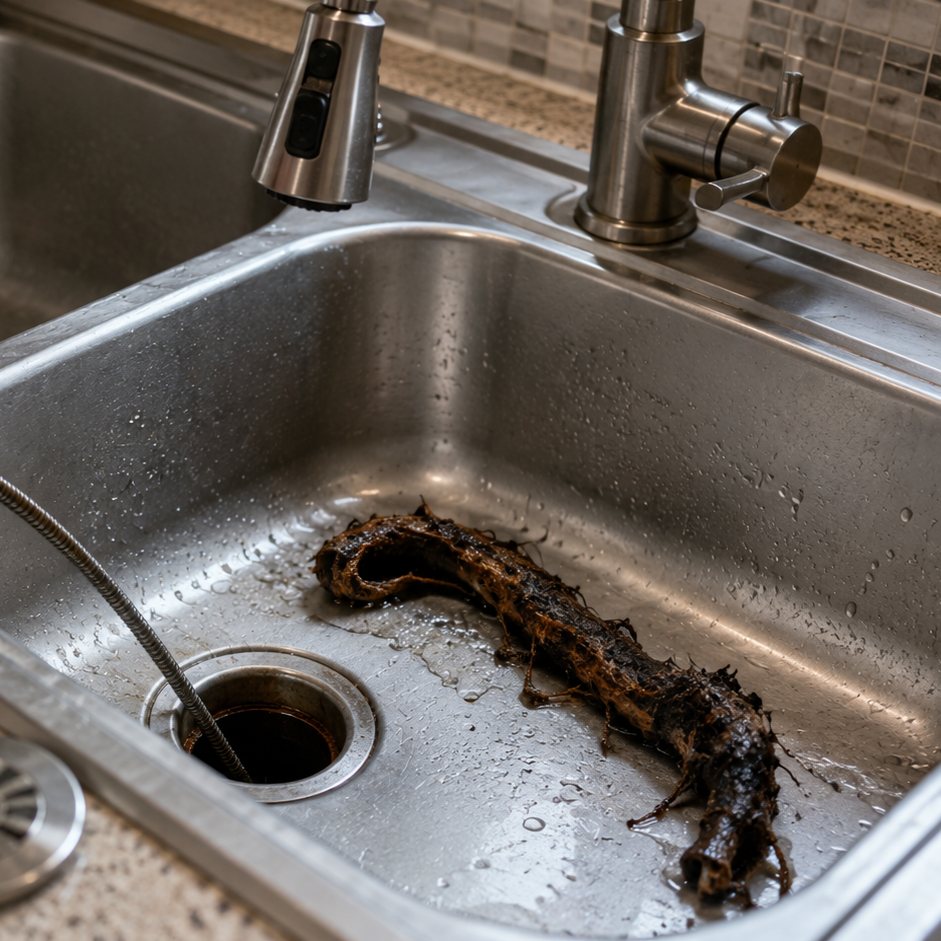
Snaking only punches a hole — it doesn't clean the pipe
Run a drain snake through a clog and you're poking a hole through the blockage. Water flows again. That's real. But the pipe walls still have a coating of whatever built up in the first place — grease, soap scum, mineral deposits, biofilm. That layer is sticky, and it catches the next bit of debris that comes through. Hair. Food particles. Sludge. The clog starts reforming almost immediately.
Think of it like clearing ice off a windshield with your bare hand. You push through the surface layer and see glass. But the next time it's cold, the ice comes back faster — because it has a rough, uneven surface to grab onto now.
Hydro jetting works differently. It uses water at high enough pressure to scour the pipe walls, not just bore a path through the middle. After jetting, the inside of the drain is smooth. Debris still comes in, but it's got nothing to stick to on the way down.
If your drain clogs every few weeks, it's rarely a new blockage. It's the old one reforming in the same spot.
The pipe itself may have narrowed over the years
In older homes — especially houses built before 1980 — drain pipes are often galvanized steel. Galvanized steel rusts from the inside out. The corrosion doesn't look like surface rust; it looks like a rough, pitted interior where scale and mineral deposits bond to the walls and gradually choke down the opening.
Hard water makes this a lot worse. In areas with high mineral content, calcium and magnesium leave scale inside the pipe the same way a kettle furs up when you use it every day without descaling it. You can see that same residue on your faucets and showerheads. It's doing the same thing inside your drain lines — just somewhere you can't see.
A 1.5-inch drain pipe narrowed to an inch by scale isn't going to clear quickly, no matter how often you snake it. The restriction is structural. And a snake can't fix that.
If you're seeing repeat clogs in a house with original galvanized plumbing, a camera inspection will show you exactly how much space is left inside the pipe. In bad cases, the only real fix is repiping.
A blocked drain vent will cause repeat clogs
Every drain in your house connects to a vent pipe that runs up through the roof. Most homeowners never think about it. The vent's job is to admit air into the drain system so water can flow out freely — without it, draining water creates a vacuum that slows the whole thing down.
When the vent gets blocked — by leaves, debris, a bird nest, or frost during a hard winter — drainage slows and creates just enough turbulence that grease and soap don't flush cleanly through the line. They stick to the walls instead.
Here's a quick way to check. After clearing a drain, run water in a nearby fixture — flush the toilet while the sink is draining. Gurgling from the drain means air is being pulled through the P-trap water instead of flowing in from the vent. That's a venting problem. You can clean the drain all day, and the cycle won't stop.
Clearing a blocked vent means someone on the roof with a hose or a snake. Not a weekend project for most people.
A belly in the drain line traps solids
Drain lines are installed on a slope — just enough pitch that gravity carries waste toward the sewer. When that slope fails because the soil shifted, the line was installed wrong, or a heavy vehicle crossed the yard — a low point called a belly forms in the pipe.
Water still flows, but slowly. Solids settle out at the bottom of the belly instead of continuing downstream. That material builds up, and no amount of snaking clears it permanently because the problem is the shape of the pipe, not what's in it.
You'd never know a belly was there without a camera. But if you've had a plumber out twice in the same year for the same main line clog, it's worth finding out. Sometimes a belly explains ten years of repeat service calls.
Tree roots come back after snaking — every time
If your sewer line runs under a yard with mature trees, roots are almost certainly part of the story. Roots seek moisture. They find hairline cracks at clay-pipe joints — common in established neighborhoods with original clay-tile sewer lines — push through, and fan out inside the pipe into a fibrous mesh that catches toilet paper and debris on every flush.
When a plumber snakes a root-infested line, the snake cuts through the mass. The line opens. But the root stubs are still in there. And they grow back faster than they came in the first time.
The more effective approach combines hydro jetting after snaking — which removes root material closer to the pipe wall — with a root-growth inhibitor on the cut stumps. If roots keep coming back within a single season, a camera inspection shows whether the pipe itself is cracked or partially collapsed. At that point, treatment alone won't hold. The pipe needs repair.
Grease coats the entire line, not just one spot
Kitchen drain clogs from grease are stubborn because the problem isn't localized. Cooking grease goes down the drain hot and liquid. It cools against the pipe wall and solidifies into a thin layer. Every pour after that adds another layer.
The clog you cleared with a plunger is just where the buildup got thick enough to fully obstruct the line. But everything upstream — the whole length of pipe between the drain and the clog point — still has a grease coating on the walls. That section recoats faster than anywhere else, because debris has something to grab right away.
Clearing the whole line, not just the visible obstruction, breaks the cycle. Enzymatic drain cleaners can help with maintenance afterward — the bacteria they contain digest grease and soap at room temperature. They won't clear a full clog. But used monthly on a freshly jetted line, they slow recoating significantly.
When to stop clearing and start diagnosing
Some situations tell you the problem is structural, not just accumulation:
The same drain clogs more than once every 60 days
You hear gurgling from a drain you're not using
Multiple fixtures slow down at the same time
You've needed a plumber for the same line twice in 12 months
A drain that used to clog occasionally now clogs constantly
A drain camera inspection takes 30 to 45 minutes and records what's actually inside the line. Grease buildup, scale, root intrusion, pipe displacement, belly — whatever's driving the problem becomes visible. That changes the next conversation from "clear it again" to "fix what's wrong."
Most homeowners wait too long on this. The inspection costs less than a second emergency call, and it answers the question instead of just delaying it.
Frequently Asked Questions
Most recurring bathroom sink clogs come from a soap scum and hair coating that reforms quickly because the snake opened a path without scrubbing the pipe walls. If cleaning doesn't last more than a few weeks, the pipe may need hydro jetting. Also worth checking: the stopper assembly itself collects debris and acts as an anchor for new buildup — cleaning or replacing the stopper rod sometimes cuts the clog frequency in half.
The fizzing reaction loosens light soap scum and deodorizes the drain. It won't dissolve a hair clog or break up hardened grease. Use it as a monthly maintenance flush on a drain that's already flowing freely, not as a fix for an active blockage.
Root intrusion is most common in main sewer lines in houses over 30 years old with mature trees in the yard. Signs: slow flushing throughout the house, gurgling from the toilet when you run a sink, and clogs that return within weeks of being cleared. A camera inspection confirms it.
Hydro jetting feeds a high-pressure water nozzle — typically 1,500 to 4,000 psi — through the drain line to scour pipe walls rather than just punch through a blockage. A camera inspection beforehand shows what's in the line and whether the pipe can handle the pressure. Older or fragile pipes need to be assessed before jetting.
Probably not helping it. Liquid drain cleaners dissolve organic material close to where they pool, which can open a temporary path. But the caustic chemicals degrade older pipe materials with repeated use, and they don't touch the coating on the pipe walls. Most plumbers see them as a short-term fix that delays — and sometimes accelerates — the longer-term problem.
If the same drain clogs more than twice in a year, or if you've needed a plumber for the same line more than once, a camera inspection tells you what you're actually dealing with. It typically costs less than a second or third emergency service call — and it answers the question.
Clearing a clogged drain is easy. Figuring out why it keeps coming back takes a look inside. If a plunger and snake have become regular fixtures under your bathroom sink, the problem is in the pipe — not in your habits.
