
Drain Snake vs. Hydro Jetting for Tree Roots: Which Actually Works
Your basement toilet was sluggish for a couple of months — flushing slow, gurgling after the washing machine drained, occasionally letting off a sewer smell that disappeared as fast as it came. Then one afternoon everything backed up at once. A plumber came out, ran a cable through the line, and pulled it back covered in stringy, rust-colored material. Tree roots.
He cleared it out. The drains ran fine. Then two months later, same thing.
If that sequence sounds familiar, you already know that snaking a root-infested sewer line isn't a lasting fix. The question is whether hydro jetting is, and whether it makes sense for your situation. The answer hinges on what your pipe is actually made of, how far the roots have spread, and what a camera inspection reveals before any equipment goes in.
Quick Reference: Drain Snaking vs. Hydro Jetting for Tree Roots
| Factor | Drain Snaking | Hydro Jetting | Right situation |
|---|---|---|---|
| How it removes roots | Rotating blade punches a hole through the mass | High-pressure water (up to 4,000 PSI) scours pipe walls clean | Emergency backup, pipe too fragile for jetting, temporary fix before repair |
| Root removal completeness | Partial — clears a channel, leaves root mass on pipe walls | Thorough — flushes root fragments and debris out entirely | Recurring root intrusion, heavy pipe wall buildup, prep before lining |
| Pipe cleaning effect | Opens a passage; leaves accumulated scale and grease behind | Restores near-original pipe diameter | — |
| Risk to fragile/cracked pipe | Low to moderate | Must confirm pipe integrity first with camera | — |
| Time per service | 20–45 minutes | 45–90 minutes | — |
| Typical cost | $150–$350 | $300–$600 | — |
| How long before roots return | Weeks to a few months (roots anchor to remaining mass) | Typically 1–3 years depending on species and pipe condition | — |
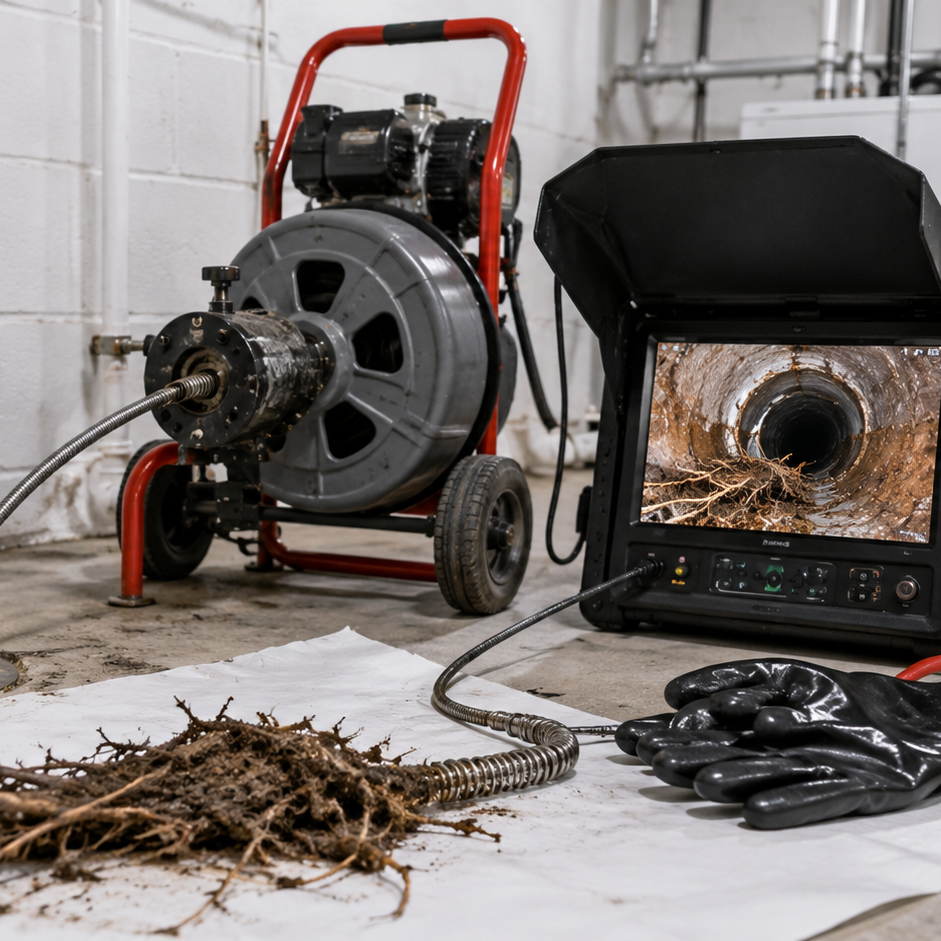
What a Drain Snake Actually Does to Tree Roots
A drain snake is a steel cable with a rotating cutting head at the tip. You feed it into the cleanout, a motor drives it down the line, and the spinning blade cuts through whatever is blocking the pipe. For a grease clog near a kitchen fixture or a hair mass in a shower drain, it's exactly the right tool. Fast and effective.
For tree roots, it's a different story.
Roots don't block a sewer line the way a wad of paper towels does. They grow in through cracks at pipe joints — usually clay-tile or cast-iron lines in pre-1980 homes — and fan out inside the pipe into a dense mesh that catches toilet paper and grease with every flush. By the time you notice a sluggish drain or a full backup, that mesh has usually been building for months.
The snake cuts through it. But it punches a hole. The root structure still lining the pipe walls — the hair-thin feeder roots, the debris already tangled through them — stays behind. The drain flows again, everything seems fine for a few weeks, and then the leftover root material starts acting as a net. Debris catches on it every day. The blockage rebuilds. You're back where you started, sometimes in a month or two.
That's not a plumber doing bad work. It's the right tool applied to a problem, it can only partially solve.
What Hydro Jetting Does Differently
Hydro jetting uses a flexible hose with a specialized nozzle that jets water forward and backward simultaneously. The forward jets blast through blockages. The rear jets push the nozzle through the pipe while scrubbing the walls clean. Pressures for residential sewer lines run between 2,500 and 4,000 PSI — well above what's needed to cut through root material and flush the fragments out.
Think of it like a pressure washer on a concrete driveway that hasn't been touched in years. Snaking is more like dragging a stick across that driveway to make a path through the grime. Jetting actually removes the buildup.
For root intrusion specifically, jetting clears the root mass and strips the fine hair roots off the pipe walls entirely. Nothing gets left behind to anchor new growth or catch debris. The pipe interior comes back close to its original diameter, which raises flow velocity — and higher velocity means less material settles in the line between cleanings.
That doesn't stop roots from returning. They can and they will. What jetting changes is how long it takes. After snaking, the remaining root structure gives new growth an immediate anchor, and regrowth can happen in a matter of weeks. After jetting, new roots are starting from nothing each time. The interval before the next service is substantially longer — one to three years in most cases, depending on tree species and whether damaged pipe joints get addressed.
Why Roots Come Back Faster After Snaking
Roots grow toward moisture. The minor seepage at a clay-tile pipe joint in an older sewer lateral is enough signal for the feeder roots of certain trees — willow, silver maple, poplar — to follow for dozens of feet underground. Once inside the pipe, they're in a near-ideal environment: constant moisture, nutrients, nothing slowing them down.
After snaking, the root mass is disrupted but not cleared. The fragments still inside the pipe have fibrous surfaces that trap debris from every flush. Soap, toilet paper, cooking grease — it builds up quickly on what's left behind. Within weeks you may have a partial clog forming again. A few months later, full backup.
After jetting, the pipe walls are clean. Roots can still re-enter through the same damaged joints, but they're starting from scratch each time. No residual structure to build on. No existing debris catch to accelerate the process. The interval to the next service is longer, and the cleaning is meaningful rather than just buying a few weeks.
When Snaking Is Still the Right Call
Jetting isn't automatic for every root situation. There are real cases where snaking makes more sense.
If your sewer line is clay tile or Orangeburg that shows deterioration on camera — cracks, separated joints, sections that have shifted — hydro jetting at high pressure can worsen that damage. The same force that clears roots can fracture a pipe wall that's already compromised. In that case, running a snake to restore flow buys time while you figure out whether repair or replacement makes sense. That's the right sequence, not a failure to solve the problem.
Snaking also makes sense as an emergency first step. If sewage is backing up into your basement and you need drainage restored quickly, a snake gets the line open faster than setting up for a jet service. Once the immediate problem is handled, you schedule the camera inspection and decide what comes next.
And if roots are minimal — a first intrusion on an otherwise sound line — snaking may hold for a reasonable stretch. Not every root situation has progressed to the point where jetting is the cost-effective call.
The Camera Inspection Step You Can't Skip
Before any plumber recommends hydro jetting a main sewer line with suspected root intrusion, they should run a camera through it first. Not as an upsell. As the only way to know what you're actually dealing with inside the pipe.
A video inspection shows the condition of the pipe walls, identifies where the root intrusion is and how dense it's gotten, and flags cracked, offset, or collapsed sections. Collapsed sections can't be jetted — the pressure makes the damage worse. Cracked sections near root entry points may mean you're past the cleaning phase and into repair territory.
This matters especially in neighborhoods with clay-tile mains. Clay tile holds up a long time, but the joints are the vulnerability. Decades of freeze-thaw cycles can shift those joints slightly, opening small gaps that roots find within a season or two. A camera inspection tells you whether the joints are still structurally sound or whether they have deteriorated to the point where jetting carries real risk.
The camera is also useful after jetting is done. A post-service inspection confirms the pipe is clean and shows the exact joint locations where roots have been entering repeatedly. That's the information you need to decide whether spot repair, trenchless pipe lining, or a regular jetting schedule is the right move going forward.
After the Roots Are Cleared — What Comes Next
Clearing roots from a sewer line is a decision point, not an endpoint. Once the line is clean, what you do next depends on what the camera showed.
If the pipe is in sound structural condition but has two or three joint locations where roots consistently get in, a chemical root inhibitor treatment applied after jetting is worth considering. Foaming treatments push into the pipe joints and create a barrier that slows regrowth without harming the pipe. But they work better when the pipe walls are clean — meaning they're more effective after jetting than after snaking.
If the camera showed cracked joints or offset sections at the intrusion points, spot repair addresses those specific locations without digging up the whole lateral. Trenchless pipe lining is an option for lines with multiple problem joints: a resin-saturated liner is installed inside the existing pipe and cured in place, sealing all the joint gaps that roots have been using. That removes the entry points. And that's the only thing that actually stops roots from coming back.
A plumber who handles only drain cleaning will get your line open. A master plumber who also does repair work can look at what the camera shows and tell you whether you're in a maintenance situation or a repair situation — and give you a realistic picture of what the next few years look like either way.
Frequently Asked Questions
Yes, with appropriate pressure and only after a camera inspection confirms the pipe is structurally sound. Clay-tile pipe that's intact handles jetting well. Clay-tile that's cracked, offset, or collapsed should not be jetted. Any recommendation to jet without inspecting first on an older clay-tile line is skipping a step that matters.
Typically one to three years, depending on tree species and pipe condition. Aggressive species like willow and silver maple regrow faster. The interval is substantially longer than after snaking because jetting removes the residual root structure that gives new growth an immediate anchor.
For recurring root intrusion — meaning you've had the same line snaked for roots more than once — it usually is. The longer interval between service visits tends to offset the price difference over a couple of years. For a first-time intrusion on a sound pipe, snaking may be adequate. A camera inspection helps clarify which situation you're actually in.
They're the same thing. "Rooter" refers specifically to mechanical cable clearing — the name comes from using auger-style equipment to cut through root intrusions. All rooter work is snaking; not all snaking targets roots.
No. Hydro jetting is a cleaning service, not a structural repair, and doesn't require a permit. If the camera inspection reveals damage that requires trenchless repair or pipe replacement, those repairs typically require a permit to be pulled by the licensed contractor doing the work.
No. Jetting removes roots from inside the pipe but has no effect on the tree. The tree is fine and keeps growing. Clearing roots from inside the pipe stops them from blocking it — it doesn't stop the tree from sending new roots toward the moisture at that joint.
Choosing between snaking and hydro jetting for tree roots comes down to pipe condition and how far the intrusion has gotten. Snaking restores flow quickly and costs less. Jetting cleans thoroughly and holds much longer. For a line that keeps backing up despite repeated cable clearing, the camera inspection is the next step — not another snake. It shows you exactly what's going on inside the pipe and whether you're dealing with a maintenance situation or a repair.
