
You don't usually notice a commercial sewer line until it's too late. It starts small — a faint sour odor drifting up from the floor drain in the back of the kitchen, or a bathroom on the lower level that smells off and nobody can explain why. By the time the line fails visibly, the problem has been building for months. Grease coating the pipe wall. A root thread widening into a mat. A clay-tile joint that shifted last winter and started catching fine silt. None of that shows up until it does — usually at the worst possible moment.
Camera inspection finds those things before they turn into an emergency service call during business hours. But the question most commercial property owners get stuck on is how often they actually need it. The answer depends on a handful of specific factors: pipe material, what the building is used for, whether there are trees near the lateral, and what the inspection history looks like. There's no single schedule that fits every property.
Here's how to figure out the right interval for yours.
Quick Reference: Commercial Sewer Camera Inspection Frequency
| Property Type / Condition | Recommended Frequency |
|---|---|
| Newer building, PVC pipe, no issues | Every 2–3 years |
| Office, retail, light commercial — older pipes | Every 1–2 years |
| Multi-tenant residential or mixed-use | Every 1–2 years |
| Restaurant, food service, commercial kitchen | Every 6–12 months |
| Building with trees near the sewer lateral | Every 12 months |
| Building with prior blockages or root intrusion | Every 12 months |
| Post-CIPP lining or epoxy rehabilitation | Every 5–10 years |
| Any building — active backup, foul odors | Immediately |
Why the Same Schedule Does Not Work for Every Commercial Property
A two-story office building with a 4-inch PVC sewer line, two restrooms, and a kitchenette doesn't generate anywhere near the load of a restaurant pushing 200 covers through a lunch service. But both of them get filed under "commercial property" when a manager is trying to figure out what to budget for.
Your actual schedule comes down to three things: how much waste the building generates, what the pipes are made of, and how old the surrounding infrastructure is. A newer building with smooth PVC can often go two to three years between inspections without much risk — as long as there are no symptoms and no large trees growing over the line. An older building with cast-iron or clay-tile pipe, surrounded by mature sycamores or oaks, probably needs eyes on that line every twelve months.
And the frequency resets when something changes. A renovation that adds a second kitchen, a new tenant whose food operation doubles the grease load, a construction project that disturbs soil around the lateral — any of those is reason to pull the schedule forward. Don't wait for the calendar.
What Your Pipe Material Has to Do With It
Pipe material is one of the most reliable predictors of how fast problems develop.
Cast iron — the standard in commercial construction through most of the mid-twentieth century — corrodes from the inside. The surface pits, rough patches form, and those patches grab grease and debris the way smooth pipe doesn't. Think of it like the inside of a teakettle that's never been descaled: the water still gets through, just slower every year. A cast-iron line that looked fine at 30 years can show significant interior corrosion by 40 and active cracking by 50. Annual or every-other-year inspections are the right call for cast iron in commercial use.
Clay tile, common in buildings put up before the 1960s, fails differently. It doesn't corrode — but it cracks under soil movement, and the joints between sections are the weak point. Root intrusion at clay-tile joints is nearly universal in older commercial properties with any tree cover nearby. Clay lines should be inspected annually if there are trees within 20 feet of the lateral. No exceptions.
PVC is forgiving by comparison. It doesn't corrode, holds up better against root penetration than clay (though roots can still work through mechanical joints), and tolerates freeze-thaw cycles without the stress that cracks older materials. A PVC line in good shape can reasonably go two to three years between inspections.
When a Restaurant or Food-Service Kitchen Needs to Go More Often
Grease is the variable that changes everything for food-service properties. It enters a commercial drain line as hot liquid, coats the pipe wall as it cools, and hardens into a layer that builds up with every service — slowly narrowing the pipe until something finally breaks through and triggers a full blockage. Even with a properly maintained grease trap, grease reaches the lateral. It always does.
For that reason, restaurants and commercial kitchens can't follow the same schedule as offices or light retail. Every six to twelve months is realistic for a full-service restaurant. A coffee shop with no kitchen prep might be fine at twelve months. A high-volume kitchen running breakfast through dinner, or a food hall with multiple operators sharing a drain stack, should probably be on a six-month cycle.
But there's another factor specific to food-service. A backup doesn't just mean a repair — it means a health department visit and a possible temporary closure. The cost of a scheduled inspection is a fraction of an emergency service call plus the revenue lost during even a single closure day. That math makes the case for keeping food service inspections on a short interval.
Warning Signs That Mean Inspect Now, Not Next Year
Scheduled maintenance is the baseline. There are also situations where waiting for the calendar is the wrong call.
A floor drain that gurgles when someone flushes a toilet on the floor above is telling you the main line is partially blocked — pressure is finding the path of least resistance and pushing back up through a floor fixture. Multiple slow drains in different parts of the building at the same time point to the main lateral, not a fixture-level clog. A sewage odor that appears suddenly with no clear source — not a dry trap, not an unflushed drain — suggests gas is escaping from a cracked pipe or a failed joint somewhere in the run. And a wet or sunken patch above a buried line is worth investigating quickly; that kind of ground movement usually means something under there is leaking.
Any of these symptoms calls for a camera inspection before any digging or snaking. If you snake a partially blocked line without seeing what caused it, you clear the symptom and leave the real problem in place. A month later, you're calling again.
What the Camera Actually Shows
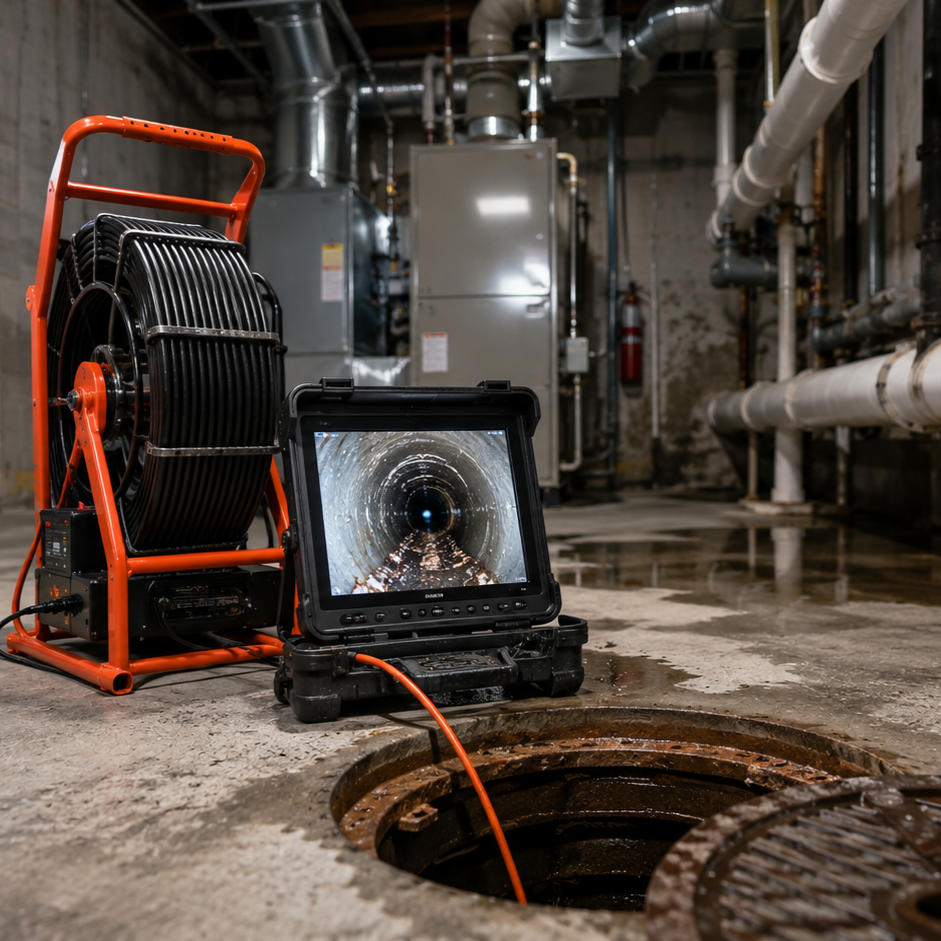
A sewer camera inspection threads a waterproof camera through the line from a cleanout or access point. The plumber watches the live feed and logs the location and condition of anything significant: grease accumulation, root intrusion, cracks in the pipe wall, joint offsets from soil movement or frost heave, debris pockets, and any points where the pipe has sagged and is holding standing water between uses.
What you get back is a condition picture. You know what's actually in that pipe, what's starting to develop, and how much time you have before it becomes urgent. That's useful for capital planning. A property manager who sees "minor root intrusion at a clay-pipe joint, 22 feet from the cleanout" can budget for a targeted repair in the next maintenance cycle — instead of getting blindsided by a main-line replacement in the middle of a tenant's lease.
The inspection takes 30 to 60 minutes for a standard commercial lateral. Larger properties with multiple branches or longer runs take more time. No excavation required. Operations don't need to stop.
After a Repair or Lining Job, How Does the Schedule Change
If a commercial sewer line has been repaired — spot repair at a specific failure point, or full CIPP (cured-in-place pipe) lining — the inspection interval changes.
Spot repairs at one or two joints should be followed by a camera check 12 to 18 months out, to confirm the repair held and that nothing adjacent is developing. After that, the schedule goes back to whatever fits the pipe material and building use.
Full CIPP lining is a different situation entirely. The lining creates a smooth, jointless interior sleeve that removes the surfaces where grease sticks and roots find entry points. A property with fully lined sewer laterals can generally go five to ten years between inspections, as long as no symptoms appear in the meantime. That extended interval is one of the actual financial arguments for relining rather than repeatedly patching the same failing sections of pipe.
What to Keep on File for Commercial Properties
Some commercial property types face documentation requirements from local sewer authorities or code enforcement. This varies by municipality and depends on whether the property discharges any regulated waste — a food-service property with grease, an auto service facility with floor-drain effluent. The specifics are local.
But keeping a maintenance log is worth doing regardless of whether it's required. A record of inspection dates, findings, and repairs serves you in several ways. Insurance carriers sometimes ask for maintenance history when evaluating water-damage claims. Buyers or tenants doing due diligence on a commercial lease often want evidence the building's plumbing has been looked after. And if a dispute ever comes up over who's responsible for a sewer problem, a paper trail of inspections is useful to have. None of that costs anything extra once the inspection itself is done — it's just a matter of keeping the reports on file.
Frequently Asked Questions
Most residential jobs take one to three days for the plumbing work itself. Trenchless jobs sometimes finish in a single day. Longer runs, deep burial, or concrete removal may push it to two or three days. Add more time if the permit inspection requires scheduling a township inspector separately.
Not always — if the damage is obvious (a complete backup, you know the line is original 1955 clay), a plumber can assess without one. But when the scope is unclear, a camera is worth the $100 to $500. It can tell you whether you need 20 feet of pipe or 60 feet. That's a $3,000 to $8,000 difference in the quote.
Standard policies generally don't cover replacement due to age, tree roots, or normal deterioration — those are treated as maintenance issues. Some policies include sewer backup coverage as an add-on that covers damage inside the home, but the pipe itself is typically out of pocket. A few insurers offer service line endorsements for underground utilities. Check your policy before assuming you're covered.
No. Trenchless makes sense when the line runs under hardscape that would be expensive to restore. For a line under open yard, traditional trenching is often less expensive total and just as effective. The right call depends on what's above the pipe and what trenchless access looks like at your property.
Repair addresses a specific failure point — one cracked joint, a short root-damaged section. Replacement swaps out a longer run or the full line from the house to the municipal connection. Older clay or cast-iron lines with widespread deterioration usually aren't good candidates for spot repair because the rest of the pipe is in similar shape. A camera inspection clarifies which approach actually makes sense.
PVC and ABS installed correctly last 50 to 100 years under normal conditions. They don't corrode, don't invite root intrusion the way clay joints do, and hold up through freeze-thaw cycling. The original clay and cast-iron lines now failing in pre-1970 homes were already 50 to 70 years old when they started showing problems. A proper PVC replacement should outlast the house.
Sewer line replacement isn't something anyone plans for, but the cost range is wide enough that two homeowners with similar-sounding problems can end up with quotes $10,000 apart. The pipe material, the depth, what's overhead, and which method is right for your situation — those are what actually set the price. A camera inspection and a conversation with a licensed plumber before anything gets dug up will tell you exactly where you stand.
Commercial sewer problems run on a slow clock. Grease builds up, roots push through joints, pipes shift — and none of it makes a sound until the line backs up or fails. A camera inspection on a regular schedule is what interrupts that progression, giving you a clear picture of what's actually inside the pipe and enough lead time to plan a repair instead of calling for emergency service.
