
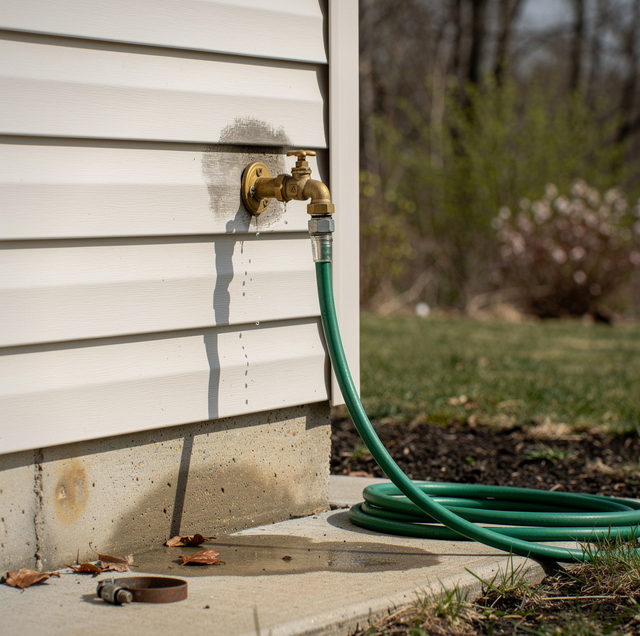
You walk out to hook up the garden hose on the first warm weekend of the year, turn the handle, and water sprays out somewhere it shouldn't. Maybe it's dripping from the pipe behind the handle. Maybe it's running steadily even after you've shut the valve all the way off. Either way, the spigot that worked fine last fall clearly doesn't now, and the timing isn't a coincidence.
A Hose Bib Is A Small Valve With Almost No Margin For Error
A hose bib, sometimes called a sillcock or outdoor spigot, is a shutoff valve mounted through your exterior wall. Turn the handle, and a rubber washer lifts off its seat, letting water flow out through the spout. Turn it the other way, and the washer presses back down, sealing the water off. That's the whole mechanism: a stem, a washer or seal, a valve body, and a spout, usually made of brass.
There are two basic types. A standard hose bib has its shutoff point right at the wall, which means the section of pipe between the valve and the spout stays full of water year-round. A frost-proof (or frost-free) hose bib is longer, with the actual shutoff valve set back a foot or more inside the wall, in a warmer space behind your insulation. When you close a frost-proof bib properly, gravity drains the exposed section so there's no standing water left out in the cold.
That difference matters more than most homeowners realize, because it's exactly where winter damage starts.
Freeze Damage Cracks The Valve From The Inside, Not The Outside
Water is one of the few substances that expand when they freeze, by close to 9% in volume. Trapped inside a closed metal pipe or valve body, that expansion has nowhere to go, and something gives. It's the same physics that splits a can of soda left too long in a freezer. Inside a hose bib, the ice usually cracks the valve body, the internal seal, or the pipe just behind the wall.
The crack rarely announces itself right away. Ice is solid, so a cracked pipe can sit frozen and silent all winter with no sign of a problem. It's not until temperatures rise, the ice inside melts, and you turn the handle to send water through that pressurized water finds the crack and starts leaking. That's why so many hose bib leaks show up in spring rather than during the freeze that actually caused them.
Frost-proof bibs aren't immune. Their whole design depends on that stem section draining fully after each use, and a garden hose left connected over winter defeats that. A hose still attached traps water in the barrel or blocks drainage entirely, so the pipe stays full through freezing weather, exactly as a standard bib does. A frost-proof valve with a hose still attached in January is functionally a standard hose bib for the rest of that winter.
Forgetting To Close The Interior Shutoff Causes Its Own Kind Of Damage
Not every winter leak starts with an ice-filled dead end at the spout. Sometimes the real problem happened months earlier, when the interior shutoff valve for the outdoor spigot was never closed before the season's first hard freeze. Many homes have a dedicated valve in the basement, crawlspace, or utility area that isolates the outdoor bib from the rest of the plumbing, meant to be shut off and the outside line drained for the season. When that valve stays open all winter, water keeps sitting under pressure right at the hose bib's valve seat instead of draining away, and it's that trapped, pressurized water at the seat that freezes and cracks it, not cold air reaching an otherwise empty pipe.
If a hose bib drips or runs even with the handle turned fully to off, don't force the handle further or try to shut off the branch line yourself with pliers. A stripped or cross-threaded valve stem needs a plumber's attention, not more torque.
A bib left connected to the house's water supply all winter, with no interior shutoff closed, has that pressure sitting against it the entire freeze, which raises the odds that any weak point turns into a full crack rather than a hairline one. Closing that interior valve for the season, then leaving the outdoor handle itself open so the exposed section can drain, is the standard way to keep both the seat and the pipe behind it from holding water into a freeze.
The Backflow Preventer Can Fail On Its Own, Separate From The Valve
Most hose bibs built or replaced in the past couple of decades have a small backflow preventer, also called a vacuum breaker, built into the spout. It's the little cap or collar just past the handle. Its job has nothing to do with turning water on and off. It exists to prevent water, or anything mixed with it, from siphoning back into your home's drinking water supply if the line pressure drops.
That backflow preventer has its own small chamber and internal parts, and it can freeze and crack independently of the main valve. When that happens, you'll often see water spraying or weeping from the little vent hole on the side of the fitting while the bib is turned on and running, even though the handle itself shuts off cleanly when you're done. It looks like a totally different leak than a cracked valve body, because mechanically, it is one. A cracked vacuum breaker is usually the simpler of the two problems to correct, since it's a self-contained part rather than damage to the plumbing behind the wall.
Simple Fix Or Hidden Wall Damage: How To Tell The Difference
Here's where the diagnosis actually matters, because the two outcomes look similar at first glance but call for very different responses.
A simple fix usually shows these signs: the leak is visible right at the spigot itself, either at the handle, the spout, or the backflow preventer collar. Water stops the moment you close the interior shutoff valve (if your home has one). There's no dampness, staining, or soft drywall on the interior wall behind the bib, even after the spigot has been run for a few minutes.
Hidden pipe damage is a different picture. Signs worth taking seriously include water stains or a musty smell on the interior wall near where the hose bib passes through, a noticeably higher water bill with no obvious explanation, water that keeps running or dripping somewhere even after the exterior handle and the interior shutoff are both closed, or a soft or discolored spot on interior wall surfaces, trim, or drywall that wasn't there in the fall. Any one of those points to water getting into the wall cavity itself rather than staying contained at the spigot, which usually means the pipe cracked further back than the visible fitting.
Run your hand along the interior wall directly behind the hose bib, at floor and mid-height, a few minutes after testing the spigot. Cool dampness on drywall or baseboard that wasn't there before is one of the more reliable early signs of a leak inside the wall.
The reason this distinction matters is that a cracked hose bib you can see and reach is a contained repair. A crack further back in the supply line, hidden inside the wall cavity, means water has likely been getting into framing, insulation, or subfloor since the freeze happened, sometimes for weeks before anyone notices the outdoor symptom. That's not a job to open up yourself. Diagnosing how far back the damage goes, and repairing or replacing the affected section of pipe, is exactly the kind of work that calls for someone who can trace the line, confirm where the crack actually is, and repipe only what needs it.
What Waiting Actually Leaves Behind
A dripping hose bib feels like a minor, seasonal annoyance, easy to put off until you're not using the hose as often anyway. But a hose bib that's actively leaking, especially one leaking into a wall cavity, keeps sending water into wood framing and insulation every time it's used, and sometimes even when it isn't, if the crack sits on the pressurized side of an interior shutoff that was never closed. Wet framing doesn't dry out on its own inside a closed wall. Left long enough, it becomes a repiping job, plus whatever wall repair follows, instead of a single valve replacement.
If you've already checked the visible signs, closed the interior shutoff if your home has one, and you're still seeing a drip, a stain, or a running water sound with everything closed, that's worth a call rather than a guess.
Frequently Asked Questions
It depends on where the crack is. A worn washer or a cracked backflow preventer collar can often be replaced as a single part. A cracked valve body or a split section of pipe behind the wall usually means the entire hose bib assembly needs to be replaced, since brass fittings aren't designed to be patched once the body has fractured.
Running water through a cracked fitting even briefly can widen the crack, since the metal around a freeze fracture is already weakened. A small drip that seems tolerable in April can turn into a steady leak by the time you're using the spigot regularly for lawn or garden watering in summer.
Look in the basement, crawlspace, or utility area for a small valve on the pipe branch that runs toward the exterior wall where the hose bib sits, sometimes labeled or tagged. Not every home has one, particularly older houses where the outdoor line ties directly into the main supply with no separate shutoff at all.
No. Closing the valve prevents new water from reaching the bib, but the section of pipe between the shutoff and the spigot remains full unless you also briefly open the outdoor handle to let the trapped water drain out and away from the pipe.
A cover slows heat loss around the exposed spout, which can help on a borderline night, but it does nothing for water that's already trapped inside the pipe behind it. A cover is a supplement to closing an interior shutoff and draining the line, not a substitute for it, and it won't stop a crack if the barrel was already full of water going into a hard freeze.
Often just the part itself. On most modern hose bibs, the vacuum breaker is a separate cap or collar that threads onto the spout, so a plumber can frequently replace it without disturbing the valve body or the pipe behind the wall. Older hose bibs installed without a vacuum breaker at all are a different situation, since there's no separate part to fail, though many local codes now call for one on any new installation or replacement.
Get a hose bib leak diagnosed — a plumber can trace whether it's a contained valve repair or a sign of pipe damage inside the wall. East Coast Plumbing serves Barto, Boyertown, and Pottstown. Call (610) 944-2998.
