
Your gas line has probably never crossed your mind. It's always worked. You turn on the stove, the burner lights. You set the thermostat, the furnace fires. That invisibility is by design — when gas piping is installed right, it can go decades without drawing any attention at all. But decades of invisibility isn't the same as decades without change. A gas line installed when your house was built in 1963 has been sitting inside your walls for over sixty years, and what's happening to it depends entirely on what it's made of and what conditions it's lived in.
How long a gas line lasts doesn't have one answer. It has four different answers, one for each material type. Knowing which one you have — and what that material does as it ages — is how you figure out whether your gas system needs attention now or whether it can quietly keep going for another decade.
| Material | Common Era | Typical Lifespan | Primary Risk |
|---|---|---|---|
| Black iron / steel pipe | 1920s–present | 40–80 years (interior); 20–30 years underground in damp soil | External corrosion if moisture exposure |
| Galvanized steel | 1920s–1980s | 20–50 years | Internal zinc flaking; external corrosion |
| CSST (corrugated stainless steel tubing) | 1990s–present | 30–75+ years | Lightning arc burnthrough without proper bonding |
| Polyethylene / HDPE (underground) | 1970s–present | 50–100 years | Physical damage; UV if above ground |
Why material determines lifespan more than age alone
You could have a black iron pipe from 1955 with no measurable corrosion, and a CSST installation from 2002 showing bonding problems. Age matters — but less than what the pipe is made of, where it was installed, and whether it's been in conditions that accelerate wear.
Black iron is a ferrous metal. Keep it dry and away from concrete or soil, and it resists corrosion extremely well. Put it in contact with consistent moisture, and the timeline compresses fast. That 1963 house might have original gas supply running the full length of the basement, and if that basement has always stayed dry, the pipe may still be in good shape. A pipe that ran through a crawlspace that collected water? Different story.
Material tells you the failure mode. Age tells you how far the clock has run.
Black iron and steel: the most common pipe in older homes
If your house was built before 1990, there is a good chance your gas lines are black iron — the threaded, dark-gray steel pipe you'll see running along basement ceilings and through mechanical rooms. Black iron is still installed today and stays the most common material for interior gas supply across the Mid-Atlantic. It threads together at fittings and joints, and those joints are where most problems start.
A well-installed, dry black iron system can genuinely last 80 years. The pipes themselves don't corrode easily in a climate-controlled interior. But the joints need proper sealing at installation, and as houses settle over the decades, pipe threads can develop stress. The real enemy is moisture. A basement that gets damp during heavy rain, a pipe running too close to a condensate line, a slow water heater leak that soaked the area for months before anyone noticed — any of those conditions will accelerate surface rust and, eventually, wall thinning.
Underground black iron runs into its own timeline. Buried in consistently damp soil, corrosion can advance enough to cause failures in as little as 20 to 30 years — far ahead of what you'd expect from the same pipe sitting in a dry basement. If your house was built before 1980 and the gas still has original underground runs, those deserve a look regardless of whether the interior piping seems fine.
If you have original black iron from the 1950s or 1960s and your basement has stayed dry, you're probably fine for many more years. If you've had any chronic moisture issues, that piping needs attention.
Galvanized steel: the material to watch in pre-1980 homes
Galvanized pipe was used for both water and gas supply in homes built through the mid-1970s. The zinc coating is meant to prevent corrosion, but it doesn't last. As it degrades, the underlying steel gets exposed from both inside and outside.
For water lines, galvanized fails most visibly through rust scaling that restricts flow and eventually flakes off into fixtures. For gas lines, the failure is less obvious — external rust at joints, pinholes developing gradually in the pipe wall, fittings that have corroded enough that the threads can't hold a proper seal. But there's also an internal failure mode specific to galvanized gas pipe that often gets missed. The zinc coating erodes from the inside, and the flakes break off and travel downstream. They can clog regulators and appliance burners, causing inconsistent flame performance that gets misdiagnosed as an appliance problem rather than a supply-line problem.
Homes throughout Berks and Montgomery Counties — particularly in neighborhoods built from the 1930s through the 1970s — frequently still have original galvanized gas supply. If the system was installed between 1950 and 1975 and has never been replaced, it's worth asking a licensed master plumber whether the pipe is still structurally sound. Galvanized at 50 years in a dry basement is a different situation than galvanized at 60 years in a damp crawlspace. But past 60 years, under most conditions, inspection isn't optional.
CSST: the flexible alternative that needs its own attention
Starting in the late 1980s and widespread by the mid-1990s, corrugated stainless steel tubing changed how gas lines were run through houses. Instead of rigid threaded pipe that required careful planning around framing, CSST is flexible enough to snake through walls and around obstacles. It installs faster — which is why it became the preferred choice for new construction and large remodels.
CSST is rated for 30 to 75+ years, and the material resists corrosion well. The issue that created real concern in the 2000s and 2010s isn't deterioration. It's electrical bonding. A lightning strike — even a nearby one — can induce a current surge through a home's electrical system. And if CSST runs close to electrical wiring without proper bonding, that surge can create a pinhole arc burn right through the thin stainless wall. The fix is bonding at the CSST fitting, which connects the gas piping to the home's grounding system so any induced current disperses safely.
If your home was built or remodeled between 1990 and 2010 and has CSST, the bonding question is worth confirming. A plumber can check whether it was bonded at installation. This isn't a replacement question — it's a safety upgrade, and the fix is typically straightforward.
Underground supply lines: what runs from the meter to your house
The pipe running from the gas meter to the equipment inside your house is often a different material than what's in the basement. For homes built after the 1970s, that underground segment is typically polyethylene or HDPE — a plastic pipe that's completely immune to rust and soil corrosion, rated for 50 to 100 years.
For homes in older established neighborhoods, that segment might be steel pipe that's been in the ground since original gas service was installed. Steel underground corrodes far faster than steel in a dry basement. It's in direct contact with soil that carries moisture year-round. The freeze-thaw cycles that stress every underground pipe in the Mid-Atlantic don't help either.
If you're adding a gas appliance that requires underground supply — a whole-house generator, an outdoor kitchen, a new line to a detached garage — a licensed plumber will inspect what's already in the ground before deciding whether the existing service line can support the additional load. It's also a natural point to replace any aging steel runs before they become a problem.
Five things that shorten a gas line's life regardless of material
Age and material set the baseline. These factors compress the timeline:
Moisture exposure is the primary accelerant for any ferrous pipe. A chronic wet basement, condensation near a cold surface, or any sustained water contact will push black iron and steel ahead of their expected schedule.
Dissimilar metal contact creates galvanic corrosion. Where black iron connects directly to copper without a dielectric fitting, the two metals generate a small electrical current that eats the junction. Older installations don't always have proper isolation at every connection.
Physical stress on connections. Houses settle, and threaded joints that develop even minor movement over the decades can work loose or crack the thread seal.
Aggressive soil conditions for buried runs. Clay-heavy and sulfate-rich soils are harder on buried steel than sandy or loamy ground. Eastern PA homes near agricultural areas or older industrial sites should give underground lines extra scrutiny.
Improper repairs. A homeowner or contractor who reconnected sections with incompatible materials or used fittings not rated for gas service, can create a failure point that looks fine until it doesn't.
Signs that an aging gas line deserves an inspection
Most gas line deterioration isn't detectable without tools. But a few things tell you the system is worth a professional look.
A faint sulfur smell that comes and goes. Natural gas is odorless — the mercaptan odorant added by the utility produces that rotten-egg smell. Even a very faint intermittent odor suggests a small leak somewhere in the system. Could be a loose fitting. Could be corroded pipe. Either requires attention.
A hissing or whistling sound near a pipe, fitting, or appliance connection. That's pressurized gas escaping through a crack or opening. It doesn't have to be loud.
Appliance flame color has shifted. A gas burner burning right runs a solid blue flame. Yellow or orange flames mean incomplete combustion — often a signal that gas pressure or flow is off, pointing back to the supply line.
Dead or dying vegetation in a line directly above where a buried gas line runs through your yard. Gas leaking underground displaces oxygen in the soil. Plants die for plenty of reasons, but a strip of dead grass tracking the exact path of a buried line is specific enough to investigate.
An unexplained jump in your monthly gas bill. Nothing changed in your usage — same appliances, similar weather — but the bill went up. Gas escaping from a small leak is one explanation worth ruling out.
Pressure loss at appliances that previously worked fine. A range that used to ignite immediately now takes multiple tries. A furnace that lit reliably now sometimes fails on the first call. The gas supply is worth looking at.
Visible rust or discoloration on accessible pipe in the basement or utility room doesn't mean failure, but surface corrosion is reason to look harder at joints and fittings nearby.
And finally: an older home that's never had the gas system looked at — particularly one where the original installation predates 1980 — where nobody has physically assessed the pipe condition since the house was built.
When replacement makes more sense than repairs
A single corroded fitting can be cut out and replaced. A joint that's leaking can be resealed. But there are situations where patching stops making sense.
If multiple fittings in the same system are showing corrosion, the problem isn't localized — the environment or the original installation created a system-wide issue. Repairing each fitting as it fails will cost more over time than replacing the affected runs.
If a rigid steel system needs to be disturbed for a new appliance, that's often a natural point to replace aging sections rather than reconnect old pipe to new.
If inspection reveals wall thinning on steel pipe — something a plumber can assess by looking at thread condition and fitting integrity — replacement is the only option that restores long-term safety.
The decision isn't always obvious. A 40-year-old black iron system in a dry basement with clean joints may have another 30 years in it. A 35-year-old galvanized system with multiple corroded fittings and a history of basement dampness might need full replacement now. There's no way to know without an inspection by someone who can look at what you actually have — not estimate from the age of the house.
Frequently Asked Questions
Black iron in a dry interior environment commonly lasts 40 to 80 years — potentially longer. Galvanized steel runs 20 to 50 years. CSST is rated 30 to 75+ years. Polyethylene/HDPE underground is rated 50 to 100 years. Material and environment matter more than any single number.
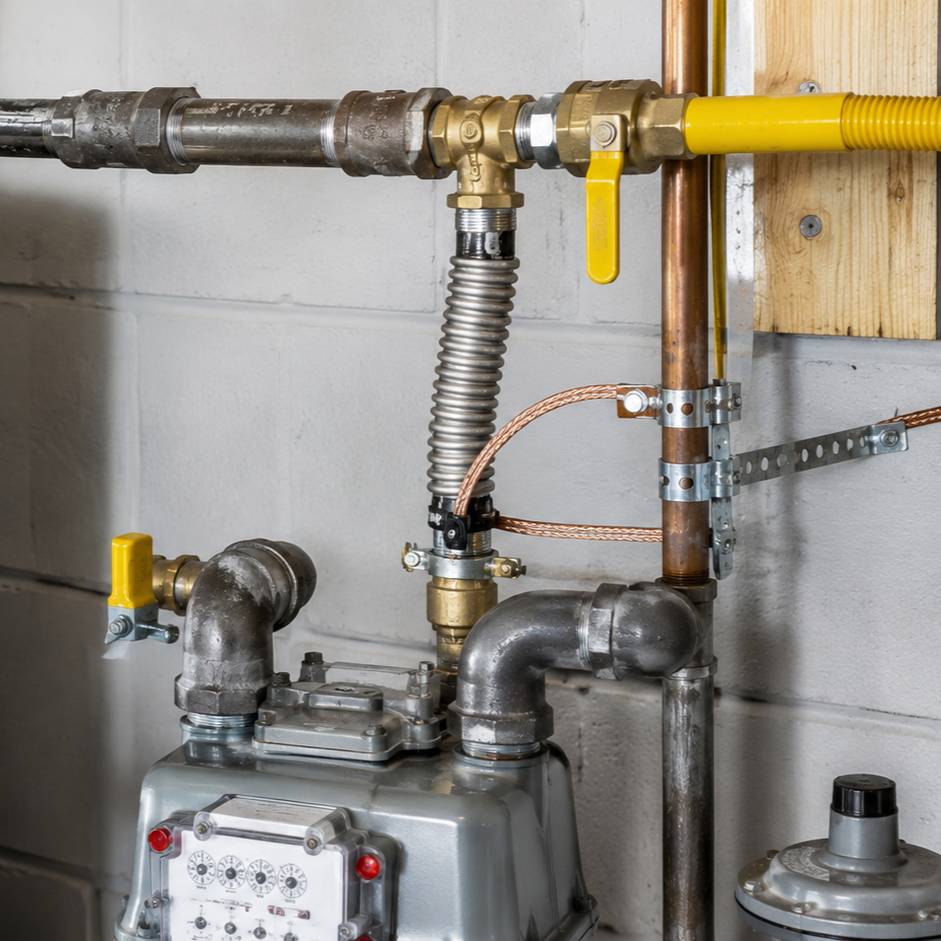
In your basement or utility room, look at the pipe running to your furnace, water heater, and meter. Black iron is dark gray or black, rigid, with threaded fittings. Galvanized steel looks similar but has a lighter, silvery-gray surface — often with white mineral deposits. CSST is flexible, ridged like a stainless steel accordion, and typically has a yellow outer coating. A plumber can identify everything in a quick walkthrough.
There's no mandatory schedule for residential interior gas lines the way there is for some commercial systems. Having a licensed plumber do a visual inspection when you're buying an older home, adding gas appliances, or noticing any warning signs is sensible preventive maintenance. Most plumbers can walk the system during a service call for something else.
Sometimes. Visible rust or white mineral deposits on accessible pipe is a starting point. But wall thinning happens inside the pipe wall and isn't visible without looking at cut ends or fitting threads. Surface appearance alone can mislead you in either direction.
Low-level leaks produce the sulfur smell that mercaptan is there to create. If you smell gas strongly or suspect a significant leak, get out of the building without turning lights on or off, don't use any devices that could spark, and call your gas utility and a plumber from outside or from a neighbor's house.
Not automatically. Many original black iron installations from the 1950s and 1960s are still sound. The right first step is an evaluation by a licensed master plumber who can look at the material, assess joint and fitting condition, check for any moisture history, and give you an honest read — not a reflexive replacement recommendation.
Aging gas piping doesn't announce itself the way a dripping pipe or a backed-up drain does. Problems develop slowly, inside walls, over the years. Knowing what your system is made of and how that material holds up in the type of house you have gives you enough information to decide when a closer look is worth it — and when what you have is genuinely fine for the foreseeable future.
