
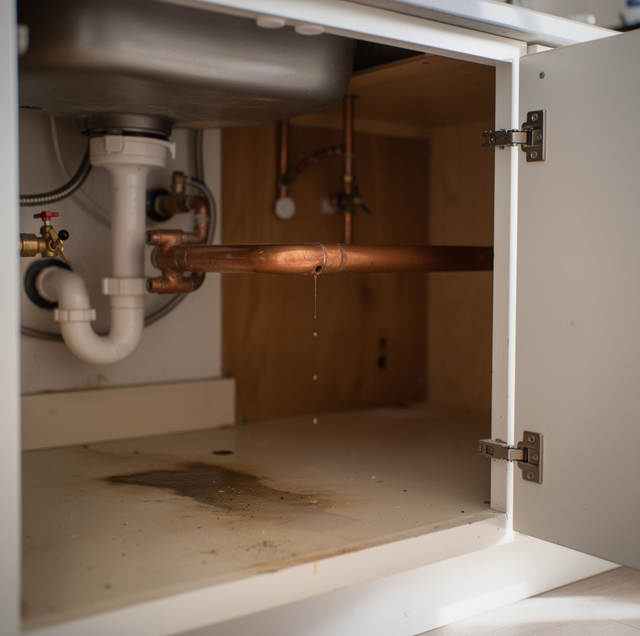
A pinhole leak starts as a single point where the pipe wall has thinned enough for water to force its way through, while the metal around that spot still looks sound. The hole itself starts out smaller than the head of a pin, so the first sign is a damp patch, a slow drip, or a stain rather than a spray. What creates that one weak point differs from house to house: the metal itself can pit from the inside, the water running through it can be aggressive toward copper, flow at a bend can wear one spot thin, or the installation can have left something behind that started the damage early. Reading which cause fits your pipe, together with how many leaks have turned up and where, tells you whether one repair closes the book or the pattern will keep repeating somewhere else in the run.
How Does Pitting Corrosion Eat Through Copper From One Spot?
Copper pipe is protected by a thin natural layer that forms on its interior surface once it meets water. That layer isn't perfectly even, and where it breaks down at one point rather than holding evenly, the exposed copper beneath keeps reacting with the water passing over it. Because the surrounding metal remains protected, that single spot continues to lose material while everything around it stays intact, boring a narrow channel through the pipe wall rather than thinning the metal over a wide area. The result is a hole narrow enough to look accidental, cut cleanly through pipe that otherwise looks new.
Pitting doesn't require decades in the wall. It can begin on the pipe, still early in its service life, if the protective layer fails at a single point, which is why age alone does not rule pitting in or out. A pit can also sit under insulation or inside a wall cavity for a stretch before it breaks all the way through, working from the inside without any outward sign until the last bit of metal gives way. A pit can also form where water sits still rather than where it moves: a line to a fixture that sits unused for days at a time, or a dead-end branch that only sees water a few times a week, gives the same chemical reaction more uninterrupted time to work on one spot than a line in constant use, since nothing is flushing fresh water past that point to dilute what's building up against the pipe wall. A small air pocket trapped at a high point in the line during installation concentrates the reaction at that spot, since the air interface changes how the water behaves against the pipe wall there compared with a fully filled section a few inches away.
Find and tag the main shutoff valve before a leak starts. A pinhole that opens into a spray is stopped there, and a handle that will not turn by hand is left for the plumber, not forced with a wrench.
What Water Chemistry Makes Copper More Likely to Pit?
Water itself plays a large part in whether that protective layer holds. Water with a low pH, meaning it leans acidic, is more aggressive toward the copper surface and can keep a stable layer from forming in the first place. Water treated with chlorine or chloramine reacts with copper differently depending on concentration and how long the water sits in the pipe between uses; in some systems, that reaction is what breaks the layer down at isolated points rather than evenly across the run. Soft water, which carries fewer dissolved minerals, can be more aggressive toward metal than hard water because the minerals in hard water help form a protective scale inside the pipe. None of this shows up to the eye; a plumber sorts it out with a water test, not by looking at the outside of the pipe.
Can High Water Velocity Wear Through Pipe at the Elbows?
Water moving through a straight run of pipe flows smoothly along the interior surface, but at an elbow, a tee, or any point where the pipe changes direction or diameter, the flow becomes turbulent rather than smooth. That turbulence can strip away the pipe's protective layer at that one point faster than it can rebuild it, wearing away a thin, localized area rather than the pipe as a whole. Higher flow speeds at those turbulence points increase erosion, which is why elbows and fitting joints show these pinholes more than straight runs do. A section right after a water heater, a pump, or a sharp direction change does more of this work than a long, quiet run of straight pipe, so a leak that lands at one of those transition points behaves exactly like this kind of wear. A recirculating hot water loop, which keeps water moving through the same fittings around the clock rather than only when a fixture is running, creates more cumulative turbulence at those elbows than a standard branch line ever sees, so a pinhole at an elbow on a recirculation loop fits this wear pattern.
Does Stray Electrical Current Play a Role in Pinhole Leaks?
Stray electrical current is a narrower cause: improperly grounded wiring or a bonding issue can route current through a home's copper piping, and that current can accelerate corrosion at the point where it exits the pipe. Sorting that out is an electrician's job, not a plumbing fix.
Installation Habits That Leave Copper Vulnerable
Some pinhole leaks trace back to how the pipe was installed rather than to what has run through it since. Flux, the paste applied before soldering a joint, is acidic by design so it can clean the copper surface enough for solder to bond. If excess flux is left inside the pipe instead of being wiped from the outer joint, that residue continues to attack the metal from the inside long after the joint has cooled, and a pinhole can develop near that joint where water chemistry alone would not explain it. Cutting a length of pipe without reaming it afterward leaves a burr, a small ridge of metal that protrudes into the flow and creates its own turbulence point, so a leak just past a cut or a coupling can point back to that burr rather than to the water running through the rest of the house.
Never solder over an active pinhole leak: trapped water turns to steam under the torch and can cause burns or start a fire. Shut off the main and let a licensed plumber cut out and repair the section.
One Pinhole or Several: What It Means for Repair vs Repipe
A single pinhole on an otherwise sound run can be closed with one repair, while several pinholes turning up across different rooms point to a pattern worth weighing against a full repipe, a decision that goes well beyond what one hole in one pipe can answer on its own.
Where a pinhole shows up first narrows the likely cause before a plumber opens anything up:
| Where the Pinhole Shows Up | What It Points To |
|---|---|
| Right at or just past a soldered joint | Leftover flux residue, or turbulence off the fitting |
| Just past an elbow, tee, or coupling | High-velocity erosion at a turbulence point |
| Scattered across several straight runs | Water chemistry acting on the pipe evenly |
| Only on hot-water lines, not cold | Heat, or constant recirculation flow, acting on the hot side |
| Near a grounding clamp or bonding wire | Possible stray current, an electrician's check |
| Multiple holes in different rooms | A system-wide pattern rather than one weak spot |
Frequently Asked Questions
A clamp or epoxy putty can slow the drip for a short stretch, but the metal around the visible hole can be thinned over a wider area than what you can see, so a patch can fail at its own edge once the thinned metal around it gives way.
Yes. Copper supply pipe comes in more than one wall thickness, marked by the color of the lettering printed along it, and the thinnest grade, lettered in red, gives a pit the least metal to get through before it opens into a leak.
Where acidic water is behind the pitting, a neutralizing filter at the main raises the water's pH before it reaches the pipe. That protects the copper from that point forward, but it does not restore metal that a pit has already thinned.
No. PEX is plastic, so it doesn't pit the way a metal pipe does; it can still fail from other causes, such as a poorly seated fitting or damage from sunlight exposure before it was installed, but that failure pattern is different from copper's pinholes.
Pressure does not start a pit on its own; it determines how much water comes through once a pit breaks through, and higher pressure increases flow speed at the elbows. A gauge threaded onto an outside hose bib reads house pressure, and a failed or missing pressure-reducing valve at the main is a plumber's repair.
It can. That staining forms as copper reacts with moisture and can appear before any active drip is visible, so a stained fitting is worth having checked even if the joint still looks dry to the touch.
Choose a copper pipe repair that starts with the cause — the pinhole matched to pitting, water chemistry, erosion, or the original installation, and the section replaced or the run scoped for repiping. East Coast Plumbing serves Barto, Boyertown, and Pottstown. Call (610) 944-2998.