
Your dishwasher station gives you the first warning. The floor drain fills slow, then the prep sink won't clear, and by the time a customer mentions a smell from the restroom, you know the grease line running to the interceptor has given out. An inspector pulls back the access panel and finds PVC pipe that's softened and partially collapsed under years of hot discharge. The whole run has to come out.
Most restaurant drain problems get blamed on grease. And grease is always part of it. But the pipe material carrying that grease matters just as much as how often you pump the trap. A drain material that holds up fine in an office building will fail in a commercial kitchen — and the failure is rarely sudden. It's gradual: a little warping here, a low spot there, until one Saturday night the line decides it's done.
The two materials that come up most in commercial grease drain specs are standard PVC and polypropylene. They look similar. They install similarly. And for basic fittings, they cost close to the same. But put them in a kitchen running a commercial dishwasher and a fryer line all day, and they behave very differently.
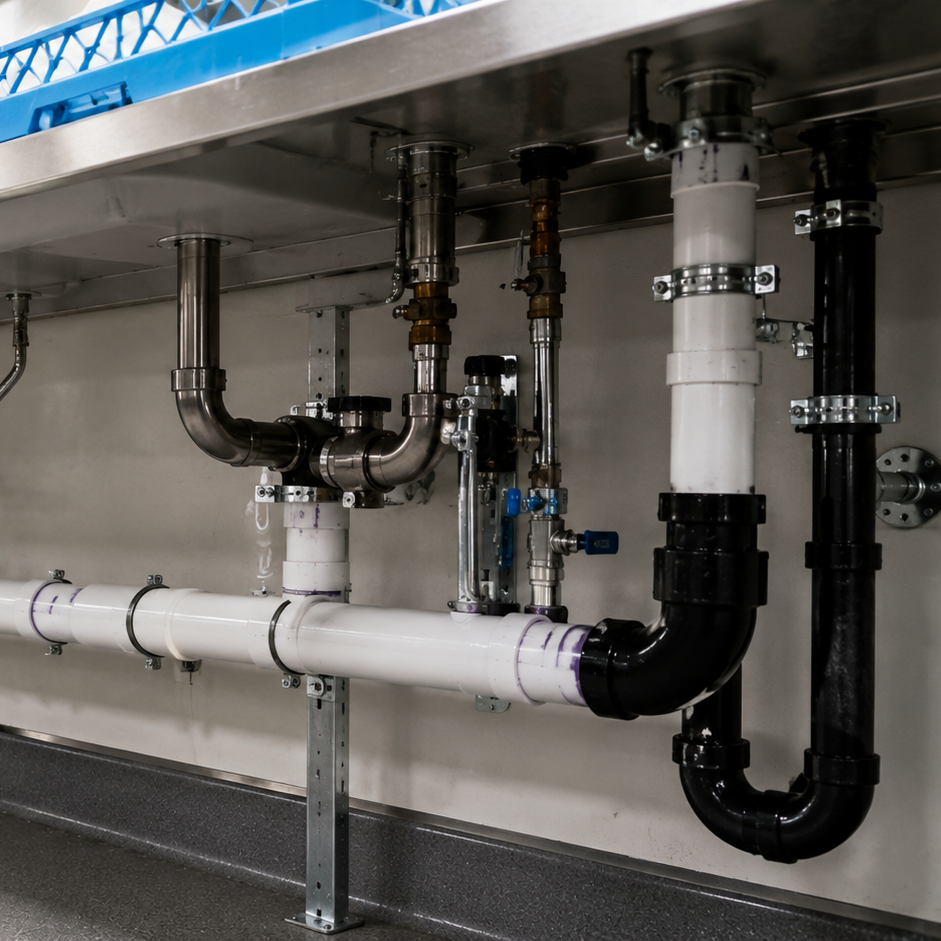
The temperature problem that separates them
Standard schedule 40 PVC is rated to 140°F. That number matters because the International Plumbing Code requires drain pipe to be rated for the actual temperature of the waste it carries. Exceed 140°F with your wastewater, and you need a material spec'd for that temperature.
In a house, 140°F is almost never reached. Residential dishwashers, showers, a water heater set to 120°F — none of it pushes PVC to its limit.
A commercial kitchen is different. Commercial dishwashers discharge at 140 to 160°F during normal cycles, higher during sanitizing. Empty a steam-jacketed kettle and you're sending water north of 200°F down the drain. A fryer station runs hot discharge continuously through the entire dinner service. PVC softens at these temperatures. It doesn't burst — it deforms slowly, forming sags and low spots where grease collects and debris catches.
Polypropylene handles higher temperatures. Depending on the product, polypropylene drain pipe carries continuous service well above 200°F and handles the intermittent spikes commercial kitchens generate without losing its shape. That's why polypropylene gets used for acid-waste lines in labs, for chemical drain systems in industrial facilities, and for grease trap filter housings — the hottest point in the entire drainage chain.
Think of it this way: putting standard PVC on a commercial grease line is like running a garden hose as a radiator return line. It'll hold for a while. The temperature spikes are intermittent. But you're working against the material's limits every shift, and eventually the material loses.
| PVC (Sch. 40) | Polypropylene | Cast Iron |
|---|---|---|
| 140°F | 200°F+ | No practical limit |
| Good at ambient | Good at elevated temp | Good |
| Yes | Yes | Yes |
| Solvent cement | Elastomeric seal or heat-fusion | No-hub coupling |
| Lowest | Higher than PVC | Higher, heavier |
| Low-temp lines (restrooms, bar) | Grease lines from equipment | High-volume grease lines |
What PVC does well — and where it breaks down
PVC is a legitimate drain material. It's code-listed, available from any plumbing supplier, and carries a 25-to-40-year service life in residential and light-commercial applications. It handles cold and warm drain water well. At ambient temperatures, fats and oils don't chemically attack it.
The problem is specific to temperature and thermal cycling. PVC's heat limit is fixed at 140°F, and commercial kitchen grease lines cross that ceiling regularly. When PVC softens, the slope changes — lines pitched correctly at installation end up with flat spots and reverse sections. Grease pools there. Each hot-water blast melts some through, but solids and scale catch on the rough interior around deformed sections, and the line starts accumulating faster than it should.
Then there's the cycling. A commercial kitchen runs hot for eight to twelve hours, cools overnight, and does it again the next day. PVC expands and contracts under those swings, and over the years of it, fittings at joints can loosen and develop slow leaks. In a wall or above a ceiling, those leaks go unnoticed until you've got visible water damage and a renovation on your hands.
What polypropylene does differently
Polypropylene's main advantage in restaurant drain applications is that temperature ceiling. It holds its shape under the discharge temperatures commercial kitchens generate. Lines stay sloped correctly. Fittings stay tight. The pipe interior doesn't develop the deformation that accelerates buildup in a heat-stressed PVC run.
It's also chemically resistant to fats, oils, and grease across a broader temperature range than PVC. At ambient temperatures, both materials resist FOG reasonably well. But at elevated temperatures — where hot grease enters the line still liquid — polypropylene keeps its resistance, and the pipe wall stays smooth and intact.
The trade-off is cost and installation. Polypropylene runs significantly higher per foot than schedule 40 PVC. Installation requires different joining methods (more below), and labor runs higher than a standard PVC job. For a restaurant grease line that gets installed once and is expected to last the life of the building, that premium is worth it. For the mop sink drain in the back hallway? It's not necessary.
Where PVC is still appropriate in a commercial kitchen
Not every line in a restaurant runs hot grease. PVC makes sense for floor drains serving dining rooms or bar areas, mop sink connections, restroom drains, cold condensate lines from refrigeration equipment, roof drain connections, and vent piping.
The question is whether a given line will carry sustained hot discharge. The outlet side of the grease interceptor — where treated water flows to the sewer — typically runs cooler because the wastewater has already shed heat through the interceptor itself. That run can use schedule 40 PVC.
But the lines carrying direct dishwasher discharge, steam table waste, and cooking equipment drainage are where temperature is the actual issue. Those lines are what determine how long you go between drain calls.
The joint method difference
PVC uses solvent cement. Wipe primer on the pipe and fitting, apply cement, push them together, and the surfaces fuse chemically in seconds. Fast, inexpensive, and easy to execute in tight kitchen spaces.
Polypropylene above ground requires something different: either an elastomeric gasket seal, similar to the compression fittings used in some DWV systems, or heat-fusion joints. Heat fusion uses specialized tools — you heat both surfaces to a specific temperature, press them together, and they form a molecular bond that matches or exceeds the strength of the pipe wall itself.
For a contractor working in an occupied restaurant where wall access is limited, that difference matters. Heat fusion takes longer and requires equipment that not every shop carries. Gasket-seal PP systems are faster and don't require specialized tooling, but they must be installed correctly to withstand years of thermal expansion and contraction.
This is part of why cast iron still gets specified for commercial kitchen grease lines. No-hub couplings are familiar. Cast iron has been in commercial kitchens for a century. Contractors know how to work with it, and any coupling in the run can be disassembled when a section needs to come out.
Cast iron as the third option
For high-volume commercial kitchens — full-service restaurants, institutional cafeterias, fast-food operations — cast iron drain pipe with no-hub couplings is still the baseline spec in many markets. No meaningful temperature limit for drain use. Extremely durable. Quieter than any plastic alternative.
The downside is cost and weight. Cast iron runs heavier than both PVC and polypropylene, which matters for elevated lines and for renovation work in older buildings. Much of the commercial building stock in eastern Pennsylvania dates to before 1980, and the original cast iron drain system may already be in place. The renovation question becomes whether to repair what's there, repipe in kind, or transition to polypropylene for the grease lines.
Cast iron above a grease interceptor can corrode from hydrogen sulfide gas when the interceptor is undersized or goes too long between service. Enhanced-coated cast iron — epoxy-lined or asphalt-emulsion-coated pipe available through commercial plumbing suppliers — mitigates this and is the right spec when cast iron is used in a grease-waste application.
A note on CPVC — why it's not the answer
CPVC gets brought up in this conversation because it's rated to 220°F in gravity drainage applications — higher than PVC's 140°F ceiling. Sounds like the right fix. But it isn't.
CPVC pipe is manufactured to a standard for chemical waste drainage systems, not sanitary drainage. It's not listed in the material tables of the standard plumbing codes for sanitary drain applications. Specifying it for a grease waste line puts the installation out of code compliance.
But the code issue isn't even the main problem. Fats, oils, and grease cause environmental stress cracking in CPVC — particularly under the combination of elevated temperatures, thermal cycling, and the installation stresses that are normal in commercial kitchen drain runs. Most CPVC manufacturers classify FOGs as "Not Recommended" or "Caution" for their products. A CPVC grease waste line that develops stress cracking fails inside a wall, not at an accessible fitting you can get to.
Which material should go where
For grease drain lines running from cooking equipment and commercial dishwashers to the interceptor — the hottest, highest-load lines in the kitchen — polypropylene or properly-specified cast iron is the right call. Standard PVC should not be used for this run.
For the outlet side of the interceptor, restroom drains, bar floor drains, and any line that doesn't carry sustained hot discharge, schedule 40 PVC is code-compliant and a reasonable choice.
For renovation work in buildings with existing cast iron grease lines, the condition is what matters. If a video camera inspection shows structurally sound cast iron, repair it rather than pull it. If it shows through-wall corrosion — common when interceptors are undersized or serviced infrequently — replacement with polypropylene or enhanced-coated cast iron makes sense.
Frequently Asked Questions
PVC is rated to 140°F. Commercial dishwashers discharge at 140 to 160°F, and steam equipment sends water down the drain well above that. PVC softens under sustained heat, causing lines to sag and lose their slope. When slope goes, grease builds up faster. The failure doesn't announce itself — the drain just backs up more and more often until the pipe itself needs to come out.
No. CPVC handles higher temperatures but isn't listed for sanitary drainage under the standard plumbing codes — it's manufactured for chemical waste lines, which is a different application entirely. More critically, fats, oils, and grease cause stress cracking in CPVC under the temperature cycling and installation stresses typical in commercial kitchen drain runs. Most CPVC manufacturers classify FOGs as not recommended for their products. It looks like an upgrade but it isn't.
Yes. Grease lines serving an interceptor require a minimum slope of 1/4 inch per foot — stricter than the 1/8-inch minimum allowed for larger 3-to-6-inch drain lines in other applications. Grease builds up faster anywhere the line runs flat, so maintaining correct slope throughout the life of the pipe matters. A material that deforms and sags under heat is a problem on a grease line in a way it simply wouldn't be on a cold restroom drain.
Polypropylene above grade uses elastomeric (rubber) gasket seals or heat-fusion connections — not solvent cement. Heat fusion heats both surfaces with specialized tools, presses them together, and produces a joint stronger than the pipe wall itself. Gasket-seal systems are faster and handle restaurant drain applications well when installed correctly. Both methods require a contractor who knows PP systems, since the technique is meaningfully different from standard PVC work.
In a light-commercial application where temperatures stay under 140°F, schedule 40 PVC runs 25 to 40 years. In a commercial kitchen grease line where discharge temperatures regularly spike above that, PVC degrades faster — deformation starts in the high-heat zones, and how quickly depends on the kitchen's load and cycle frequency. Polypropylene doesn't face the same thermal degradation mechanism, making it the longer-lasting choice for lines that carry hot kitchen discharge.
Not automatically. Cast iron in good structural condition — confirmed by camera inspection — is worth keeping. It handles temperature and grease better than PVC, it's already in place, and pulling it out adds cost and disruption. Replacement makes sense when the inspection shows through-wall corrosion, when a renovation requires opening those walls anyway, or when the interceptor has been neglected long enough that the pipe above it has already deteriorated.
Polypropylene's advantage over PVC in a commercial kitchen comes down to one number: 140°F. Above that, standard PVC is working against its own material limits on every hot discharge cycle. Polypropylene and cast iron are the right spec for grease-line applications precisely because commercial kitchens generate heat that standard PVC wasn't designed to handle. Getting the material right the first time is considerably cheaper than ripping out a softened drain run on a weekend when the kitchen is fully booked.
