
Your shower used to be fine. Now you are rinsing shampoo out in lukewarm water by minute eight, racing to finish before it turns cold. Six months ago that wasn't happening. The tank is the same size. Your household hasn't changed. Something inside the heater has.
Most hot-water problems that develop gradually aren't about a worn-out unit. They're about specific mechanical failures — some quick to fix, one requiring a new tank, and one that a lot of plumbers miss on the first call. Here's what's actually going on.
| What You're Noticing | Most Likely Cause | How Urgent |
|---|---|---|
| Hot water lasts half as long as it used to | Sediment buildup in tank | Schedule soon — gets worse each year |
| Water feels lukewarm, not fully cold | Thermostat set too low | Try adjusting before calling anyone |
| White plastic bits in aerators or shower head | Broken dip tube | Replace within a few weeks |
| Second shower runs cold, first is fine | Tank undersized for household | Upgrade if usage has increased |
| Popping or rumbling sounds from the heater | Sediment layer over heating element | Flush tank; inspect element |
| Hot water runs out and heater is 10+ years old | Aging tank, degraded components | Evaluate for replacement |
| Only one fixture runs cold, rest are fine | Mixing valve or cross-connection | Call a plumber — valve diagnosis needed |
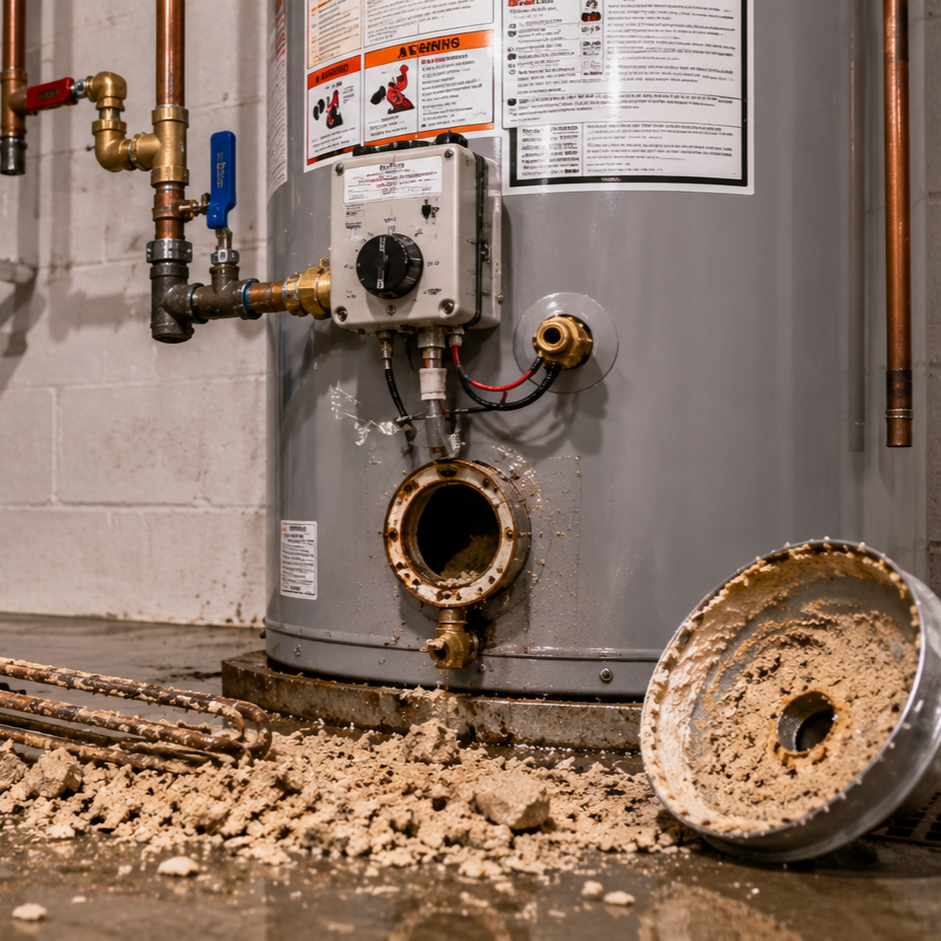
What sediment buildup actually does to your tank's capacity
Your cold water supply carries dissolved calcium and magnesium — the minerals that make water "hard." In eastern Pennsylvania, particularly in Berks and Montgomery Counties, the water hardness runs well above the national average. Every gallon that enters the tank leaves a trace. As that water heats up, the minerals drop out of suspension and settle to the floor as a dense, chalky layer.
Here's the part most people don't realize. A 50-gallon water heater with 10 gallons of sediment on the bottom is now a 40-gallon water heater. You're paying to maintain a 50-gallon system and getting 40-gallon output. Hot water runs out 20 percent sooner, with no other obvious explanation.
And it gets worse from there. That sediment layer sits directly on top of the heating element or burner. Heat has to push through it before it can warm the water above. The heater runs longer to reach the desired temperature. The element or burner operates hotter than it's designed to, which shortens its life on top of everything else.
Listen to your heater when it's running. A low rumbling or popping sound — especially on a unit that's never been flushed — is the most reliable indicator you've got significant buildup. Rust-tinted water from the hot tap is another sign. So is a heater that seems to cycle constantly without ever fully recovering between showers.
A broken dip tube is mixing cold water into your hot supply
Most people have never heard of a dip tube. But when it fails, you feel it immediately.
The dip tube runs from the cold-water inlet at the top of the tank straight down to the floor. Its job is to route incoming cold water to the bottom — where the heating element or burner is — and away from the hot-water outlet at the top. That separation is the whole design. Cold comes in at the bottom, gets heated, rises, and exits as hot water through the outlet.
When the tube cracks or breaks apart, cold water short-circuits. Instead of dropping to the floor to get heated, it crosses the top of the tank and exits through the hot-water outlet before it's ever warmed. You're drawing "hot" water and getting a steady chaser of cold mixed in. The shower turns cold in half the normal time.
Dip tubes are plastic. They degrade. The giveaway that yours has failed is specific: small white plastic chips or shards showing up inside your shower head or sink aerators. If you've been cleaning out aerator debris without knowing where it's coming from, that's likely it. A failed tube can push fragments into fixture valves and appliances throughout the house — it's not something to sit on.
The thermostat is set too low, and you're burning through the supply faster
Check this before you call anyone. It's the easiest fix in this list, and it's the right starting point if your hot water has been gradually underwhelming rather than suddenly running out.
The thermostat on a tank water heater controls the temperature the unit holds. Standard recommendation is 120°F. Below that, the water at the tap feels moderately warm rather than properly hot.
When the thermostat is too low, you use more hot water per shower to reach a comfortable temperature. More gallons per minute leave the tank chasing the same warmth. The tank empties faster — not because it's producing less, but because each use pulls more of it. If the dial on your unit is set below 110°F, bumping it to 120°F often restores normal duration within a day. Try that first.
A failing heating element is slowing recovery — and you're pulling from an empty tank
This one trips people up because the tank doesn't feel broken. The heater runs. Water eventually gets hot again. But it takes twice as long as it should, and if you're showering before recovery is complete, you'll run cold.
Electric water heaters have two heating elements: one near the top of the tank, one near the bottom. The lower element handles most of the heavy lifting — it's submerged in the coldest water and runs longer under sediment stress. When it fails, recovery time roughly doubles. What used to be a 60-minute recovery becomes 90 to 120 minutes.
Think of trying to boil a full pot of water on one burner when you need two. The water gets there eventually. But if you keep scooping it out before it reaches temperature, you'll never catch up.
Gas units have similar failure modes — a thermocouple drifting out of calibration or a burner that's cycling on and off erratically without fully heating the tank. The symptom looks identical from the shower: water that turns cold too soon, then comes back hot an hour later as if nothing happened.
Your tank may be sized for a household smaller than the one using it now
This is the one where no repair will fix the problem. The math is what it is.
Standard sizing runs 10 to 15 gallons per person per day for comfortable use. A 40-gallon tank is appropriate for two to three people. A family of four needs at least 50 gallons; five or more people should be looking at 60 to 80 gallons, or a tankless system that doesn't have a fixed capacity limit.
| Household size | Recommended tank size |
|---|---|
| 1–2 people | 30–40 gallons |
| 3 people | 40–50 gallons |
| 4 people | 50–60 gallons |
| 5 people | 60–80 gallons |
| 6+ people | 80–100 gallons or tankless |
A 40-gallon tank can sustain about 30 to 40 minutes of continuous use before it starts running cold. If your household has grown since the last replacement — or if you've added a soaking tub, a second full bath, or a dishwasher that runs while showers are going — the current tank may simply be undersized. No flush or repair changes the physics of a 40-gallon tank serving five people.
An aging water heater that's losing efficiency from the inside out
Water heaters don't quit all at once. They degrade slowly. And the degradation often shows up first as shorter hot-water duration — years before the tank actually fails.
Several things happen inside an aging unit. The anode rod — a sacrificial metal bar that corrodes so the tank lining doesn't — depletes after 8 to 10 years. Once it's gone, the lining starts corroding instead. The tank can develop pinhole leaks that bleed warm water out of the system before it's ever drawn. Insulation around the tank wall deteriorates, and the unit loses heat faster while sitting idle overnight. Heating elements build up mineral scale that insulates them from the water they're supposed to warm.
A heater past 10 years old that's consistently running out of hot water sooner than it used to is likely showing a combination of these. The question isn't whether something's wrong — it's whether the repair cost makes sense versus replacement. A plumber can test the elements, check the anode rod, and give you a straight answer on that.
One cause most people don't think to check: a mixing valve or cross-connection
If your hot water runs out fast at one fixture but seems normal everywhere else, the problem isn't in the water heater. A failing pressure-balancing valve, a worn mixing valve on a shower fixture, or a cross-connection where cold-water pressure is bleeding into the hot-water line can mimic every symptom of an undersized or failing tank.
But this one is easy to isolate. If your kitchen sink runs hot for five solid minutes while the master shower goes cold in six, the issue is localized. A water heater problem affects the whole house equally. A valve problem does not. Plumbers diagnose these by isolating fixtures and measuring water temperature at different points in the supply line — it's not guesswork once you know where to look.
Frequently Asked Questions
A 40-gallon tank can sustain about 30 to 40 minutes of continuous hot-water use before it starts running cold. A 50-gallon tank extends that to 40 to 60 minutes, depending on thermostat setting and incoming water temperature. In winter, when the cold-water supply coming into your home is significantly colder, both tank sizes recover more slowly — the heater has to raise water temperature farther before it's usable.
Listen to the heater when it's running. A low rumbling or popping sound — especially on a unit that's never been flushed — is the most reliable indicator. You can also check for rust-tinged water from the hot tap, or notice that the heater seems to cycle constantly without fully recovering between showers.
Five-year-old units with sediment problems are common in hard-water areas. If the tank has never been flushed, meaningful buildup can accumulate in three to four years, depending on local water hardness. A broken dip tube is also more common on units between three and eight years old than most people expect — check for white plastic bits in your aerators or shower head.
It depends on where the dial is currently set. If it's below 110°F, raising it to 120°F often restores normal duration within 24 hours. If the thermostat is already at 120°F and hot water is still running out in half the time it used to, the thermostat isn't the issue.
The rough threshold is 10 years. Replacing a failed heating element on a six-year-old tank usually makes economic sense. The same repair on a 12-year-old tank with a depleted anode rod, significant sediment, and degraded insulation often doesn't — you'll spend money on the repair and replace the whole unit within two years anyway. A plumber can lay out the comparison clearly.
Yes. A pinhole leak in the tank lining or a slow drip in a hot-water supply line can bleed warm water out of the system continuously, with no visible evidence at floor level. Check your water meter when every fixture in the house is shut off — if the dial is still moving, there's a leak somewhere. Warm spots on floors near the heater are another sign.
Most of these problems start mild and get worse each year. A sediment-filled tank that recovered in 45 minutes last fall may take 90 minutes this winter. A cracking dip tube shedding small chips will eventually fragment enough to clog fixtures throughout the house. Plumbers working across Montgomery, Bucks, Berks, and Lehigh Counties in Pennsylvania see the same causes repeat across thousands of homes — the mechanisms don't change, and neither does the repair sequence once the actual cause is pinpointed
