
The grease trap gets pumped on schedule. Every quarter, maybe every six weeks. The service company shows up, does the work, and drives away. And a week later the floor drain starts gurgling again. The dishwasher backs up mid-shift. The whole kitchen smells like it has been sitting in a bucket of old fryer oil — because, in a way, it has.
At that point, pumping more often is not a maintenance plan. It is a delay tactic. The question is whether the trap is failing because it is not being pumped frequently enough, or because the trap itself has hit the end of its useful life.
Those are two different problems with two different answers.
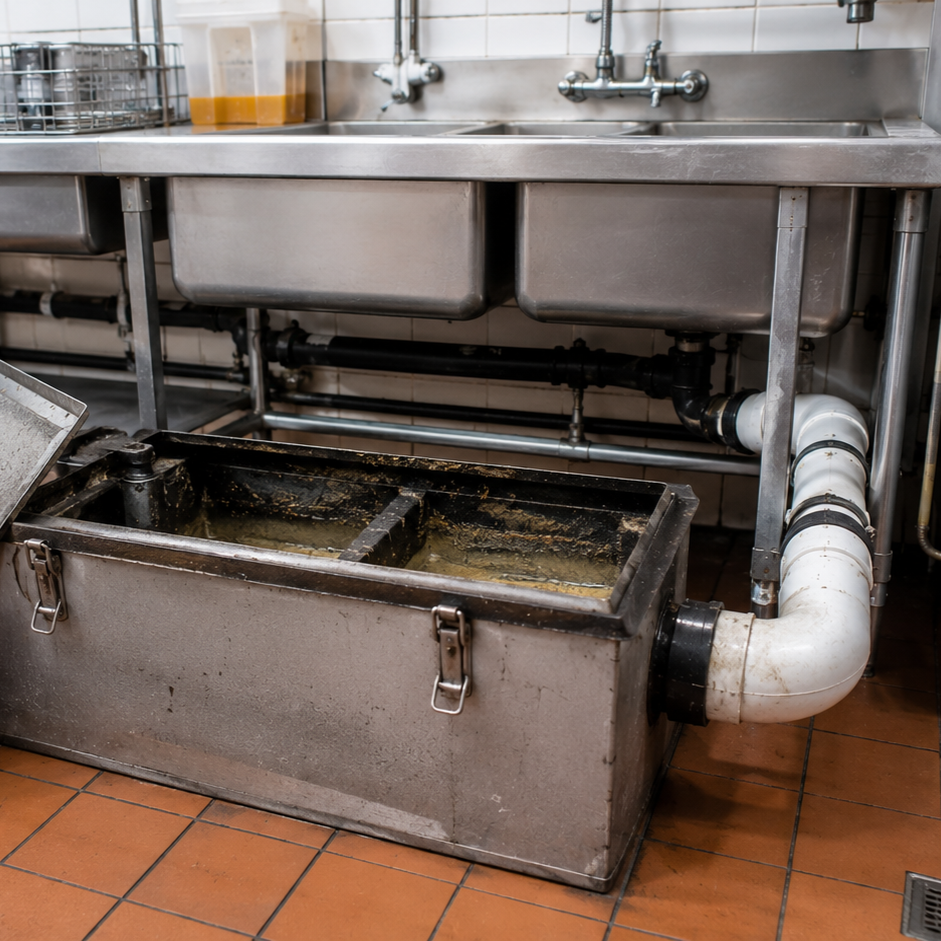
How a grease trap actually works
A grease trap is a passive separation tank. Wastewater from the kitchen flows in, slows down, and the physics of density take over. FOG — fats, oils, and grease — floats to the top. Food solids settle to the bottom. The clarified water in the middle exits toward the sewer. The FOG stays trapped.
That is the whole mechanism. No moving parts, no filters, no technology. Just time, gravity, and a box with baffles.
The box has a fixed capacity. As FOG accumulates in the top layer, efficiency drops. Most service standards set the threshold at 25% of total trap volume — when grease fills more than a quarter of available space, the trap starts allowing FOG to slip through into the sewer line. By 33%, it is barely doing its job.
Pumping resets the clock. But if the trap is the wrong size for the kitchen's grease output, you can pump every month and still watch it hit 25% three weeks later.
| Factor | Pump More Often | Replace the Trap |
|---|---|---|
| FOG output has grown due to menu changes | ✓ Adjust schedule | — |
| Trap body cracked, corroded, or leaking | — | ✓ Required |
| Trap consistently full 2–3 weeks after pumping | — | ✓ Likely undersized |
| Backups despite pumping on schedule | Inspect baffles and inlet/outlet pipes first | ✓ Often needed |
| Metal or iron trap over 7–10 years old | — | ✓ Replace proactively |
| Concrete trap over 20 years old | Monitor closely | ✓ Consider proactively |
| Kitchen volume or cover count increased significantly | — | ✓ Likely undersized |
| Sewer line backup beyond the trap itself | — | Camera inspection first |
Signs that pumping more often is not working
The clearest sign: backups arrive sooner and sooner after each pump-out. If the trap was being pumped every 90 days and now you are calling every 30 — and still getting slow drains between visits — you are not managing a grease trap. You are managing a symptom.
Other signs worth knowing:
The trap is consistently 50% or more full at pump-out time. If the technician is always pulling a trap that is half-packed with grease and solids, the cleaning interval is too short for the trap's actual capacity. That is not a frequency problem. That is a sizing mismatch.
Sewer odors persist inside the kitchen even two weeks after service. A properly functioning trap seals the line from the sewer. Smell it after a fresh pump-out and the inlet or outlet baffles may be corroded past the point of sealing correctly. Damaged baffles are a mechanical failure, not a cleaning problem — no amount of pump-outs restores a baffle that has physically degraded.
There is visible deterioration in the trap body. Concrete traps crack — especially in high-traffic areas where the lid gets driven over, or where freeze-thaw cycles have worked at the lid seal. A cracked concrete body leaks FOG directly into surrounding soil before it ever reaches the sewer. At that point the trap is not protecting the sewer. It is just a buried container with a hole in it.
Kitchen volume has grown. A trap sized for a 50-seat lunch spot is not adequate after an expansion that doubled cover count or shifted the menu toward heavier fried items. The trap does not grow with the business.
When pumping more often is the right answer
Not every grease trap problem requires replacement. Sometimes the fix is genuinely just an adjusted schedule.
If the trap is structurally sound — no cracks, functioning baffles, intact lid seals — and the only issue is slow drains appearing two weeks after a quarterly pump-out, moving to monthly service may be all it takes. FOG output varies with the menu. A kitchen that shifted from salads to fried food over a year will outpace a cleaning schedule calibrated for the old menu. That is not a trap problem. It is a scheduling lag.
High-volume periods are another legitimate reason to pump mid-cycle. A kitchen that does 40 covers on a Tuesday may do 180 on a Friday night in summer. A schedule set to average volume will struggle at peak volume.
And if a renovation or expansion is already planned for the next 12 to 18 months, running the current trap harder with a tighter service schedule can be a reasonable short-term bridge while a properly sized replacement is planned.
When replacement makes more sense
Replacement is the answer when the trap itself has degraded past what pumping can fix.
Material matters more than most owners realize. Metal and iron traps are the shortest-lived — typically 7 to 10 years under commercial kitchen conditions. The decomposed organic matter inside a trap releases sulphuric acid as a byproduct of bacterial breakdown. That acid does not just corrode the metal surface. It works into the walls over time, thinning them until the trap body loses structural integrity entirely. A metal trap that is 10 years old in a high-volume kitchen is not aging gracefully — it is dissolving from the inside.
Concrete traps last longer — typically 20 to 30 years — but they are not immune to the same process. Acid, hot wastewater, and physical stress from lids being driven over all accelerate wear. Concrete pores absorb grease over the years of use, which degrades structural integrity even when the exterior looks intact.
Plastic and fiberglass traps sit between those two extremes, with plastic running 10 to 15 years and fiberglass lasting somewhat longer. Both are more resistant to acid corrosion than metal, but they are susceptible to warping from hot effluent and to joint separation at connections.
The other driver that forces replacement rather than continued service: the trap is undersized for the current code. If local sewer authority requirements specify a minimum gallon-per-minute flow rate based on fixture count, and the existing trap does not meet that threshold, a pump-out cannot solve a compliance gap. That requires a properly sized installation.
What replacement actually involves
Replacing an in-ground grease trap is a one-to-two-day job in most cases. The scope includes excavation, removal of the old unit, installation of the new one, connection to inlet and outlet lines, backfill, and surface restoration.
The kitchen may need to be taken offline for part of the process — how much depends on where the trap is buried. Traps under parking lots or driveways require cutting asphalt or concrete before any plumbing work begins. Traps under tile floors inside the kitchen are more disruptive to restore after the job.
Cost variables include trap size, burial depth, location, and surface type above it. A 500-gallon trap under a rear parking lot is a different scope than a 1,500-gallon trap under a working kitchen floor. A plumber experienced in commercial work will assess the site before quoting — the range between scenarios is wide enough that general estimates do not hold.
One option sometimes worth asking about: a second trap installed in series with the existing one rather than full replacement. If the drain line layout allows it and there is physical space, adding capacity in series can extend the system's useful life without full excavation. Not every site accommodates it, but it is worth the conversation before committing to replacement.
How to tell if the trap is undersized
The benchmark: after a standard cleaning, the trap should stay below 25% full for a minimum of 30 days under normal service.
If the service company is consistently finding more than 25% grease at 30-day intervals, the trap is undersized for the kitchen's actual load. Sizing is based on flow rate — how many gallons per minute the fixture count generates — matched against a retention time long enough for grease to separate before water exits.
A kitchen that has grown, shifted its menu toward fried or fatty items, or added fixtures without upsizing the trap is running a unit that was never designed for current output. Staff habits also factor in. A kitchen where plate scraping is inconsistent, where cooking oil gets rinsed down sinks, or where dishwashers run without pre-scraped loads puts more FOG into the system than the same kitchen operating with disciplined disposal practices. The trap is sized for a certain load. Staff behavior determines what actually reaches it.
The hidden cost of keeping a failing trap
The math on more frequent pumping adds up faster than it first appears. Quarterly service at $300 to $400 per visit becomes $3,600 to $4,800 per year when compressed to monthly. Add in emergency calls for active backups, and the running total climbs.
But the larger exposure is downstream. A grease trap that is not doing its job allows FOG into the municipal sewer. In most jurisdictions, that is a violation that can result in fines, mandatory inspection schedules, and required mitigation — all at the operator's cost. A grease-blocked sewer line backing up into a kitchen during a dinner rush is a health code issue and a revenue loss in a single event.
A trap that fails and allows FOG into the surrounding soil or a drain field creates an environmental remediation situation that makes replacement look like the cheaper option in retrospect.
The comparison between replacement and continued patching is almost always closer than it looks at the start.
Frequently Asked Questions
Have a plumber calculate the flow rate from your fixtures — sinks, floor drains, prep stations — and compare it against the trap's rated capacity. The trap needs to retain wastewater long enough for grease to float before it exits. If the kitchen's flow rate exceeds what the trap can handle with adequate retention time, it is undersized.
In some cases, yes. Installing an interceptor in series with the existing trap can extend total capacity without full replacement. Whether that works depends on drain line layout and available space. Ask a commercial plumber to assess the option before committing to full replacement.
Most in-ground replacements take one to two days. The timeline extends if access is complicated — concrete or asphalt above the trap, tight clearance, or unusual depth. Plan the sequencing with your plumber so the kitchen downtime falls at a low-volume time.
In most PA municipalities, replacing or upsizing a grease trap requires a plumbing permit and an inspection. The plumber handles permit applications as part of the job. The inspection confirms the new trap is installed at the correct depth, slope, and connection configuration.
A well-installed concrete trap in a commercial kitchen typically lasts 20 to 30 years with regular pumping service. Metal and iron traps run considerably shorter — 7 to 10 years before acid corrosion from organic breakdown weakens the walls. Plastic interceptors fall in between at 10 to 15 years; fiberglass runs somewhat longer and handles acid better than metal.
The most common outcome is a notice of violation with a correction deadline. Fines escalate if the deadline passes without resolution, and the local authority can mandate inspection at your expense on an accelerated schedule. Repeated violations can affect the food service operating license. The details vary by municipality, but an uncorrected violation rarely costs less than fixing the underlying problem.
A grease trap that is constantly falling behind is not a maintenance problem. It is a sizing or condition problem, and more frequent pumping is a workaround, not a fix. If you are calling for service more than quarterly and still dealing with slow drains and odors, the trap is telling you something. The question is whether you hear it before or after a backup shuts down your kitchen during a Friday dinner rush.
