
Your tenant in 3B calls it a pipe bang. It shows up right after the laundry finishes filling — one sharp knock, loud enough to wake the person in the unit below. The tenant in 2A hears it every weekday morning around seven when showers and dishwashers start up across the building. You chalk it up to the building settling. Then come the callbacks. Then another bang, louder.
That's water hammer. Water doesn't compress the way air does, so when a valve slams shut and cuts off a column of fast-moving water, all that kinetic energy has to go somewhere. It travels backward through the line as a pressure wave, slamming into bends, fittings, and unsecured pipe sections like a fist inside the wall.
In a single-family house, one valve closes at a time. In a multi-unit building with a shared riser and a dozen fixtures shutting off over a two-hour morning window, those shockwaves don't fade — they stack. One tenant's washing machine finishing its fill cycle while two others step out of the shower creates simultaneous valve closures the pipe system wasn't necessarily sized or secured to handle.
| Cause | What You'll Hear | Where It Typically Originates |
|---|---|---|
| Fast-closing solenoid valves | Single sharp bang after appliance fills | Laundry hookups, dishwashers |
| High water pressure | Repeated banging from multiple fixtures | Anywhere; worse on lower floors |
| Waterlogged air chambers | Hollow clunking when flow stops | Behind walls near washing machines |
| Unsecured riser pipes | Banging with rattling in wall cavities | Inside chases between floors |
| Worn pressure-reducing valve | Banging that has progressively worsened | Near building's main water entry |
| Thermal expansion in hot-water lines | Rhythmic ticking or thudding | Hot-water risers near water heater |
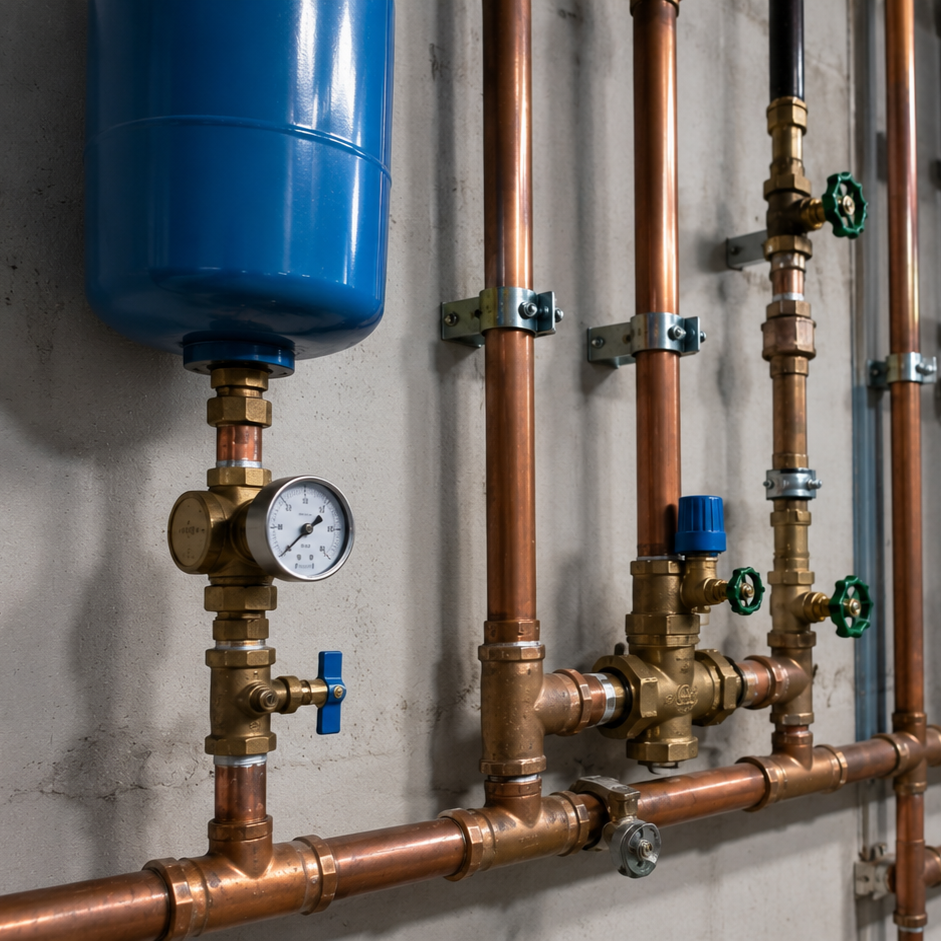
Why multi-unit buildings get the worst of it
A single-family home has one service line, a handful of fixtures, and short pipe runs. Close a faucet hard and the shockwave dissipates fast across a compact system.
Multi-unit buildings don't work that way. Shared vertical risers run three or four stories. Water stays under continuous pressure to reach every unit, which means there is more of it in motion at any given time. When a valve closes and sends a shockwave backward, it travels further before it dies out — bouncing off fittings, bends, and unbraced sections along the way.
And the morning rush makes it worse. Six units running washing machines, a dozen showers starting up, several dishwashers cycling — all within the same 90-minute window. Valves are closing every few seconds. The shockwaves reinforce each other rather than fade.
Buildings with original galvanized or cast-iron water lines face extra exposure. Plenty of pre-1980 construction still has them. Those pipes have narrowed interiors from decades of scale and mineral buildup, so water moves faster through a smaller channel. Faster water carries more kinetic energy. When it stops, the impact hits harder.
Fast-closing solenoid valves: the most common trigger
Modern appliances — washing machines, dishwashers, icemakers — use solenoid valves to control water fill. These are electromechanical devices that open and close quickly, which is exactly what lets them fill precisely without overflow.
The problem is the physics. A solenoid valve can shut in a fraction of a second. Water flowing at normal velocity has momentum. Cut that momentum off that fast and the energy has to go somewhere — and it goes into the pipe as a bang. Think of braking hard at highway speed. The force transfers somewhere. In plumbing, it transfers into the wall.
Washing machines are the biggest source because every fill cycle ends with a hard valve closure. One unit with one washing machine might produce a dozen shockwaves per day. Eight units? You're looking at close to 100 shockwave events before dinnertime.
Worn solenoid valves close faster than new ones. An aging valve that's lost its smooth closure creates stronger shockwaves than the day it was installed. That's why water hammer in a building tends to get worse over the years, not better.
High water pressure and how it amplifies everything else
Every cause on this list hits harder when pressure is high. Water hammer is like the kickback from a garden hose when you pinch it shut — the harder the water's flowing, the harder the kick. High pressure means the water column carries more force, so each shockwave punches with more energy.
In multi-unit buildings, pressure is typically highest on the lower floors. Ground-floor and basement-adjacent units often run above 80 psi — especially in older buildings where the original pressure-reducing valve has weakened or been ignored for years. Those units take the brunt of it: worn fittings, loosened joints at elbows, small leaks at connection points that quietly worsen.
Mineral scale speeds up the deterioration. It builds up on valve seats, making them close less smoothly. What starts as moderate water hammer grows worse as the PRV drifts and scale builds — and nobody flags it until a fitting starts weeping.
Air chambers that have waterlogged over time
Before water hammer arrestors became standard, plumbers installed air chambers — capped vertical pipe stubs behind walls near appliances. The air inside cushioned the shockwave when a valve slammed shut.
They work until they waterlog. Water slowly absorbs the trapped air over months and years, and the chamber fills entirely with water. Now there's no cushion — just more pipe. The shockwave hits the dead end of that stub the same way it'd hit any solid obstruction. The hollow thunking sound in older buildings right after a washing machine cycle often traces back to an air chamber installed in the 1970s that nobody's serviced since.
Draining the system can temporarily restore the cushion, but the chamber will waterlog again. Modern water hammer arrestors use a spring-loaded piston and don't waterlog. That's the permanent fix.
Loose riser pipes and what happens inside the wall
Properly secured pipes don't just sit in wall cavities — they are strapped at regular intervals to framing, which holds them still when pressure changes. A shockwave hits a strapped pipe, the pipe absorbs the impact and transfers it to the structure, and you hear almost nothing.
A loose pipe moves. When the shockwave hits, it bangs against the framing, neighboring pipes, whatever else is in the cavity. You get the hydraulic shock and the physical rattling of an unbraced section layered on top of each other. Louder noise and more joint stress, both at once.
In older multi-unit buildings, riser straps corrode and loosen. Some weren't adequate to begin with — a building put up in 1960 on the spacing standards of that era may have long unsupported spans that vibrate freely inside the walls. Getting to them means opening wall sections, which is exactly why the repair gets deferred until something finally fails.
A failing pressure-reducing valve at the main
The pressure-reducing valve at the building's main water entry drops street pressure — often 80 to 120 psi — down to a range the building can safely handle. It's a mechanical device with a diaphragm and spring. It has a service life. In a lot of older buildings, it hasn't been touched in 20 or 30 years.
A failing PRV rarely fails all at once. It drifts upward slowly. Sixty psi becomes 75, then 85, then higher. Nobody notices right away — until faucets drip faster, toilet fill valves start running, and water hammer is noticeably worse than it was a couple of winters back.
Replacing or recalibrating a PRV is one of the highest-value repairs in a building with chronic water hammer. If system pressure is running high, every other cause on this list gets amplified. You can confirm it with an inexpensive gauge at any hose bib or under-sink shutoff.
Thermal expansion in hot-water lines
This one is quieter than true water hammer — more of a tick or thud than a bang. But it gets misdiagnosed often enough to be worth separating out.
When water heats up, it expands. In a closed system with a backflow preventer or check valve, that expanded water has nowhere to go. Pressure builds inside the supply lines. The pipes flex slightly as pressure rises and drops with the water heater's cycle. In a building with long hot-water supply risers running three stories, that expansion and contraction plays out in a pipe section that may be 30 feet long.
The thudding you hear when the water heater kicks on isn't water hammer in the traditional sense — no valve closed. But it is a sign that thermal expansion pressure has no relief path. An expansion tank at the water heater gives it somewhere safe to go.
Frequently Asked Questions
Volume's a rough guide, not a reliable one. A single loud bang from a washing machine valve might cause no lasting damage. Repeated moderate banging — dozens of cycles per day from multiple units — can gradually loosen fittings and stress copper pipe enough to develop cracks over years. Any water hammer that's been present for more than a few months in a multi-unit building warrants a proper look.
In residential plumbing, sudden rupture from water hammer alone isn't common, but it happens. More typically, repeated shockwaves weaken joints and connections gradually. A fitting that was solid for 40 years develops a hairline crack at an elbow. A threaded connection starts weeping. The direct cost of the eventual failure gets blamed on the fitting, not the years of hammering that worked it loose.
Water hammer is a sharp bang at the moment a valve closes or flow stops. Thermal expansion sounds like a slow tick, creak, or thud that shows up when the water heater cycles on and hot water moves into a cool supply line. Banging during or right after appliance cycles and shower shutoffs is water hammer. Ticking in the early morning before anyone's run water is likely thermal expansion.
Arrestors installed at the problem appliance supply lines usually resolve hammer from fast-closing valves. But in a building with high water pressure, waterlogged air chambers, and unsecured riser sections, arrestors alone won't be enough. They address the symptom at the source without correcting the pressure driving it. A full diagnosis — checking PRV output, testing air chambers, inspecting pipe securing — gives you a clearer picture of what actually needs to happen.
Loose pipes have a physical rattling quality — you can often feel the vibration in the wall near the sound. A PRV issue produces banging across multiple units and fixtures with no single obvious source. Check pressure at any hose bib or under-sink shutoff with an inexpensive gauge. Consistently above 80 psi points to the PRV. Banging that rattles inside a specific wall points to a pipe support.
Yes. Water hammer is often the first symptom that draws attention to a building with aging infrastructure. A plumber diagnosing water hammer in a pre-1980 building may also spot narrow galvanized supply lines, corroded riser straps, and deteriorating shutoff valves — all capable of their own separate failures. Addressing water hammer creates a natural opportunity to assess the surrounding system.
Water hammer in a multi-unit building is rarely one problem with one fix. It's usually several things reinforcing each other — high pressure amplifying the shock from a fast-closing valve, unsecured risers rattling in response, and aging air chambers that stopped cushioning anything decades ago. Diagnosing it right means checking pressure first, then tracing the source, then working through the pipe-support and shock-absorption issues, floor by floor.
