
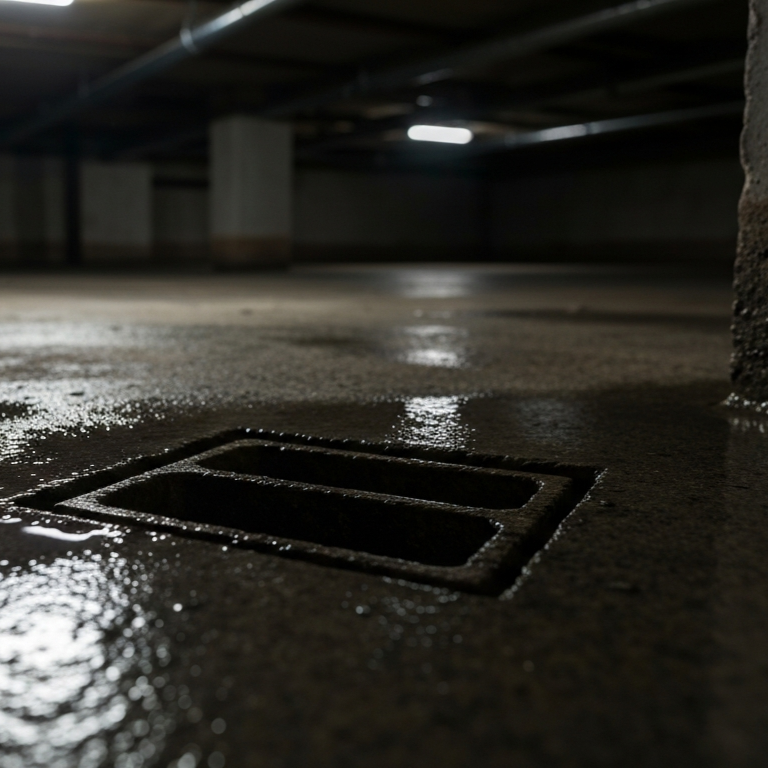
You open the basement door, and the smell hits you before the light does. Something wet and dark is pooling around the floor drain — and it isn't coming from above. It's coming up.
That's sewage. And the fact that it's coming out of your basement floor drain tells you something specific: the problem isn't the drain itself. It's somewhere deeper in your plumbing system, and it needs attention today, not next week.
Here's what's actually happening, why the floor drain is always the first place it shows up, and what the different causes mean for how you fix it.
Why the basement floor drain is always the first to go
Every drain in your house connects to a single main sewer line that runs out through the foundation and into either the municipal sewer or a septic tank. Water moves through that main line by gravity. Always downhill.
The basement floor drain sits at the very bottom of that system. It's the lowest opening in your home's drainage. So when something blocks the main line, and sewage can't flow forward, it backs up, fills the pipe, and finds the easiest exit. That exit is always the lowest one available.
Think of it like a clogged bathtub with the faucet still running. Water doesn't disappear — it rises until it overflows. Your basement floor drain is the overflow point. When sewage comes out of it, the system has run out of anywhere else to put the backflow.
This is actually useful information. It means you don't have a broken floor drain. You have a blocked main line.
Quick reference: common causes and what they mean
| Cause | Happens on dry days? | Happens after heavy rain? | Likely fix |
|---|---|---|---|
| Tree roots in main line | Yes | Sometimes | Hydro jetting or line repair |
| Debris / improper flushing | Yes | Rarely | Drain cleaning |
| Deteriorated cast-iron or clay pipe | Yes | Sometimes | Camera inspection, cleaning or replacement |
| Belly or low spot in line | Yes | Rarely | Excavation and regrade |
| Municipal sewer overwhelmed | Rarely | Yes | Backwater valve |
What's actually blocking the main line
Tree roots seeking moisture
Roots are patient. A tree 30 feet from your house can push feeder roots 60 feet toward your foundation, following any trace of moisture in the soil. Older clay-tile sewer lines — common in established eastern Pennsylvania neighborhoods — have joints every few feet where pipe sections meet. Those joints are sealed with mortar that cracks with age. Roots find those cracks, push through the pipe wall, and fan out inside into a fibrous mesh that catches toilet paper, grease, and debris with every flush.
The root mass doesn't block the pipe overnight. It grows slowly, a little thicker each season, until one day the line can't pass enough volume and sewage backs up. Hydro jetting clears root masses and cleans the pipe walls. But if roots have been growing long enough to crack the pipe itself, repair or replacement may be the only option.
Debris that shouldn't have been flushed
Wipes labeled "flushable" don't dissolve the way toilet paper does. Neither do paper towels, feminine hygiene products, or cotton rounds. These items make it through the toilet trap fine — then they collect in the main line, usually at a bend or where the pipe diameter narrows. Cooking grease does the same thing by a different path: it enters the drain as a liquid, hits the cooler pipe wall, and hardens into a layer that narrows the inside diameter and catches everything sticky that passes through after it.
This type of blockage builds over months, not overnight. A main line that drained fine six months ago starts running slow, then backs up under heavier use.
Deteriorated pipe walls
Many pre-1980 homes in eastern Pennsylvania were built with cast-iron main sewer lines. Cast iron is durable, but it corrodes from the inside out. Hard water — common in Berks and Montgomery Counties — speeds that process up. As the interior walls rust, the surface turns rough and porous. Toilet paper clings to it the way a sweater catches on a splintered wood surface. Debris accumulates faster, and less is needed to cause a backup.
A corroding cast-iron line doesn't automatically need to be replaced. Hydro jetting strips scale and debris off the walls and restores flow. But if the pipe has corroded through or sections are collapsing, cleaning won't hold for long.
Clay-tile lines fail differently. The tile itself is hard and smooth, but the joints are vulnerable. Ground movement — including decades of freeze-thaw cycles working through eastern PA winters — can shift sections out of alignment. Debris catches at every misaligned joint.
Bellies and low spots in the line
A belly is a low spot in a pipe that should run at a continuous downward slope. They form when the soil under the line settles unevenly over time, which is common in this region after years of freeze-thaw pressure on the ground. The pipe dips, water pools in the belly instead of flowing through, and solids settle into that standing water. Eventually, the accumulated debris causes a blockage.
Bellies are one of the harder problems to find without a camera. The pipe isn't cracked. There are no roots in it. It's just holding water where water shouldn't be sitting.
Heavy rain overwhelming the municipal sewer
On a stormy night, when the backup happens after a full day of rain, the cause may not be your sewer line at all. Municipal sewer systems have a finite capacity. During heavy storms, groundwater seeps into the city's aging mains and the system fills beyond what it can handle. When that happens, sewage flows backward through service laterals and comes up through the lowest drain it can reach — yours.
This type of backup is distinct because your line may be completely clear. The sewage is coming from the street side. A backwater valve — a one-way check valve installed in the main line before it meets the street — blocks that backward flow. And it's one of the more straightforward preventive fixes for homes in areas with older municipal infrastructure.
How timing tells you which cause it is
If sewage backs up on a dry day with no weather event, the problem is almost certainly in your portion of the line. Tree roots, debris, corroded pipe, or a belly. The fix is somewhere between your foundation and the street connection.
If it backs up specifically after heavy rain and you've had no other drainage problems, municipal sewer overwhelm is the more likely factor. That doesn't let you off the hook — the solution is still something a plumber installs — but the diagnostic path is different.
Repeat backups after every significant rain: that pattern points toward a backwater valve. Random backups regardless of weather: camera inspection first.
What to do the moment you discover it
Raw sewage is a biohazard. Keep people and pets out of the basement. Don't run water anywhere in the house — every toilet flush, every sink drain, adds more volume to a system that's already full and pushing the wrong direction.
Turn off the main water supply if you can do so safely. Open windows. Call a plumber. A plunger won't fix this. The blockage is in the main sewer line, not in the floor drain itself — no amount of plunging at that drain will clear what's happening 20 feet underground.
How a plumber finds out which cause it is
The answer is almost always a camera inspection. A plumber feeds a waterproof camera into the main line through a cleanout access point and watches what it shows. Tree roots look like a tangled mesh filling the pipe interior. Debris accumulation shows as a narrowed channel packed with dark material. A belly is visible as standing water in a section that should be empty. A cracked or collapsed section appears as a deformation or gap in the pipe wall.
Without a camera, you're guessing. With one, you know exactly what's wrong and where it is — which changes both the repair approach and the cost.
Can you prevent another backup?
That depends on what caused this one, but yes — most of the time.
If roots were the cause, hydro jetting every one to three years keeps the line clear. The roots don't go away — the tree is still there — but routine maintenance prevents them from accumulating enough to block flow.
If the line is deteriorated cast iron or misaligned clay tile, the long-term answer is replacement or pipe lining. Trenchless pipe lining installs a resin liner inside the existing pipe without excavating — useful when the original line runs under a finished floor or a paved driveway.
If heavy rain triggered the backup, a backwater valve is the most direct fix. It doesn't require touching the rest of your plumbing.
And regardless of what caused this one: be strict about what goes down the drains. Toilet paper only in the toilet. Cooking grease in the trash after it solidifies. No wipes, no paper towels, no dental floss — not even the ones marketed as safe for plumbing
Frequently Asked Questions
The basement floor drain is the lowest fixture in the drainage system, so it's where backed-up sewage exits first. Upper-floor fixtures are higher in the system — sewage would have to fill the entire main line before it could reach them. If multiple drains throughout the house are backing up at once, the main line is likely completely blocked.
Standard homeowner's policies typically exclude sewer backups. A sewer backup rider or separate endorsement covers it — but most homeowners find out they don't have that coverage when they file a claim. Check your policy now, before this happens again.
If backup happens only during or after heavy rain, municipal sewer overwhelm is a likely factor. If it happens on dry days or under normal household use, the problem is almost certainly in your portion of the lateral — between your foundation and the connection to the city main. A camera inspection confirms which side of that line the problem is on.
Homes with clay-tile or cast-iron sewer lines, mature trees on the property, or a history of backups benefit from a camera inspection every two to three years. Homes with newer PVC lines and no root history can go longer between checks.
Hydro jetting uses high-pressure water — no chemicals — and is safe for PVC and sound cast-iron lines. If a pipe is already cracked or near collapse, a camera inspection should happen before jetting so the plumber knows what they're working with before they pressurize the line.
A backwater valve is a one-way check valve installed in the main sewer lateral. It allows water to flow out toward the street but closes automatically if flow reverses — which is exactly what happens during a municipal sewer backup. Installation is relatively straightforward, and for homes in areas with older sewer infrastructure, it's one of the more effective things you can do.
A basement floor drain backing up with sewage isn't something to watch and hope improves on its own. The main line is blocked — or the municipal sewer pushed back — and neither of those problems clears itself. But once a camera goes in and shows what's actually there, the fix follows directly from what it finds.
