
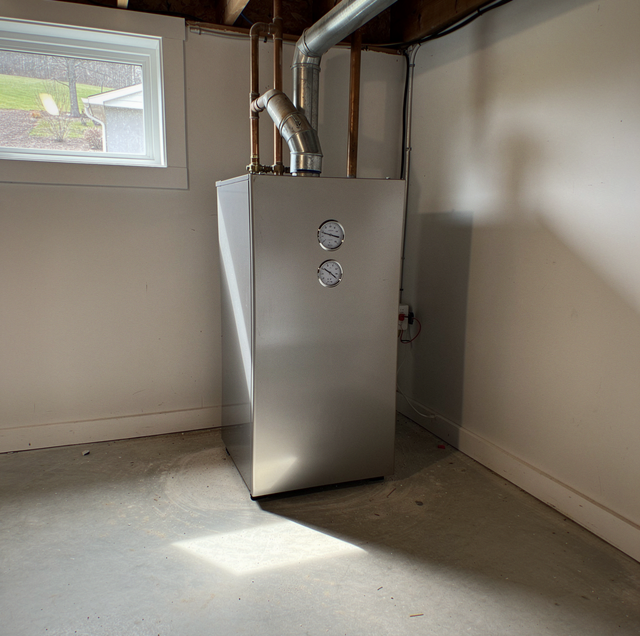
You go down to check on the boiler before bed, the way you like, and something sounds different to you tonight. It fires the same as ever for you, but takes a beat longer to catch, then drops into a rumble you don't remember from last month. You crouch by the jacket and listen for a minute, trying to tell whether your ears are making this up or your boiler needs you to do something.
A boiler rarely fails without warning. It spends weeks sending small signs before the day it quits, and each one points to a different part wearing out. Learning what your boiler is doing, rather than guessing, turns a night like that into a call you can make on your own schedule.
How a Boiler Wears Between One Service Call and the Next
A boiler doesn't sit idle between cold snaps. Every time it fires, water passes through it; minerals in that water settle out somewhere inside the heat exchanger, and the burner goes through a startup and shutdown cycle that stresses its ignition components a little more. None of that depends on the season. A boiler running a finished basement zone or a hydronic towel warmer in July is doing the same wearing, cycle for cycle, as one that only runs on the coldest nights of the year. Federal safety guidance urges a yearly professional inspection of fuel-burning home heating systems, including boilers.
That is why a yearly service interval isn't tied to weather at all. A qualified technician checks combustion, pressure, and venting on a schedule, catching a small problem well before it becomes the kind that leaves you without heat. A boiler running a snow-melt loop or serving several units cycles far more often than a typical single-family system, and one of those setups may be worth a second look partway through the year, not only once every twelve months.
Eight Signs at a Glance, and What Each One Means
Some of these signs are worth a phone call this week. Two of them are not something to wait on at all, and the difference matters more than the list itself.
| Sign | What's Happening Inside the Boiler | How Soon to Act |
|---|---|---|
| Short cycling, on and off every few minutes | A control, sensor, or sizing problem is stopping the burn early | Schedule service soon |
| Kettling or rumbling during the burn | Scale is coating the heat exchanger, trapping steam pockets | Schedule service soon |
| Soot at the jacket or a yellow, lifting flame | Combustion is incomplete, and byproducts aren't venting cleanly | Get out and call now |
| A carbon monoxide alarm sounds near the boiler | A combustion or venting fault may be pushing exhaust into the room | Get out and call now |
| Pressure gauge running above or below the normal band | A leak, a bad fill valve, or a failing expansion tank | Have it checked this week |
| Water or steam discharging from the relief valve | The system is over-pressurized, or the valve itself has failed | Call today |
| Fuel bills climbing with no change in use | Scale or poor combustion is forcing longer burns for the same heat | Schedule service soon |
| Pilot or ignition trouble on startup | A dirty sensor, a weak thermocouple, or a failing ignition module | Schedule service soon |
Most rows on that list describe wear a technician can catch on a routine visit, something you can work around your own calendar. Two rows are not a scheduling decision at all, and they get their own section below. None of these signs guarantees a failure by itself, but two or more together are worth a same-week call no matter which pair they are.
Short Cycling and the Wear It Adds With Every Restart
A boiler that fires, runs for a minute or two, and shuts off again and again is spending most of its cycle on startup and shutdown, not on steady heat. Each restart draws extra current through the ignition system and puts a small jolt of stress on the same components, so a system that short-cycles all day is aging its igniter and control board faster than one that runs longer, steadier cycles.
The cause is rarely the same twice. A thermostat mounted somewhere drafty can call for heat and satisfy it within a few minutes. A boiler sized larger than the space it heats reaches temperature too quickly. Low water in a steam system can trip a safety cutoff long before the room actually warms. A technician determines which of those is happening on your system with a combustion and pressure check, not by guessing from the pattern alone. A technician who traces the actual cause the first time saves you a second visit for the same complaint.
What Vents a Boiler's Exhaust, and What Does Soot Reveal?
A boiler burns fuel, and the exhaust must leave the house through a flue or vent pipe. When combustion is clean and the venting is doing its job, that exhaust never enters the living space at all. Soot staining around the jacket or the draft hood, a flame that burns yellow and lifts off the burner, not sitting blue and steady, or a scorch mark on nearby wood all point to combustion that isn't finishing the way it should, or exhaust that isn't leaving the way it's supposed to.
If a carbon monoxide alarm sounds near the boiler, or you notice soot, a scorched smell, or a yellow flame, get everyone outside and call a licensed heating technician to test combustion and inspect the venting before anyone goes back inside.
None of those signs can wait for next week or a routine appointment down the line, because a combustion or venting fault rarely stays small on its own. A technician who finds one traces it to a cracked heat exchanger, a blocked or disconnected vent, or a burner that needs adjustment, and confirms the flue is drafting properly before signing off on your system. A carbon monoxide detector near the boiler backs up that inspection; it is not a substitute for it.
Kettling and Rumbling: The Sound of Scale Building Inside
A boiler that pops, rumbles, or knocks from inside the unit itself, as opposed to a pipe or radiator elsewhere in the house, is usually describing scale buildup on the heat exchanger. Minerals dissolved in the water settle onto the hottest surfaces first, and that layer insulates the metal from the water it's supposed to be heating. Water trapped against an insulated surface superheats into small steam pockets that collapse with a knock or a low rumbling boil, a sound plumbers call kettling because it resembles a kettle just before it whistles. Catching it early can spare the whole exchanger some real wear.
Left alone, scale keeps thickening in the same spot, and the heat exchanger has to run hotter to move the same amount of heat through it, which shortens its working life. Water hardness in your area plays a real role in how quickly this builds, so a system on harder water tends to develop the sound sooner than one on soft water, even at the same age, which is worth mentioning when you call.
Pressure Swings and Where the Gauge's Reading Should Sit
A cold hydronic boiler usually holds somewhere around twelve to fifteen pounds per square inch, rising a little once the system heats up. A gauge sitting well above that band, or one you keep needing to top up to stay in range, points to a leak in the loop or a fill valve stuck open and overfilling the system on its own. A gauge near zero tells a different story: water has been lost, air has gotten in, or a failing expansion tank is letting the pressure swing on you. Either extreme points to a loop fault, so a reading that has drifted from its usual position is worth a service call this week. Adding makeup water or draining the loop to move the needle is work for your heating technician, since a gauge that keeps drifting is describing a leak or a failed part that refilling only hides.
A Relief Valve That Discharges on Its Own
Every boiler has a pressure-relief valve whose job is to open automatically if pressure or temperature climbs past a safe limit, releasing hot water through a discharge pipe that should run down to the floor or outside. A valve doing that occasionally under a real overpressure event is doing exactly what it's built to do. A valve that drips steadily, hisses, or discharges water in a system that otherwise seems normal is indicative of either a genuine overpressure problem or a valve that has begun to fail on its own.
That water is coming out hot and under pressure, and there is no safe way for you to test, cap, or adjust the valve yourself while it's discharging. The right response is to call a plumber or heating technician, who shuts down the boiler, lets the system cool, and determines whether the cause is a bad expansion tank, an overfilled system, or the valve itself, rather than reaching for the valve by hand. A valve that has discharged even once is often worth replacing, not just reusing, since a valve that has already opened under real pressure can fail to reseat fully the next time it matters.
Rising Fuel Bills and the Efficiency a Neglected Boiler Loses
A boiler loses efficiency quietly, long before it loses heat output. Scale on the heat exchanger, incomplete combustion, and a burner that has drifted out of adjustment all make the same unit burn more fuel to deliver the same warmth, and none of that shows up as something you would notice by feel. It shows up on the bill a few months later, once you have stopped thinking to compare it against last year's numbers for the same weather. A one-time high bill during a cold stretch is normal load, not a boiler problem.
Most of the signs on this list describe a system that is wearing in the ordinary way and give you room to book a visit around your own calendar. One does not. A carbon monoxide alarm sounding near a boiler, a scorched smell, or a flame burning the wrong color is not a maintenance item you fit in next week the way you would a noisy pump or a rising bill. It is the sign that should never wait for a booked visit; everything else on this list can.
Frequently Asked Questions
Once a year is the standard interval for a typical residential boiler. Use the visit as a lesson too: ask your technician to walk you through the controls on your system and point out where its gauge, relief valve and air vent sit, so the warning signs above mean something real the next time you look down there.
Yes. A humming or grinding sound near your unit can come from a circulator pump bearing, not the boiler, a different repair than scale inside the heat exchanger. A technician isolates the source by feeling for vibration at the pump housing rather than at the jacket, not by guessing at what you and your neighbors hear.
One near the boiler is a good start, but put battery-operated or battery-backup CO detectors in every sleeping area in the home, too. A basement alarm can go unheard from your bedroom two floors up while you sleep, and battery backup keeps it sounding through a power cut, so check that your detectors carry it before relying on them, not after the next outage.
A combustion analyzer reading shows a technician whether your burner is running cleanly, which nothing you can see or smell will confirm on its own. The visit also covers the heat exchanger itself for hairline cracks and, on steam boilers, a low-water cutoff test, tools you simply don't have.
It does, and the effect adds up faster than the short runtime suggests. Every startup purges the burner and ramps up combustion from nothing, burning fuel less efficiently than during a steady run, so a boiler cycling every few minutes spends more fuel on each startup than yours would if you let it run longer between startups, even with your thermostat unchanged.
For most signs on this list, no. Rising fuel bills or a gauge drifting from its usual reading are not emergencies, and shutting the system down yourself just leaves you without heat until someone can look at it. Calling to get it looked at matters more than waiting for it to get worse on its own. The exception is a genuine safety sign, a carbon monoxide alarm, a scorched smell, or a valve discharging hot water, where the better move is leaving the house and calling for help, not you testing the emergency shutoff switch on your way out.
Schedule an annual boiler service — a licensed technician can check pressure, combustion, and venting, replace worn parts before they fail, and confirm the relief valve is still working properly before anything gets worse. East Coast Plumbing serves Barto, Boyertown, and Pottstown. Call (610) 944-2998.
