
Saturday morning. Two teenagers want showers, someone has a load of laundry going, and you're standing at the kitchen sink wondering why it's taking two minutes for hot water to arrive. Twenty minutes later, the second person out of the shower gets hit with cold water halfway through and comes downstairs unhappy. The 40-gallon tank gave out. It always gives out on Saturday mornings.
This is the conversation most families of four eventually have: is it time to switch to a tankless water heater? The answer isn't a simple yes or no. It depends on how your house is set up, how old it is, and what your water quality is actually like.
Here is what the real comparison looks like — not the manufacturer brochure version, but the actual numbers, including the things that surprise people during installation.
| Property | Tank Water Heater | Tankless Water Heater |
|---|---|---|
| Installed cost | $1,200–$2,500 | $3,500–$6,500 |
| Annual energy use | Higher (standby heat loss 24/7) | 24–34% lower for most homes |
| Lifespan | 8–12 years | 18–25 years |
| Annual maintenance | Anode rod check, occasional flush | Descaling flush (critical in hard-water areas) |
| Flood risk if unit fails | 30–80 gallons released | Minimal — no stored water |
| Space required | ~2 ft diameter floor space | Wall-mounted, roughly luggage-sized |
| Hot water supply | Limited to tank capacity | Continuous, limited only by flow rate |
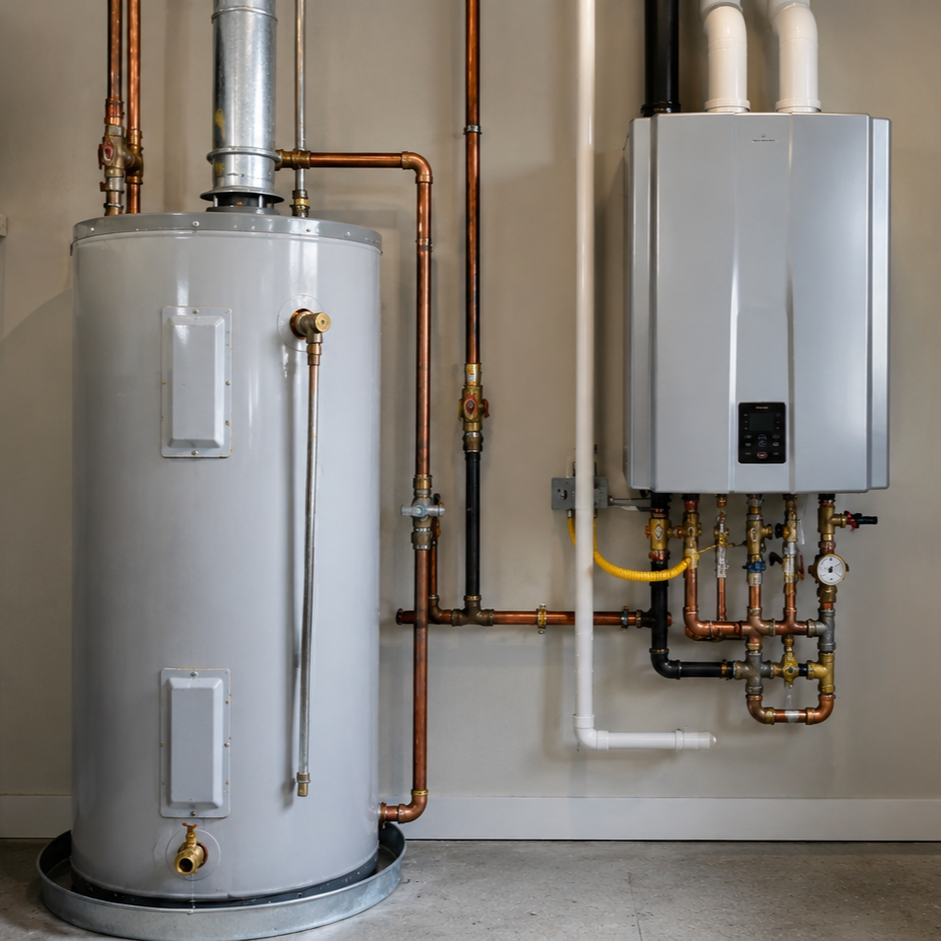
How each system actually heats your water
A storage tank water heater does one thing: it keeps a reservoir of hot water ready. Your 40- or 50-gallon tank stays heated to around 120°F around the clock — whether you are home, asleep, or away for a week. When someone turns on a faucet, hot water flows out of the tank and cold water fills in from the bottom to be reheated. When the tank empties, you wait 30 to 60 minutes for recovery.
The energy waste baked into that system is called standby heat loss. You're paying to keep 40 gallons of water hot every hour of every day, including the hours nobody is home and the hours everyone is in bed.
A tankless water heater doesn't store anything. Cold water enters the unit, passes over a heat exchanger powered by a high-BTU gas burner (or electric elements), and exits hot — in seconds. The unit fires when a tap opens and shuts off when it closes. No stored hot water, no standby heat loss.
The tradeoff: a tankless unit can only heat so much water at once, measured in gallons per minute. If demand exceeds the unit's capacity, you get lukewarm water instead of hot.
What a family of four actually uses — and what that means for sizing
The Department of Energy uses 41 gallons per day as its benchmark for a low-use household. A family of four with teenagers almost always exceeds that. A 10-minute shower uses roughly 20 to 25 gallons. Four showers, a load of laundry, and a dishwasher cycle add up to 80 to 100 gallons on a normal weekday.
Sizing a tankless unit comes down to two numbers: peak flow rate (gallons per minute) and temperature rise. If your household needs to run two showers and a dishwasher simultaneously, that's roughly 3.5 to 5 gallons per minute of demand. A properly sized residential gas tankless unit handles that.
The catch is temperature rise — and that's where eastern Pennsylvania winters change the math.
Why cold winters change the performance numbers for tankless
In Texas or Georgia, groundwater coming into the house stays above 60°F even in winter. In eastern Pennsylvania, groundwater temperatures drop to 40–45°F by February. If you want 120°F water at the showerhead, you need an 80°F temperature rise. That's a significantly harder job than the 60°F rise a unit tested in warmer climates was rated for.
A tankless unit rated for 5 GPM at a 70°F temperature rise might only deliver 4 GPM when ground temperatures drop to 42°F in January. That's still enough for most families — but it means sizing a unit for Pennsylvania inlet temperatures, not the numbers on a Texas installer's recommendation sheet.
What the cost difference really looks like over 15 years
A standard 50-gallon gas tank installed runs $1,200 to $2,500. A gas tankless unit installed runs $3,500 to $6,500 — sometimes higher if your house needs gas line or venting work, which we'll get to in the next section. That's a real gap, and it's the number that stops most people cold.
Where tankless catches up is ongoing energy use. The Department of Energy puts tankless gas heaters at 24% to 34% more efficient than tank units for homes using under 41 gallons daily, and 8% to 14% more efficient for high-use households. In practical terms, that's roughly $100 to $200 per year in gas savings.
Over 15 years, that's $1,500 to $3,000 back. Combined with the fact that you won't replace a tankless unit during that window the way you will with a tank (which typically needs replacement at the 10- to 12-year mark), the long-term math often favors tankless for homeowners who plan to stay.
Think of it the way you'd think about work boots versus cheap sneakers. The boots cost twice as much. But you buy them once, they outlast three pairs of sneakers, and your feet still feel fine at the end of a long day.
What your house might need before a tankless unit can go in
This is the part that surprises people. A tankless gas water heater burns 150,000 to 200,000 BTU at peak demand. A tank unit burns 30,000 to 40,000 BTU. That's a four- to fivefold increase in gas consumption rate — and your existing 1/2-inch gas line probably can't support it.
Upsizing a gas line to 3/4 inch adds $500 to $1,500 depending on the run length from the meter to the unit. Pre-1980 homes in eastern Pennsylvania often have original steel gas piping that should be inspected before any upsizing work begins.
Venting is another item. Tankless units typically require Category III stainless steel vent pipe, or PVC exhaust on condensing models. Your old B-vent from the tank installation won't work. New venting runs $300 to $800.
Even gas tankless units need a 120V electrical outlet for controls and ignition. If there isn't one near the installation location, you're looking at $200 to $1,000 in wiring work.
A plumber will identify all of this during a site walk before giving you a quote. These infrastructure costs aren't always cheap, but they're one-time. You don't pay them again on the next water heater.
Hard water and why it matters more for tankless than for a tank
Eastern Pennsylvania draws from limestone-heavy geology, and Berks County and Montgomery County both have notably hard water. The dissolved calcium and magnesium in that supply don't disappear at the tap — they migrate into your plumbing and build up wherever water is heated.
In a storage tank, scale settles to the bottom gradually and reduces efficiency slowly. In a tankless unit, the heat exchanger is where water goes from 45°F to 120°F in a matter of seconds, and that's exactly where mineral deposits concentrate. Scale buildup inside a tankless heat exchanger is like the inside of a teakettle that's never been descaled — the water still flows, but the exchanger works harder, uses more gas, and eventually the mineral crust causes premature failure.
Tankless units in hard-water service need to be flushed with a descaling solution once a year. A plumber charges $150 to $200 for that service. If you skip it for a few years in a hard-water area, a 20-year unit can start failing at 10.
Installing a whole-house water softener or a dedicated scale filter upstream of the tankless unit provides meaningful protection and is worth considering for homes in harder-water parts of the region.
When a tank water heater is still the right call
Tankless makes sense for families staying in their home long-term, with high daily hot water demand, and a house that already has adequate gas service. It doesn't always make sense otherwise.
If your home runs on propane rather than natural gas, the energy savings calculation shifts. Propane costs significantly more per BTU, so the efficiency gains from tankless shrink when measured in actual dollars per month.
If you're planning to sell in the next two or three years, you may not recoup the installation premium in added home value. A quality tank replacement gets you reliable hot water without the overhead.
If your home needs significant infrastructure upgrades — gas line, venting, and electrical all at once — and total installation cost climbs past $7,000, the payback period stretches out enough that a high-efficiency tank unit becomes the more practical answer.
And if your water is hard and you're not willing to commit to annual maintenance, a tank is simply more forgiving. It degrades slowly and loudly. A neglected tankless unit in hard-water service fails quietly and faster.
Frequently Asked Questions
For a family of four in eastern Pennsylvania, look for a gas tankless unit rated at a minimum of 9 GPM at a 70°F temperature rise. Because of cold winter groundwater temperatures (40–45°F), you want a unit that isn't already at maximum output during a normal winter morning. A plumber should calculate your household's peak simultaneous demand — showers, dishwasher, laundry — before selecting a model.
Tank water heaters typically last 8 to 12 years. Tankless gas units, properly maintained, last 18 to 25 years. In hard-water areas, annual descaling is what makes the difference between reaching that full lifespan and replacing the unit well before it.
Yes. The calcium and magnesium in the eastern PA groundwater deposit inside the heat exchanger every time water is superheated through the unit. Annual descaling slows that process significantly. A whole-house softener or scale filter upstream of the unit provides additional protection, especially in Berks and Montgomery County homes.
For families staying in their home five or more years with high daily hot water use, the math usually works out. You're looking at $100 to $200 per year in gas savings, and you won't replace the unit during a 20-year window the way you would with two tank replacements. The higher upfront cost becomes less significant when you account for the second tank replacement you're skipping.
Yes — if it's correctly sized. An undersized unit will struggle at peak demand and deliver lukewarm water across the house. A properly sized unit based on your household's actual simultaneous demand handles two showers, a dishwasher, and a washing machine without a temperature drop.
The most common are gas line upsizing ($500–$1,500), new venting ($300–$800), and an electrical outlet for controls ($200–$1,000 if one isn't already nearby). Pre-1980 homes may also have original steel gas piping that needs inspection before the work begins. A plumber will assess all of this during a site visit before providing an estimate.
A family of four in Montgomery, Bucks, Berks, or Lehigh County puts real daily demand on a water heater — and the right choice between tank and tankless comes down to your house's gas service, your water quality, and how long you plan to stay.
