
Water Heater Replacement Cost: What Actually Drives the Price
Your water heater gave out on a Tuesday in January. The shower ran cold, you found a puddle spreading across the utility room floor, and by noon, you had three quotes sitting in your email: $1,700, $2,400, and $3,900. Same job, same house. You're not being gouged — or maybe you are. The problem is you have no way to know.
Water heater replacement is one of the most variable home repair costs out there. Two identical houses on the same street can get quotes that differ by $2,000, and both can be completely legitimate. The unit type, fuel source, how complex the installation turns out to be, the age of your existing connections, whether code upgrades are needed — all of it adds up differently for every home.
Understanding what drives the price is the only way to evaluate what you are being told. Here is a breakdown of every factor that moves the number.
| Type | Unit Cost | Installed Total | Typical Lifespan |
|---|---|---|---|
| Gas tank (40–50 gal) | $700–$1,300 | $1,500–$3,000 | 10–14 years |
| Electric tank (40–50 gal) | $500–$900 | $1,200–$2,500 | 10–14 years |
| Propane tank (40–50 gal) | $800–$1,400 | $1,800–$3,500 | 10–14 years |
| Heat pump / hybrid electric | $1,200–$2,500 | $3,000–$5,500 | 12–15 years |
| Gas tankless | $1,500–$2,500 | $3,500–$6,500 | 18–22 years |
Ranges include labor and permit fees. Code-compliance add-ons detailed below can push totals higher.
The type of unit creates the biggest price spread
A standard 50-gallon gas tank water heater runs $700 to $1,300 for the unit itself. A gas tankless system starts around $1,500 and can reach $2,500 before anyone picks up a wrench. That $1,200 gap in equipment cost doesn't include the extra labor tankless installation almost always requires.
Five types show up in residential replacements: gas tank, electric tank, propane tank, heat pump (hybrid electric), and gas tankless. Each has a different price floor, a different installation footprint, and a different operating cost over its life.
Gas tanks are the most common replacement in older homes. They heat water fast and parts are easy to find. Electric tanks cost less upfront but run more expensive month to month. Heat pump models flip that equation — they pull warmth from the surrounding air and use it to heat the water, running at two to three times the efficiency of a standard electric tank. But they need room to breathe and ambient temperatures above 40°F to function right; a cramped utility closet rules them out. Gas tankless heats water on demand with no storage tank. It typically runs 20 to 30 percent cheaper to operate than a comparable tank unit. And the installation cost is higher up front.
The unit price you see online is 40 to 60 percent of what you'll actually spend. Labor, permits, and whatever the installation turns up account for the rest.
Tank size and how it's matched to your household
Tank water heaters are sized in gallons. Tankless units are rated by flow rate — gallons per minute (GPM). Getting the size wrong costs money either way. Too small and the tank runs out during back-to-back showers. Too large and you're paying to keep 75 gallons of hot water sitting there for showers that never come.
For two people, a 40-gallon gas tank usually handles it. A family of four generally needs 50 gallons. Larger households — or homes with multiple showers running at the same time — should look at 75-gallon tanks or a whole-house tankless system. Stepping up from 40 to 75 gallons adds $300 to $600 to the equipment cost alone.
One thing that trips up switchovers to tankless is gas line sizing. A standard 40,000-BTU tank heater runs fine on a half-inch gas supply line. A 180,000-BTU whole-house tankless system needs three-quarter-inch or larger. If your house doesn't have it, upgrading the line is part of the job — and that's not priced into the unit.
What installation labor actually covers
The labor charge on a water heater replacement covers more than the physical connection work. A plumber shows up, assesses the existing setup, stages the new unit, disconnects the old one, pulls it out (a 50-gallon tank full of sediment and rust weighs well over 100 pounds), connects the new unit, checks venting, pressure-tests, and cleans up. Whether that takes 3 hours or 6 depends on what they find when they get there.
A straightforward swap — same fuel type, same location, open floor space — takes 2 to 4 hours. Licensed plumber labor rates in this part of Pennsylvania run $100 to $175 per hour, putting a basic gas tank swap at $350 to $600 in labor before any add-ons. Complications push that number up quickly.
Location matters a lot. An open utility room is different from a heater tucked behind cabinetry or wedged into a tight closet. Second-floor installations mean extra work just getting the old unit out and the new one in. Attic installs add access difficulty on top of everything else. All of it is real cost, and plumbers who don't account for it up front will add it to the final bill.
And venting is another variable. Gas units push exhaust gases out through a flue. If the existing flue is corroded, undersized for the new unit's design, or configured wrong, it needs work. Rerouting or extending a vent run adds $200 to $600, depending on the distance and configuration.
Code upgrades that show up in the quote
This is where quotes start to diverge — and where homeowners sometimes feel like they're being added to. A water heater replacement in a home built before 1980 routinely turns up items that weren't required when the original unit went in but are required now. A plumber who skips them is either missing them or planning to find them once the job is open.
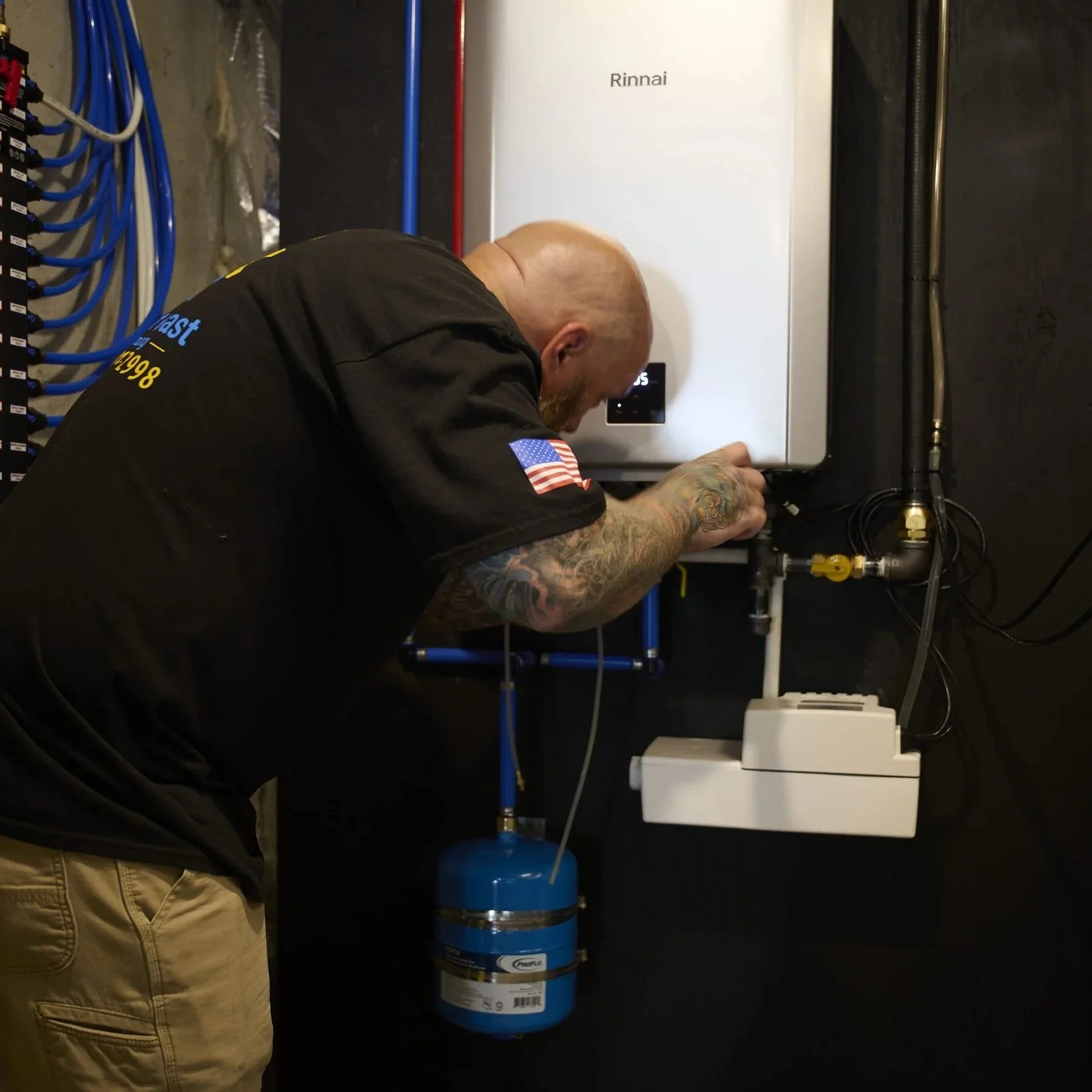
A thermal expansion tank is needed on any closed water system — one where a pressure-reducing valve prevents water from pushing back into the street main. When water heats up, it expands. On an open system, that extra pressure bleeds back out. On a closed system, it has nowhere to go. The expansion tank absorbs it. If your home has city water with a PRV on the line, you likely need one. Cost installed: $175 to $350.
A pressure-reducing valve (PRV) steps incoming municipal water pressure down to a safe operating range. Older homes sometimes have a PRV that's been in place for 20-plus years and no longer holds properly. When a new heater goes in and the plumber tests the system, a failing PRV gets flagged. Replacement runs $375 to $600.
Lead-free shutoff valves are required on potable water connections. If your existing shutoffs are old brass fittings that predate the lead-free standard, they get swapped out as part of the installation — typically $75 to $150. New temperature-and-pressure relief valve discharge piping sometimes needs extension or rerouting under current installation standards. Add $50 to $150 for that.
Together, these items can total $700 to $1,200 on a job that looked simple from the outside. They're not optional. A quote that omits them either isn't accounting for them or will find them mid-job.
Fuel type and what you'll pay every month afterward
The unit you choose today sets your utility bill for the next decade. Gas heats water faster and costs less to run than electric — typically 30 to 50 percent less per year, depending on local rates. For a family of four, that difference runs $15 to $40 per month. Electric tanks cost less upfront and don't require venting, which keeps the installation simpler. They are the right call for homes without gas service.
Heat pump water heaters work differently from either. Think of a refrigerator running backwards: instead of pushing heat out of a space, it pulls heat in from the surrounding air and uses it to warm the water. About one-third the electricity of a standard electric tank. The practical catch is space — they need roughly 700 to 800 cubic feet of air volume around them, plus ambient temperatures above 40°F year-round. A tight utility closet won't work. They do qualify for federal tax credits as of this writing, which can help offset the higher equipment cost.
Hard water speeds up wear on any tank heater. Scale builds on heating elements the way it coats the inside of a kettle that's never been flushed — it insulates the element from the water, forcing the heater to run longer to reach temperature. Efficiency drops. The element burns out sooner. Annual flushing slows that process down, but in areas where the water comes in with high mineral content, the useful life of the tank is shorter than it would be with soft water.
Emergency replacement vs. a planned one
When the tank fails on a cold weekend night, you're calling whoever picks up. Emergency service premiums run 20 to 40 percent above standard rates. Under that kind of time pressure, there's no opportunity to compare unit options carefully or get a second quote.
A planned replacement is a different experience. You catch it before the heater actually fails — while it's still running but clearly aging. You get multiple itemized quotes. You compare unit types. You schedule a weekday. For a typical gas tank replacement, the difference between an emergency weekend call and a scheduled weekday appointment runs $300 to $600.
The signal to start planning: a gas tank over 10 years old in an area with hard water. Inside every tank is an anode rod — a sacrificial metal rod that attracts corrosive minerals before they can attack the tank walls. It typically lasts 8 to 10 years in hard-water conditions. Once it's spent, the minerals go after the tank itself. By the time you see rust-colored water at the tap, the useful life is nearly over.
When repair makes sense vs. when it doesn't
Some calls that look like replacements turn out to be repairs. A heater that won't heat might have a failed thermostat or a burned-out heating element — a $200 to $400 fix. A unit leaking from a fitting rather than the tank body might just need a new connection.
But the calculation shifts fast once a tank hits a certain age. A gas tank has a useful life of 10 to 14 years. Spending $300 to $400 on a repair for a 12-year-old unit running in hard water isn't a savings — it's buying a few months. The next failure isn't far off, and you end up paying both the repair and the replacement within a short window.
Practical rule: if the unit is under 8 years old and the failure is a standard replaceable part, fix it. Over 10 years old — particularly where the water runs heavy with minerals — replacement is usually the better use of the money.
Frequently Asked Questions
A standard 50-gallon gas tank replacement runs $1,500 to $3,000 fully installed, including permit and disposal of the old unit. Electric tanks run $1,200 to $2,500. Gas tankless installations start around $3,500 and can reach $6,500 or more when infrastructure upgrades are needed.
Unit type and installation complexity are the two biggest variables. A quote given over the phone without a site visit is essentially a guess — the plumber can't see how accessible the unit is, what the existing connections look like, or what code-compliance items will be needed. Quotes that differ significantly often include different items: one may cover code upgrades, disposal, and permit fees; another may not.
A thermal expansion tank is a small vessel, roughly the size of a football, connected to the cold water supply line near the water heater. On a closed water system — one with a pressure-reducing valve — heated water has nowhere to go when it expands inside the pipes. The expansion tank absorbs that pressure so it doesn't cycle back through the heater. Most homes with city water and a PRV need one. Installed cost: $175 to $350.
A straightforward gas or electric tank swap takes 2 to 4 hours. Add 1 to 2 hours if code upgrades are needed. Gas tankless installations typically run 5 to 8 hours. Electric tankless installations that require a panel upgrade may take two visits.
It depends on how long you plan to stay and what your hot water usage looks like. A gas tankless unit lasts 18 to 22 years compared to 10 to 14 for a tank, meaning one fewer replacement cycle over 30 years. Energy usage runs 20 to 30 percent lower. The math generally favors tankless for homeowners planning to stay in place for at least 10 years — less so for a home being sold in the near term.
Brand matters mainly through warranty length and parts availability. Standard tank warranties run 6 years; some manufacturers offer 9 or 12 years at a premium. In hard-water conditions, warranty length matters more because scale accelerates wear. Ask your plumber which brands they service regularly and which ones they've seen fail early — field experience tells you more than spec-sheet comparisons ever will.
Replacing a water heater is rarely as simple as swapping out a box. The price depends on the type of unit going in, the existing plumbing, how accessible the space is, and any code upgradeanyquired for the required for installation. Hoacross Montgomery, Berks, Bucks, and Lehigh Counties deal with older housing stock, hard water, and closed water systems that almost always involve at least one or two add-ons. The contractors who quote accurately account for all of it upfront.
