
It's 6 a.m. on a January morning. The temperature outside dropped to 4°F overnight. You turn on the kitchen faucet and nothing comes out. You try the bathroom. Nothing. Then you hear it — a hiss from somewhere behind the drywall, and a dark stain starts spreading across the ceiling below the second-floor bathroom. The pipe didn't freeze and stay frozen. It froze, the pressure built, and something gave way.
The call we get most often after a freeze event is some version of the same question: "Why did my pipes burst when my neighbor's didn't?" The answer usually comes down to two things — where the pipes run, and what they're made of.
Not every pipe material behaves the same way in freezing temperatures. Some crack clean. Some split down the length. Some swell at the fittings. And one type common in older homes around here fails in a way that catches most people off guard. Here's what you need to know.
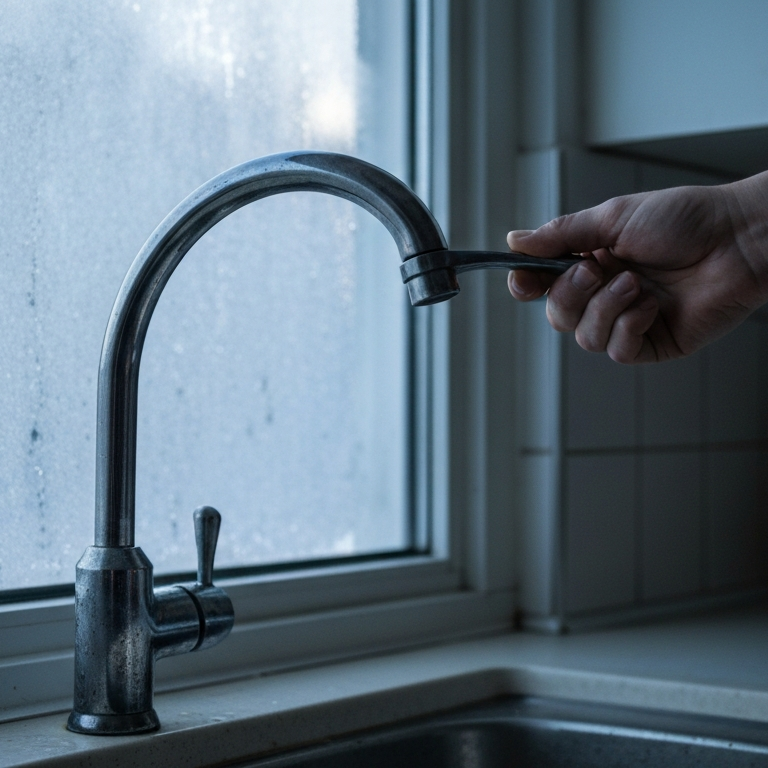
How a pipe actually bursts — it's not what most people think
Most people assume the ice tears the pipe apart by expanding outward against the walls. That's not quite right.
What actually happens: ice forms as a plug on the inside surface of the pipe and grows inward until the cross-section is sealed. Then the plug grows along the length of the pipe, pushing the liquid water trapped between it and the nearest closed valve — a shut-off, a frost-free hose bib, a washer supply angle. Water can't compress. When the ice plug pushes against that trapped water, pressure spikes. The pipe fails at its weakest point, whether that's a thin wall section, a soldered joint, a corroded patch, or a fitting.
This is why location matters almost as much as material. A pipe that freezes completely with both ends open rarely bursts. It's the one that freezes on a run between two shut valves — with no room for that pressure to go — that fails.
| Pipe Material | Typical Failure Mode | Freeze Risk (new) | Freeze Risk (aged) |
|---|---|---|---|
| Copper | Longitudinal split or joint separation | High | High |
| Galvanized steel | Fracture at corroded section | High | Very high |
| CPVC | Shattering/cracking (brittle at extreme cold) | Medium | Medium–high |
| PEX | Fitting blow-off; pipe wall survives more often | Low | Medium |
Copper: the most common supply-line material, and the most vulnerable to freezing
Most supply lines in homes built between the 1950s and the 1990s are copper. It's a good material — durable, bacteria-resistant, and handles high water pressure without complaint. But two properties make it bad news in a freeze.
First, copper conducts heat extremely well. That's useful in your wiring. In your plumbing, it means the pipe loses warmth fast. A copper line in an uninsulated exterior wall cavity reaches 32°F well ahead of a plastic pipe in the same location.
Second, copper is rigid. When ice pressure builds against a copper pipe wall, the material doesn't flex or give. It splits — usually as a long longitudinal crack running several inches down the pipe. Sometimes the solder joint at an elbow or tee separates instead. Either way, when that pipe thaws, you have running water where you don't want it.
In older homes with hard water, there's a compounding factor: mineral scale deposits coat the inside of copper supply lines after years of use. That scale layer is brittle. It gives the ice pressure something to crack against and reduces the effective interior diameter, concentrating stress unevenly along the run.
Galvanized steel: the sleeper risk in pre-1960 homes
A lot of homes built before 1960 in this region still have their original galvanized steel supply lines. The outside of a galvanized pipe looks rough, dull gray-white. The inside is far worse: decades of rust, scale, and mineral buildup have narrowed the bore and left the inner walls pitted and weak.
Here's what happens in a freeze. Ice crystals form not just in the water column but inside the rust itself. The scale that lines the inside of the pipe is porous — water gets into those micro-gaps, freezes, and expands, physically prying the rust layer away from the pipe wall beneath it. The remaining wall, already thinned by corrosion, takes the full force of the ice plug pressure. When galvanized pipes fail from freezing, they typically fracture rather than split. The break is jagged, sometimes at a joint, sometimes mid-run at a corroded patch.
Galvanized steel has a service life of roughly 40 to 70 years under normal conditions. A pipe installed in the mid-1950s that has been handling hard well water for 70 years is at the end of that window. Freezing is often the event that triggers a failure that was already building from the inside.
CPVC: better than copper, but brittle in extreme cold
CPVC — chlorinated polyvinyl chloride — is the cream-colored rigid plastic used in many homes built between the 1980s and early 2000s. It has thicker walls than copper and withstands more internal pressure before bursting (roughly 1,250 psi versus what a thin-wall copper line can handle before cracking). It also loses heat more slowly, so it takes longer to reach freezing temperature in the first place.
In a moderate freeze event — temperatures dipping into the teens for one night — CPVC often comes through where copper fails. It expands slightly, which relieves some of the pressure from the ice plug, and its higher burst pressure means it can absorb more stress before cracking.
The problem is sustained extreme cold. CPVC and standard PVC both become brittle at very low temperatures. Think of it like a cold hot-glue stick — somewhat flexible at room temperature, but snap it on a cold day and it shatters cleanly rather than bending. If temperatures drop well below zero and hold there for an extended period, CPVC can shatter rather than split. The break isn't a crack — it's a section of pipe that's simply gone, and the damage is typically more extensive.
PEX: the most freeze-resistant option, with a real-world caveat
PEX — cross-linked polyethylene — is the flexible plastic tubing now standard in new construction and most repiping work. It earns that status for good reason. When a PEX supply line freezes, the tube can expand significantly before pressure causes a failure. In lab tests on new pipe, PEX consistently survives freeze events that copper would not. When PEX does fail in a freeze, it's usually the fitting at the end of the run that blows, not the pipe wall itself. Fitting failures are easier to repair and cause less water damage than a split pipe hidden inside a wall.
There's a caveat that doesn't get enough attention.
The freeze-resistance of PEX depends on its ability to stretch. That ability decreases as the pipe ages and the interior surface oxidizes from contact with chlorinated water — the same treated water that comes out of every municipal tap. Research published by the Plastics Pipe Institute found that a thin oxidized layer on the interior of an aged PEX pipe can reduce its elongation before breaking by 30 to 90 percent. A pipe that was highly freeze-resistant when installed 10 or 15 years ago may behave much more like a rigid material today.
PEX also can't expand freely when it's constrained — buried in a concrete slab, tightly packed in conduit, or strapped firmly to a joist with no room to move. In those situations, the expansion that protects the pipe is blocked, and it can fail at pressures more like a rigid pipe. This is one reason PEX failures turned up during the 2021 Texas freeze, a storm that was widely blamed on copper or cast-iron failures. Many of those PEX lines were encased in slabs with no room to flex.
None of this makes PEX a bad choice. It remains the most resilient option for freeze events, especially in newer installations. The point is that age changes the equation, and no material is automatically safe.
Where the pipe runs matters as much as what it's made of
The same copper pipe that runs safely through a heated interior wall can freeze and burst when it routes twelve inches through an exterior wall cavity with no insulation. Material is one variable. Location is the other.
The highest-risk plumbing locations — regardless of material:
Exterior wall cavities that open to an unheated space. Uninsulated crawl spaces with gaps in the foundation. Attic runs exposed to overnight outdoor temperatures. Supply lines running through an unheated attached garage. Hose bib supply lines on the north or shady side of the house.
Drain and waste lines — the dark pipes that carry water out of sinks, tubs, and toilets — are much less likely to burst from freezing. They drain by gravity and rarely hold standing water in the runs. It's the supply lines, always under pressure, always full, that fail.
Frequently Asked Questions
Copper is the most commonly burst pipe in residential freeze events. It's in more homes than any other material, it loses heat quickly, and it doesn't flex under pressure. Galvanized steel is a close second in older homes where corrosion has already weakened the walls.
More than you would be with copper, especially if the home is pre-1960 and you have hard well water. Rust-lined galvanized pipe fractures rather than splits, and the failure often happens at a section that looked fine from the outside. If your home still has original galvanized supply lines, it's worth having a plumber assess both the freeze risk and the overall condition of the piping before winter.
Yes. PEX is the most freeze-resistant of the common materials, but it's not immune. New PEX handles ice pressure much better than copper or galvanized. Older PEX, or PEX constrained in concrete, can fail in a significant freeze. When PEX does fail, it's usually the fitting that blows rather than the pipe wall — which is easier and cheaper to repair.
The standard threshold is around 20°F inside the pipe, but duration and airflow matter as much as temperature. A drafty crawl space at 25°F can freeze pipes faster than a still, sealed space at 15°F. A drop to 10°F for three hours is typically less damaging than a sustained 22°F for 18 hours with wind moving through the space.
Turn off the main water shut-off first. Don't try to force or thaw the pipe before you know what you're dealing with. If the pipe has a hairline crack that the ice is holding closed, you'll have a running water emergency the moment it thaws. A plumber can assess the situation safely.
Most standard policies cover sudden and accidental water damage from a burst pipe, but typically exclude freezing damage if the heat was off and the home was unoccupied. The exact terms depend on your policy. Document the damage thoroughly, call your agent, and get a plumber on site as soon as possible — delays in addressing the water damage can complicate a claim.
Pipe material explains a lot, but not everything. A copper line run through a conditioned interior wall will outlast a PEX line strapped to a rim joist eight inches from the exterior sheathing. If you want to know your home's actual freeze risk before next winter — or if you've had a freeze event and aren't sure whether surviving pipes are still trustworthy — the answer starts with knowing what's in your walls and where it runs.
