
You're sitting in the house after dinner, everything off, and there it is — a faint hiss or low gurgle somewhere in the walls. You check the faucets, the laundry room, the basement. Nothing's running. The sound keeps going anyway.
That sound has a source. Not a ghost, not the house settling. Water is moving somewhere it shouldn't be.
Here's how to track it down, starting with the most common cause and working toward the ones that need a plumber.
Quick Reference: What You Might Be Hearing and Where to Check First
| Sound | Most Likely Source | Where to Look | DIY or Plumber |
|---|---|---|---|
| Low hiss or trickling from bathroom area | Running toilet (flapper or fill valve) | Toilet tank — lift the lid | DIY if you can swap the flapper |
| Gurgle or drip from a specific wall | Hidden pipe leak or supply line | Water meter test first | Plumber if meter confirms |
| Intermittent running, 20–30 min intervals | Water softener regenerating | Basement or utility area | Normal — no action needed |
| Running sound from basement/utility room | Water heater, sump pump, or humidifier | Inspect each unit | Depends on source |
| Hissing under the floor | Possible slab leak | Water meter + shut off test | Plumber immediately |
| Constant low flow sound, no visible source | Hidden supply line leak | Water meter test | Plumber if confirmed |
Start with the Toilet — It's the Most Common Culprit
Check every toilet first. Don't skip this step.
A running toilet doesn't sound like a flush. Most of the time, a worn flapper or a faulty fill valve creates a quiet, constant hiss that travels through the floor joists and comes out sounding like water running somewhere in the walls. The tank drops, the fill valve kicks on, runs until it's full, shuts off — and the whole cycle repeats every few minutes without you ever hearing a full flush.
Here's what's actually happening: the rubber disc that seals the tank from the bowl warps or gets coated in mineral scale. Hard water in Berks and Montgomery Counties does this faster than softer-water regions — a flapper that might last five years elsewhere needs replacing in two. Water trickles past the seal, the tank drops below its fill line, and the fill valve starts up again.
To confirm it: drop a few drops of food coloring into the tank (not the bowl) and wait 10 minutes without flushing. Color shows up in the bowl, the flapper is leaking. New flappers cost a few dollars and swap in 15 minutes. But check the fill valve too — if the water never quite shuts off, the float may be set too high or the valve has worn out. If you have multiple bathrooms, check each one.
Check Faucets, Supply Lines, and the Water Heater
After the toilets, walk through and look at every fixture.
Faucets drip at the spout or seep around the base. Slow drips sound exactly like distant running water when the house is quiet. Check the kitchen, every bathroom, the laundry tub, and any utility sink you might have tucked in a corner.
Supply lines — the braided metal hoses under sinks and behind toilets — can develop slow seeps at the compression fittings. Older chrome or unbraided plastic supply lines are worse for this. Run your hand along each hose and feel for moisture.
The water heater's temperature-and-pressure relief valve can weep when pressure in the tank climbs above its set point. Water runs down the discharge pipe into a floor drain or bucket, and you may hear it without seeing it. Pull the discharge pipe slightly away from the drain and look inside.
If you have a water softener, check its timer. Most regenerate automatically overnight — 30 minutes to 2 hours depending on the model. Water flows through the unit and down the drain during that cycle. Normal operation, not a leak.
What the Water Meter Tells You
If toilets, faucets, and the water heater all look fine, go to the meter.
Locate it — usually in the basement near the front of the house, or in a curb box at the street. Before checking, shut off every fixture and appliance: dishwasher, washing machine, ice maker. Don't use any water for 30 minutes. Read the meter before and after. If the number changed while everything was off, water is moving through the system somewhere it shouldn't be.
Most modern meters also have a small leak indicator — a tiny triangle or dial that spins with any water flow at all. If you've confirmed the toilets aren't running and that indicator is still moving, the leak is somewhere else.
And here's a second test worth running. Shut off the main supply valve completely — usually at the point where the main line enters the house — and listen. If the sound stops, the leak is on the pressurized supply side inside the house. If it keeps going after you shut the main, you're likely dealing with a drain issue or a gravity-fed system like a humidifier.
Other Physical Signs That Confirm a Real Leak
The sound alone is concerning. Paired with any of these, it's something to act on today.
Warm or damp spots on the floor — tile, hardwood, anywhere — suggest a slab leak. Press your bare foot along the floor near the sound. A noticeably warm patch where there's no radiant heat system points straight at a pressurized hot water line below. A musty, wet-earth smell in that same room usually means water has been sitting inside the wall long enough to start breaking down what's behind the drywall.
Low pressure at one fixture that used to flow fine is another tell. If a supply line is losing water upstream, less pressure arrives at the faucet downstream. One sink running weak while the rest of the house flows normally? The problem's likely between that fixture and the meter. A water bill running more than 10–15% above your typical usage — with no change in how much you've actually been using — is the financial confirmation.
When the Sound Is Coming from Inside the Wall
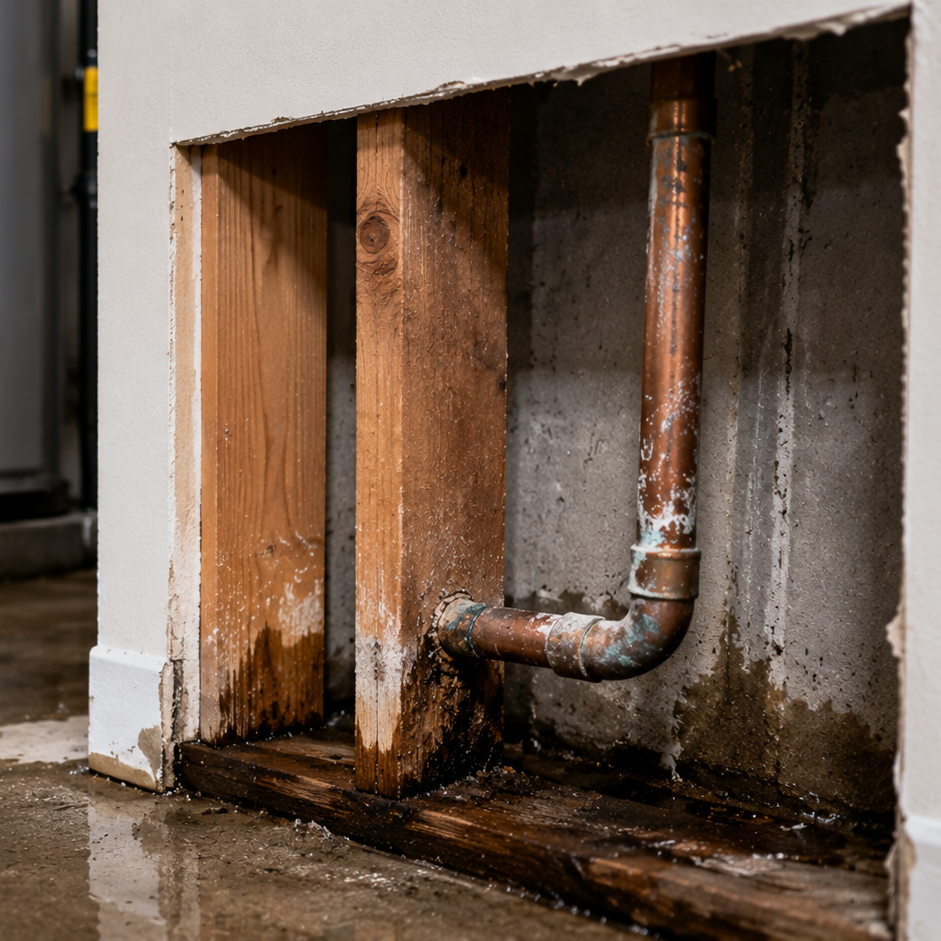
Sound travels through framing. A leak inside a wall can seem to come from several feet away from the actual pipe — the hissing you hear in the living room might trace back to a supply line running through the wall on the other side of the bathroom.
Supply lines inside walls in pre-1980 construction — galvanized steel, still common in older neighborhoods across this region — corrode from the inside out. The diameter narrows as corrosion builds up, and then pinhole failures open at the thinnest spots. A pinhole in a pressurized line produces a fine, constant hiss you can hear but can't see.
Still confirm with the meter first. Then let a plumber find it with the right tools before anyone opens a wall in the wrong place. Acoustic sensors amplify the sound of water escaping a pressurized pipe; thermal imaging cameras detect the temperature drop moisture creates (wet material reads cooler than dry); moisture meters measure water content in wall materials without piercing the surface. Together, they narrow the location to within a foot or two before any drywall comes off.
Keep in mind: not every wall sound is a leak. Copper pipes expand when the house heats up during the day and contract when it cools at night. That's a tick, click, or occasional pop — brief and intermittent. A continuous hiss or low gurgle that doesn't stop is different.
Less Obvious Sources Worth Checking
Some systems run water on a timer, and the sound can genuinely catch you off guard.
Whole-house humidifiers drain water during operation; a clogged drain line in the unit creates a backing-up sound. Ice maker fill valves cycle on their own schedule — if the valve is wearing out, it runs longer than needed. Irrigation zone timers often fire in the early morning when the house is quiet. That 15–20-minute burst of sound is just the system doing its job.
Sump pump cycling during a rain event is working exactly as designed. But a pump running for several minutes at a stretch during dry weather may have a failed check valve — water pumped out flows back down the discharge line into the pit, the pump kicks on again, and that loop produces intermittent running sounds from the basement.
If the Sound Is Under the Floor
Hissing that seems to come from underneath the floor rather than the walls is a different situation.
Think of pipes embedded in concrete like water lines frozen inside a solid block. The slab holds everything rigid, but it also traps any moisture from a leak and slows its spread to the surface. A small pinhole under a slab can run for weeks before a wet spot appears above it — and during that time, water saturates the substrate, undermines the concrete, and works toward the framing.
Slab leaks in this region often develop in older copper lines embedded in acidic soil — the corrosion attacks from the outside in, opposite of how galvanized pipe fails. Run the meter test, then call a plumber who handles leak detection. Caught early, it's a pipe repair. Running for months, it can need concrete cutting, subfloor work, and days of drying.
How Fast a Hidden Leak Adds Up
A pinhole leak can waste 2,500 to 3,000 gallons a month. A running toilet cycling every 10 minutes wastes 25 to 50 gallons a day. Neither one looks dramatic while it's happening.
But the higher cost is structural. Moisture inside a wall cavity creates conditions for mold within 48 to 72 hours. In pre-1980 homes with fiberglass batt insulation — common in older neighborhoods across this area — the insulation holds moisture long after the pipe is fixed. By the time you find it, remediation can cost more than the original repair.
Frequently Asked Questions
Yes. A supply line leak inside a wall or under a slab can run for weeks without surface moisture appearing. The water disperses through concrete, insulation, and framing materials before it reaches a visible surface. The water meter test and listening for the sound with everything else off are your best early indicators.
Houses are quieter at night, so low-level sounds become detectable that you wouldn't notice during the day. A toilet that cycles every 15 minutes is generating the same sound all day — you just don't hear it over normal household noise. Some systems, like softeners and humidifiers, also run on nighttime timers, which can account for sounds that seem to appear after midnight and stop by morning.
Normal water hammer or thermal expansion sounds are typically brief — a knock, click, or pop as pipes shift. A hissing, rushing, or continuous dripping sound that doesn't stop is not normal. Neither is a low gurgle that persists for more than a few minutes with everything turned off.
Don't wait. A confirmed hidden leak — one where the meter test shows movement with everything off and you can't locate the source yourself — should have a plumber looking at it within a day or two. Moisture damage gets worse fast. The longer water runs in a wall or slab, the more the repair scope expands.
Worth spending 45 minutes checking before this turns into a drywall job you didn't budget for. Start with the toilets. Run the meter test. If both confirm something is wrong, and you can't find the source, call a plumber with those test results ready — knowing the meter moved with everything off tells them exactly where to start
