
It's early January, temperature has been sitting in the teens overnight, and you turn on the kitchen faucet. Nothing comes out. Not even a slow drip. You try the bathroom — same hollow silence.
You already know what this means.
A pipe has frozen somewhere in the house, and what you do in the next fifteen minutes matters more than anything that comes after. The frozen section itself isn't the main danger. The real problem is the pressure building in the liquid water trapped between the ice blockage and your closed fixtures. Move fast, but in the right order.
The quick-reference sequence
| Step | Action | Why It Matters |
|---|---|---|
| 1 | Open every affected faucet | Releases pressure so water has an exit when ice melts |
| 2 | Locate the frozen pipe | Find the cold section before applying heat |
| 3 | Check for signs of a burst | Cracked pipe means main shutoff first |
| 4 | Apply gentle heat, faucet-end first | Prevents pressure buildup behind thawing ice |
| 5 | Watch for flow to return | Confirms the blockage is clearing |
| 6 | Inspect everything after thawing | Hairline cracks open wider once pressure's back |
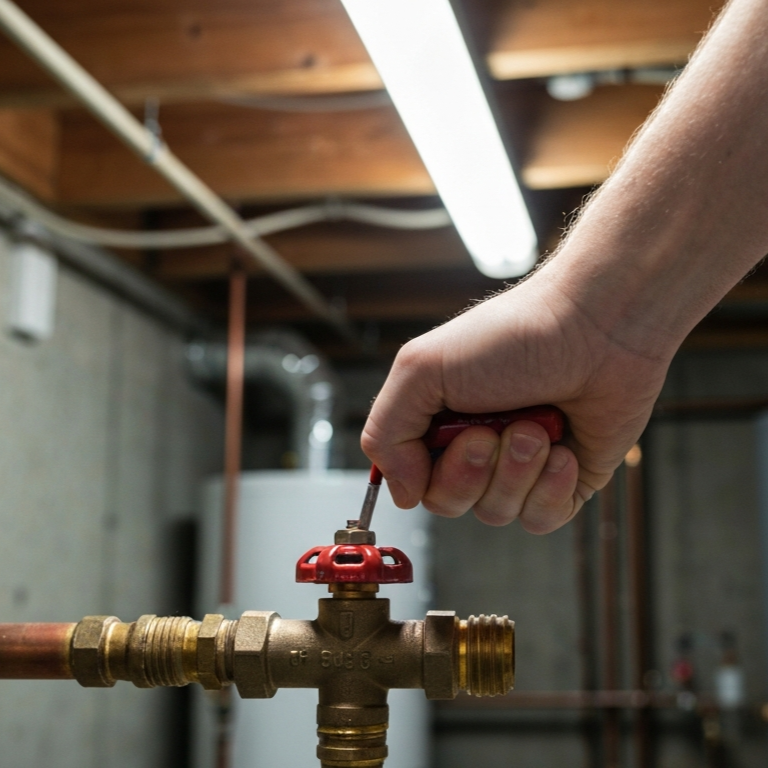
Open the faucets before you do anything else
This is the step most people skip. It's also the most important.
When a pipe freezes, the water turns to ice at the coldest point — usually along an exterior wall, in a crawl space, or where the supply line comes in through the foundation. That ice blocks flow, but it also traps liquid water between the blockage and whatever closed valve or fixture is downstream. As that trapped section cools further and starts to freeze too, pressure climbs inside the pipe wall. Think of it like sealing both ends of a garden hose and then squeezing the middle — the pressure has nowhere to go.
Opening the faucet gives it somewhere to go. Water and steam escape through the fixture instead of through a crack in the pipe. Do this before you touch anything else.
Turn both handles if it's a two-handle faucet. And check other fixtures on the same branch — if one pipe is frozen, anything running through the same cold zone is likely in the same condition.
Find the frozen section
Once the faucets are open, figure out where the pipe froze.
In older homes, the vulnerable spots are predictable. A huge portion of the housing stock in eastern Pennsylvania dates to pre-1980 construction, and plenty of those houses have supply lines running through exterior wall cavities that were never insulated worth a damn. The main supply line where it enters through the foundation is always suspect. Same with any pipe that runs through an unheated crawl space, an attic chase, or under a kitchen or bathroom sink on an outside wall.
On exposed pipes, look for frost on the surface, a section that feels noticeably colder than the rest, or a visible bulge where expanding ice has pushed out on the pipe wall. That bulge is bad news — more on that in a minute.
But if the frozen section is behind a finished wall and you can't find it, that's where this becomes a plumber job. Don't start cutting drywall blind hoping to stumble onto it.
Check whether the pipe has already burst
Before applying any heat, look carefully at every visible section of pipe near the suspected freeze.
A pipe that's already cracked may not show water yet. The ice is still plugging the breach from the inside. The moment that ice starts to melt, water pushes through whatever opening the pressure created. You need to know what you're dealing with before the heat goes on.
Signs the pipe has already burst:
- A crack, split, or visible separation in the pipe body
- Bulging or deformation along the pipe's length
- Water stains, soft spots, or new damp patches on nearby walls, floors, or ceilings
- Discoloration or swelling in ceiling tiles directly below a pipe run
If you see any of that, shut off the main water supply to the house before you do anything else. Thawing a burst pipe with the water on turns a contained problem into a flood. Get the main off, then call a plumber.
How to thaw an accessible frozen pipe
If the pipe looks intact, you're clear to thaw it. The method is simple: gentle heat, starting at the faucet end and working back toward the blockage.
Starting from the faucet end matters. When you warm the pipe closest to the fixture first, melt-water has a clear path out through the open faucet. If you start in the middle of the ice instead, you can create a new sealed section with liquid water on both sides — and the pressure problem starts all over again.
A hair dryer handles most situations well. Point it at the pipe, keep it moving, don't let it sit on one spot. An electric heating pad wrapped around the pipe works for sections that are awkward to angle a dryer toward — secure it, plug it in, and check on it every few minutes. Warm towels soaked in hot water work in a pinch, though they cool fast and need to be refreshed.
Keep the faucet open the whole time. When flow starts returning — first as a trickle, then building back to normal pressure — you'll know the blockage is clearing. Don't turn the water off until you've run it for a few minutes and confirmed no leaks are developing.
If the pipe is behind a wall
For a frozen pipe you can't reach, warm the room rather than the pipe.
Raise your thermostat. Open cabinet doors under any affected sinks so warm air can get into the wall cavity behind them. Set a space heater to raise the temperature in the room where the frozen section runs. This is slower — it can take several hours in a cold house — but it's safer than cutting into walls and applying direct heat to pipe you can't fully see.
Don't leave a space heater running unattended in a closed room overnight.
If you've had the house above 65 degrees for three or four hours and water still isn't coming back, the freeze is likely in a location with no real heat access — a vented crawl space, a section of exterior wall with no insulation at all, or somewhere the cold air has been pushing in from a gap in the foundation. At that point, call a plumber.
After the pipe thaws — don't walk away yet
Full flow is back. You're not done.
Inspect every joint, fitting, and valve near the section that froze. Let the water run for a few minutes and watch closely. A pipe that froze without bursting can still have hairline cracks that were too small to notice but open up once normal pressure returns. Wet spots on walls, bubbling paint, a sour smell in the days after a thaw — all of those point to a slow leak working its way through.
Check the floor below the pipe run, too. Wet insulation doesn't dry on its own and can harbor mold for months.
Frequently Asked Questions
It depends on how cold the surrounding space is. If your house is above 60 degrees and the pipe is in a partially conditioned area, a mild freeze may clear in a few hours. If the pipe is in an unheated crawl space or pressed against an uninsulated exterior wall with outdoor temperatures still well below freezing, waiting it out isn't realistic. Apply heat or call for help.
If you see any sign of a burst — cracks, bulging, water stains — yes, get the main off immediately. If the pipe looks intact, leave the water on and open the faucet. Moving water helps during thawing, not hurts.
No. Pouring boiling water directly onto cold metal or PVC creates a sudden temperature shock that can crack a pipe that wasn't broken yet. It's also a burn risk and turns the floor into a mess. Use electric heat.
A frozen pipe has an ice blockage but no breach in the pipe wall. A burst pipe has a crack or rupture, often still plugged by ice. The difference matters because thawing a burst pipe with the water on releases water immediately. When in doubt, shut off the main first and examine the pipe under good light before you apply any heat.
Pre-1980 construction often put supply lines in exterior wall cavities with minimal insulation — sometimes none at all. Add air infiltration through gaps at the rim joist and foundation sills, and you've got cold air in direct contact with copper or galvanized pipe on the coldest nights. Eastern Pennsylvania's hard freeze-thaw winters stress those older runs repeatedly over the years. It's not that the pipes are weaker; it's that they were installed in spots that never anticipated real insulation.
Call a plumber if you can't locate the frozen section, if you see any sign the pipe has burst, if multiple fixtures on different floors lose water at the same time, or if flow doesn't return after several hours of steady warming. A pipe that freezes in the same spot every winter is also a routing problem, not just an insulation problem — and that's worth having someone look at properly before next season.
The frozen section will eventually thaw. The question is whether the pipe survives it whole or opens up and turns your basement into a pond.
