
Pipe Burst? Do These 5 Things Before the Plumber Arrives
It's usually late at night. You hear something — not a drip, but a rush. You follow the sound to the basement and find water sheeting across the floor from a copper elbow that split at the joint. Or you come home from work and the kitchen ceiling is sagging and brown-stained, bowing toward the floor.
A burst pipe doesn't give you time to think. What you do in the next five to ten minutes determines whether you're looking at a few hundred dollars in pipe repair or a full remediation project that opens up your walls, replaces your subfloor, and takes weeks to sort out.
The pipe break is already done.
What matters now is stopping the water, staying safe, and protecting the house until a plumber gets there.
Quick reference: burst pipe checklist
| Step | What to do |
|---|---|
| 1 | Shut off the main water supply valve |
| 2 | Cut power to affected rooms at the breaker |
| 3 | Open nearby faucets to drain remaining pressure |
| 4 | Remove standing water — towels, buckets, wet-dry vac |
| 5 | Photograph everything before you clean up |
| 6 | Call an emergency plumber |
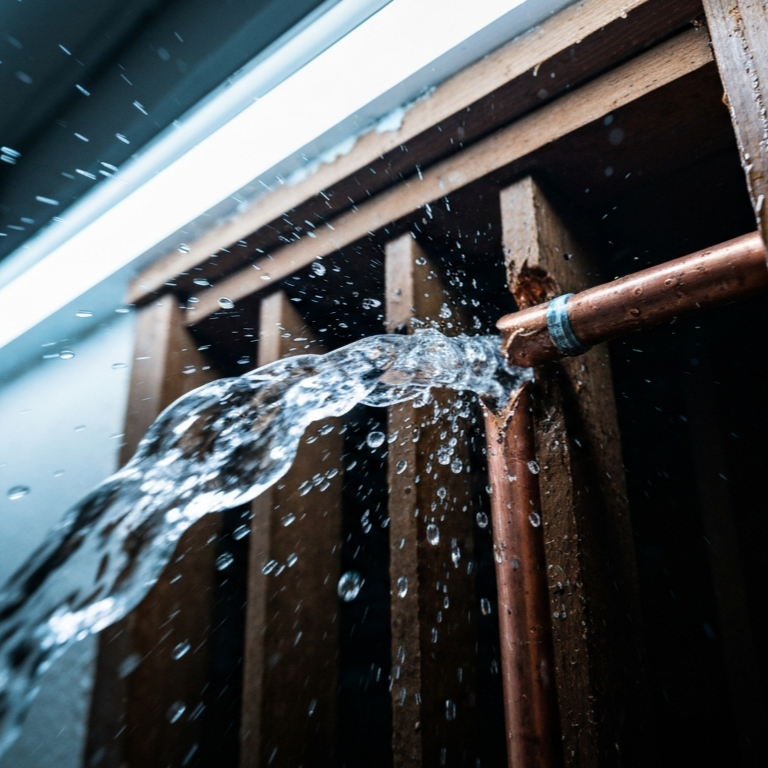
Shut off the main water supply — right now
Every second the main stays open, pressurized water is moving into the house. A half-inch supply line at normal residential pressure — 50 to 70 psi — can push around 50 gallons per minute through a break. A one-inch line moves more than 200. That's not a slow seep you'll mop up later. That's a flood.
The main shut-off valve is usually near the water meter, along the foundation wall where the supply enters the house, or inside a crawl space. In many pre-1980 homes in this region, it's an older gate valve — a wheel handle you turn clockwise until it stops. Newer homes typically have a ball valve with a lever that rotates 90 degrees to close.
After you turn it, open a cold water faucet nearby. Pressure should drop and water should slow to a trickle within a minute as the lines drain down. If water keeps running hard, you may have found the wrong shutoff — there's also a meter-level valve at the curb, which requires a utility key from any hardware store.
Cut the power to affected areas
Water and electricity don't mix — and they don't warn you first. Basements, laundry rooms, utility areas, and kitchens all tend to have outlets, appliances, and wiring close to floor level. That's exactly where the water goes.
Shut off the breakers for any room with standing water. If you can't tell which circuits serve the wet areas, shut off the main breaker. Do it from a dry spot with dry hands. Keep your feet on dry ground.
If the panel itself is in the wet zone, or if you see sparking or smell burning near the electrical equipment, don't touch it. Get out and wait for help. Some situations need an electrician before they need a plumber.
And don't plug in fans or a wet-dry vac until the area's confirmed dry and power is off.
Open the faucets and let the lines drain
Closing the main valve stops the incoming flow, but water is still sitting in the supply lines under whatever pressure remains. Open the cold water taps closest to the burst. Then open the hot-water taps too — that draws water down through the heater lines and relieves pressure on both sides.
Leave the faucets open until the plumber finishes the repair. This lets trapped water drain out rather than force through some other weakened joint you don't know about yet. A plumber can cut and resolder a drained line far more cleanly than one with water still pushing behind it.
Contain the water and protect what you can
The supply is off, but whatever got in is still on the floor — soaking into baseboards, climbing into drywall, wicking through the subfloor. Every minute it sits, it goes deeper.
Move electronics, furniture, and rugs to a dry area. Lay towels along door thresholds to block water from spreading into adjacent rooms. A wet-dry shop vac pulls up standing water faster than anything else — empty the tank often, because it fills faster than it seems. Buckets and mops are slower, but they work.
Open interior doors and cabinets. Airflow into wall cavities and under counters slows how deep the moisture penetrates. If the temperature outside is above freezing, crack the windows.
Water damage restoration averages around $3,500, and that figure rises fast once moisture sets in behind walls. How quickly you get water off surfaces is the single biggest variable in where that number lands.
Document the damage before you clean
Before you grab a mop, take photos and video. Walk through the wet space and capture water on floors, soaked drywall, stained ceilings, damaged belongings. Get a shot of the burst pipe if you can reach it safely.
This matters if you file a homeowners insurance claim. Adjusters want to see the damage at its worst — not after you've already pulled wet carpet and run fans for two days.
Signs the burst is behind a wall or under the floor
Not every pipe burst announces itself with a visible spray. Sometimes the first clue is paint that starts bubbling on a section of drywall. Or a patch of flooring that's soft and warm underfoot with no obvious spill source. Or a ceiling that develops a slow stain in one corner.
A sudden drop in water pressure — normal flow that drops to a trickle without explanation — can mean water is escaping somewhere in the supply system. So can a water meter that keeps moving after you've closed the main and turned off every fixture in the house.
Tell the plumber what you noticed: where pressure dropped first, which fixtures lost flow, any soft floor patches or stained wall sections. That information narrows down where to look before anyone cuts into drywall.
What not to do while you wait
Tape, putty, rubber patches, and pipe repair clamps don't hold on a pressurized supply line. At 50 to 70 psi, most of them fail within minutes. Skip them.
Don't turn the main back on to test whether the pipe is still leaking. That re-pressurizes the system before the break is isolated, and it restarts the flooding.
Don't use power tools or appliances near standing water, even if you think the breaker for that room is off. Verify the floor is dry before you roll anything electrical in.
And don't skip calling a plumber because the leak seems contained. A burst pipe rarely fails in isolation — the same freeze event or pressure spike that blew one joint may have stressed the joints next to it. A plumber will pressure-test the repaired section and check the surrounding system before turning water back on.
What the plumber actually does when they arrive
First thing: confirm the main is off, then trace the break back to its source. Supply-line failures don't always show where the water came out — water travels along framing, runs down studs, and drips several feet from the actual burst.
The repair means cutting out the damaged section and fitting new pipe. In copper systems, that's a sleeve soldered at both ends. PEX uses push-fit or crimp fittings that don't need heat. After the repair, a plumber will check neighboring joints and fittings — especially anything in the same wall or that shared the same freeze event. Then pressure is restored slowly and the line is checked for leaks before the job is done.
Frequently Asked Questions
In most homes it's along the foundation wall closest to the street, near where the supply line enters — often in the basement, crawl space, or a utility room, sometimes near the water heater. If there's no indoor valve, there's a curb-side shutoff at the meter box in the sidewalk. That one requires a meter key tool, available at any hardware store for a few dollars.
Yes, any time standing water is near outlets, appliances, or a breaker panel. Shut off the breakers for the wet rooms — or the main breaker if you can't isolate them. Stand in a dry spot with dry hands. If the panel itself is in the flooded area, don't touch it.
On a low-pressure drain line, a clamp might buy you a few hours. On a pressurized supply line at 50–70 psi, don't count on it. The correct fix is cutting out the burst section and replacing it. Leaving a patch in place gives you false confidence while moisture keeps building inside the wall.
A half-inch supply line at normal residential pressure puts out roughly 50 gallons per minute. A one-inch line can move more than 200. A pipe that runs for 10 minutes before you find it can drop several inches of standing water in a basement. Time between the burst and the main shutoff is what matters most.
Most standard policies cover sudden, accidental discharge — a pipe that fails without warning. They typically don't cover gradual leaks, water entering from outside, or damage from a pipe you knew about and didn't address. Document the damage before cleanup and call your insurer once the plumber has assessed it.
Freeze-thaw stress is the most common cause in this region. When temperatures drop below 20°F and hold there, water in uninsulated supply lines — in exterior walls, crawl spaces, garages, and rim-joist areas — freezes and expands. The burst happens because that expansion works like pressing a thumb over the end of a garden hose: pressure builds between the ice plug and the closed fixture downstream until the weakest joint gives. In older homes with original galvanized or cast-iron supply lines, corrosion is the other factor — the pipe wall has been thinning for decades, and a hard freeze is enough to open it.
Shut off the main. Kill the power in the wet zone. Open the faucets and let the lines drain. Get water off surfaces as fast as you can, photograph the damage, and get a plumber on the way. The pipe repair needs a licensed hand — but how much damage reaches your walls, floors, and belongings while you wait is mostly up to you.
