
You walk into the ground-floor restroom before the morning rush, and the last stall is already running. Nobody has been in the building since closing. The sound is a thin, steady hiss — almost like a faucet cracked open just a fraction — but it hasn't stopped in hours. By the time you do the math, a running flushometer can push through 750 to 1,000 gallons of water in a single 24-hour period.
Commercial toilets fail quietly. A leaky tank toilet at home is loud about it — water rushes, the fill valve cycles, things overflow. A commercial flushometer that won't fully close produces a hiss that blends straight into the background noise of a busy building. A lot of facility managers find out there's a problem when the water bill arrives, not when they first hear the toilet.
The fix is usually straightforward. But knowing which component is failing makes the difference between a $20 cartridge swap and replacing hardware that was working fine.
| Symptom | Most Likely Cause | Urgency |
|---|---|---|
| Constant hissing after flush | Worn flushometer diaphragm or cartridge | Medium — wastes water daily |
| Water runs in 30-second cycles, stops, restarts | Stuck piston or relief valve | Medium |
| Weak flush followed by a slow trickle | Debris in the valve seat | Medium — easy fix |
| Water running from tank rim, possible overflow | Float valve stuck open | High — flooding risk |
| Running only in early morning or late evening | Building pressure surge | Low — monitor first |
| New installation, never stops | Improper pressure adjustment | Low — recalibrate first |
Why commercial toilets work differently from residential ones
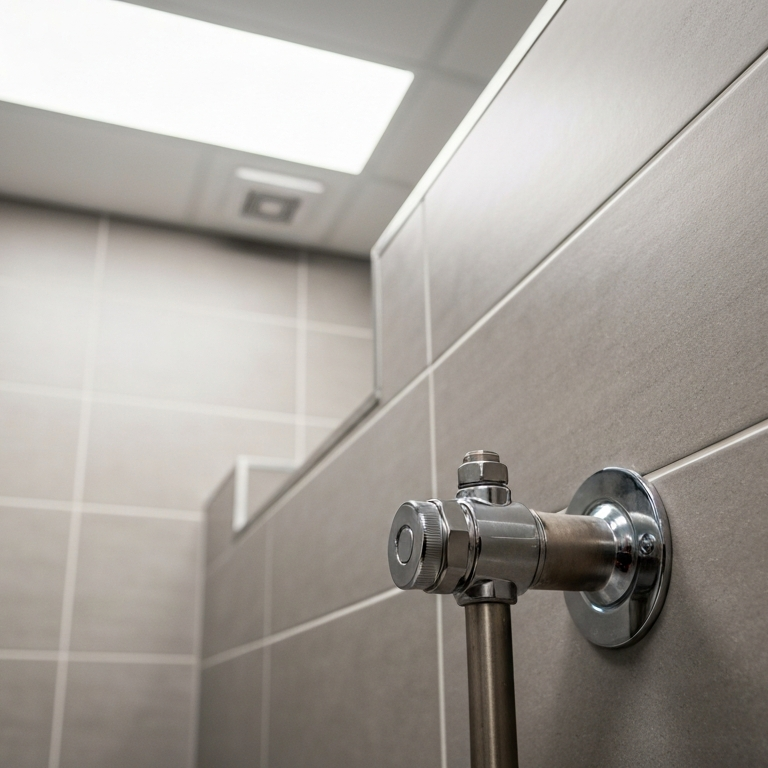
Most commercial toilets don't have tanks. Instead of a ceramic tank that sits above the bowl and fills slowly between uses, a commercial restroom runs on a flushometer — a valve mounted directly to the supply pipe that delivers a metered burst of water, then closes. When it's working, the valve opens, sends exactly enough water to clear the bowl, and seals shut until the next flush.
No tank to crack, no recovery time between flushes, and enough pressure to do the job in a busy restroom. The trade-off is that the diaphragm and piston inside the valve do real work all day. They cycle constantly, handle higher pressures than anything in a house, and in buildings with older supply lines, they absorb whatever pressure swings the building throws at them.
When a flushometer doesn't fully close, water moves through the valve constantly — either a slow trickle into the bowl or a bypass stream draining into the waste line. Neither shows from outside the stall. Both are running up your water bill every hour.
The diaphragm cartridge: what fails and why
The most common cause is a worn or damaged diaphragm. Picture a flexible rubber gasket sitting between the inlet and outlet ports inside the valve. When you push the handle, a small bypass hole in the diaphragm lets pressure equalize, which allows the main valve to open. Once the flush cycle finishes, the diaphragm reseats and blocks flow.
That seal depends on two things: the bypass hole staying clear and the rubber staying pliable enough to close flat against the seat. Hard water in Berks and Montgomery Counties is hard on both. Mineral scale — the same calcium deposits that cake the inside of a teakettle — slowly coats the bypass hole and the valve seat. The diaphragm can't close flat anymore, so water finds the gap.
A Sloan or Zurn replacement cartridge costs $10 to $20 at a plumbing supply house. The work is quick. Shut the water to the fixture, pull the valve cover, swap the cartridge, flush clean. What drags it out is when maintenance has been tightening the handle or swapping random parts for months without figuring out which component actually failed.
Debris in the valve seat — the fastest fix
Before ordering a cartridge, check for debris. A piece of pipe scale, grit, or pipe dope caught in the valve seat will hold the diaphragm open even if the cartridge is fine. This shows up constantly in older buildings with galvanized or cast-iron supply lines — scale breaks loose during pressure changes and travels to the nearest small orifice. The weep hole in the diaphragm is usually the first place it lands.
Here's the test: shut the water supply to the toilet, take apart the flushometer bonnet, pull the diaphragm out, hold a rag over the inlet port, and briefly open the supply to flush whatever's sitting in the seat. Reassemble and check. If the running stops, you just solved a $200-per-month water waste problem for free.
But if debris comes back a few weeks later, the issue is upstream. Corroded supply lines are shedding scale into every fixture on that branch, and the valve is just the first thing catching it.
One more thing worth checking before ordering parts: the handle assembly. If the push button or lever doesn't return fully to neutral after a flush, the valve stays cracked open. The toilet runs because it was never told to stop. Pull the handle back to the center manually and listen for the hissing to stop. If it does, the handle mechanism needs adjustment or replacement — not the diaphragm.
And if your building has sensor-operated automatic flushometers, there's one more component in the chain: the solenoid valve. The sensor detects when someone steps away and triggers the solenoid to release the flush. A solenoid stuck in the open position produces the same constant-running pattern as a worn diaphragm but won't respond to a cartridge swap. If replacing the diaphragm doesn't fix it, the solenoid assembly is next.
Piston-style valves: when the piston sticks
Older commercial buildings sometimes have piston-type flushometers instead of diaphragm cartridges. Where a diaphragm uses a flexible disk, a piston-style valve uses a cylindrical plunger with O-rings that slides up and down to control flow.
Piston O-rings wear faster than diaphragms in high-cycle restrooms. When they degrade, the piston stops sealing in the closed position and water bypasses continuously. The tell is a rhythmic pattern — water runs for about 30 seconds, briefly stops as relief pressure equalizes, then starts again. Not constant. Rhythmic.
Fixing a piston valve usually means replacing the entire internal assembly, not just a cartridge. On valves over 10 years old, replacing the whole valve body is often cheaper in the long run than sourcing internals for an older unit.
What water pressure does to a flushometer
A flushometer has a rated inlet pressure range — 15 to 80 PSI for standard commercial fixtures, up to 125 PSI for heavy-duty models. If the building's supply pressure runs above that range, the valve simply can't close against the inlet force. It stays open.
High-pressure problems tend to show up during off-hours. Overnight, on weekends, early mornings before the building fills up — whenever demand drops, line pressure rises. A toilet that runs between midnight and 6 a.m. and stops once the morning crowd arrives isn't a worn cartridge. It's a pressure problem.
The fix is a pressure-reducing valve on the supply line to the restroom, or an adjustment to the building's main PRV if the whole system is running hot. A pressure gauge at the fixture shutoff takes two minutes and tells you immediately whether you're in range.
Tank-style commercial toilets: the float and flapper
Not every commercial toilet is a flushometer. Smaller office suites, break rooms, and older commercial buildings sometimes use tank-style toilets — the same basic design as a residential toilet, just with a higher-flow fill valve.
In a tank toilet, a running problem almost always comes down to the flapper or the float. A flapper that doesn't seat fully lets water seep from the tank into the bowl nonstop. The float valve controls when the tank refills — if the float is set too high or the valve doesn't shut off when the float rises, water trickles in until it hits the overflow tube and drains continuously.
The dye test settles it fast: drop a few drops of food coloring into the tank and wait ten minutes without flushing. Color in the bowl means the flapper is leaking. Water sitting level with the overflow tube means the float is the problem.
How much water a running commercial toilet actually wastes
A flushometer hissing constantly loses somewhere between 1 and 3 gallons per minute, depending on how far open the valve is. At 1 gallon per minute, that's 1,440 gallons a day. At the commercial water rate in southeastern PA — roughly $0.008 per gallon — a single running toilet adds $11 to $33 per day to your water bill before sewer fees, which typically mirror the water rate.
A six-stall commercial restroom with one running flushometer, undiagnosed for two months, can add $1,300 to $4,000 to utilities for that space alone. The toilet isn't the expensive part. A cartridge and labor runs $75 to $200 per fixture. Waiting costs ten times that.
Frequently Asked Questions
Pressure. When the building empties and demand drops, municipal supply pressure rises. A flushometer rated for standard commercial pressure may not fully close against the higher nighttime line pressure. Testing the inlet pressure with a gauge at the fixture shutoff will tell you if you're outside the rated range. If you are, a pressure-reducing valve on the supply line to that restroom is the fix.
The mechanical work is straightforward — shut the water, unscrew the bonnet cap, swap the cartridge, restore flow. But in Pennsylvania, any work on the water distribution system in a commercial building falls under the scope of a licensed plumber. More practically: if the repair doesn't solve the problem and the running continues, having a plumber diagnose from the start is cheaper than going through several rounds of trial replacements.
In a high-use commercial restroom — a restaurant, a school, a medical office — a diaphragm cartridge typically lasts three to five years. In a lower-use setting like a small office, eight to ten years is realistic. Hard water shortens that range. Buildings with a water softener on the supply line see longer cartridge life, fewer valve failures, and less scale accumulation in the valve seat.
A diaphragm or cartridge replacement runs $75 to $150 in parts and labor for a single fixture. A piston assembly replacement is $150 to $300. If the entire flushometer valve body needs replacement — worn-out threading, cracked housing, or simply age — figure $250 to $500 per fixture for parts and labor. High-use institutional fixtures cost more.
It can be. Pennsylvania's commercial plumbing standards require that fixtures be maintained in good working order and not waste water continuously. In practice, the more immediate pressure is from the water utility — some municipalities in Montgomery and Berks Counties will flag high-use accounts for inspection if consumption spikes sharply. A running flushometer may also indicate a backflow risk if the inlet pressure drops and the valve can't maintain its seal.
Shut the water supply to the toilet completely. If the sound stops immediately, the issue is in the flushometer valve itself — the water was flowing through a valve that wouldn't close. If there's still movement or dripping after shutoff, the shutoff valve itself may be failing. And if multiple fixtures in the same restroom are running at once, the problem is more likely supply pressure or a shared branch issue than individual valve failures.
A running commercial toilet is almost never an expensive fix. It's an expensive problem to let sit. A $15 diaphragm cartridge can waste $1,000 in water in a month, and the only way to catch it is to listen for the hiss in a quiet building — or notice the line item on the water bill before it happens again next month.
