
Why Does Your Restaurant Run Out of Hot Water During the Lunch Rush?
Your dishwasher hit the lunch rush at full speed. Pre-rinse stations going since 11:45, a rack cycling every four minutes, and right around 12:15 someone at the three-compartment sink notices the hot tap is running warm. Not hot. Warm. By 12:30 it's barely above room temperature, and the commercial dishwasher isn't hitting sanitizing temp anymore.
This isn't a mystery. If your restaurant runs out of hot water during a rush — any rush — there's a mechanical explanation behind it. Usually it's not one thing. It's a combination of how the water heater was sized, how much scale has built up inside it, and how the recovery rate stacks up against what your kitchen actually pulls during peak service. The problem won't fix itself.
How much hot water a restaurant actually burns through
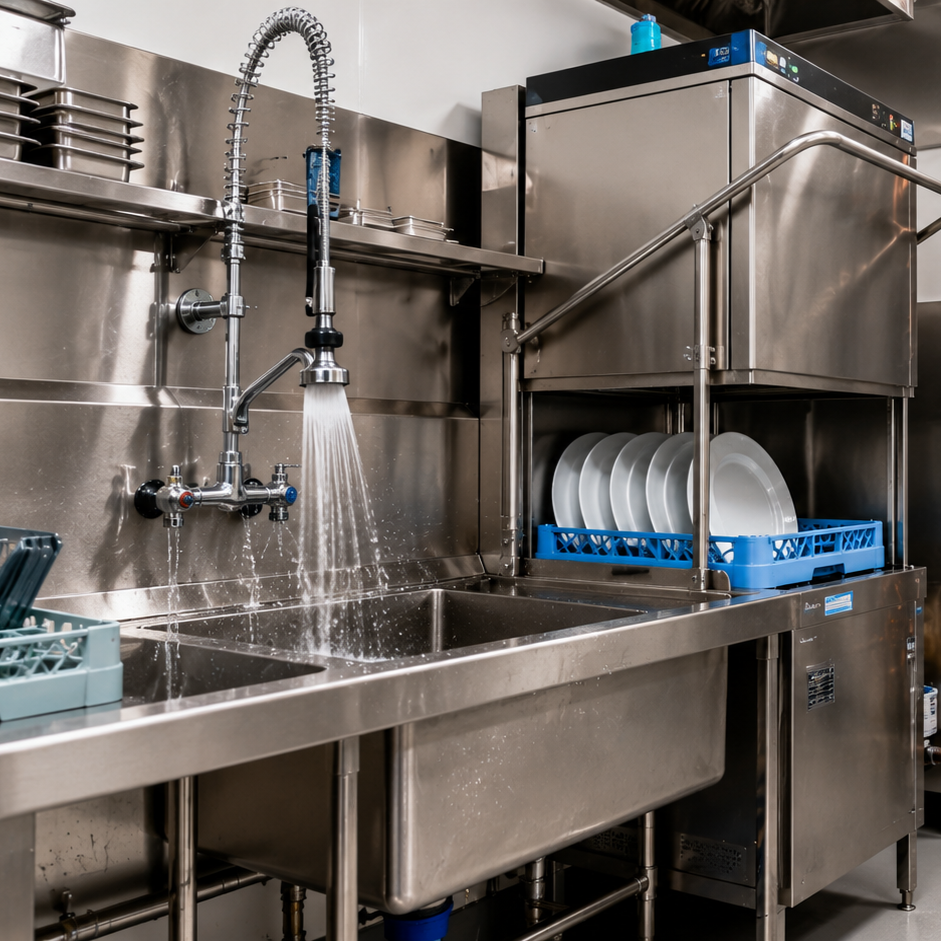
Simple math explains why a lunch rush drains a water heater so fast. Your kitchen runs multiple fixtures simultaneously — dishwasher, pre-rinse stations, three-compartment sink, handwashing — and each one pulls hot water at rates most restaurant owners never stop to add up.
| Fixture | Hot Water Demand |
|---|---|
| Commercial pre-rinse spray valve | 1.0–1.6 GPM (at 110°–120°F) |
| High-temp commercial dishwasher | 1–2 gallons per rack (at 165°–180°F) |
| Three-compartment sink (per fill) | 12–20 gallons per compartment |
| Handwashing stations (per shift) | 0.5–1.0 GPM cumulative across staff |
| Steam kettles / food prep equipment | Varies widely; up to 8–10 GPM peak |
Two pre-rinse stations and a high-temp dishwasher running at the same time can pull 4–6 gallons of hot water per minute. Run that for 45 minutes — a typical lunch rush arc — and you've consumed 180 to 270 gallons of hot water at or above sanitizing temperature. That number alone explains why a 100-gallon tank runs out before desserts are being plated.
The first-hour rating problem: your tank was sized for the wrong thing
Commercial water heaters carry two ratings: storage capacity (gallons in the tank) and first-hour rating, or FHR — how many gallons the unit can deliver in its first hour of operation from a full, hot start.
The FHR is what actually matters for a restaurant. It adds stored hot water to what the unit can heat during that first hour. A 100-gallon tank with a 200-gallon FHR can deliver roughly 200 gallons of hot water in the first hour of full demand — far more than the tank size alone suggests.
But here's where restaurants get burned. A water heater specified by square footage or seat count — instead of actual fixture demand — doesn't account for the specific equipment in your kitchen, how often your dishwasher cycles, or whether your three-compartment sink gets refilled twice during a rush. A restaurant pulling 270 gallons of demand from a system with a 180-gallon FHR will run dry before the rush is over. Every time.
Scale buildup is stealing your effective capacity
This one sneaks up on you slowly. In Pennsylvania's harder water counties — Berks and Montgomery in particular, where groundwater mineral content runs high — a commercial water heater accumulates calcium and magnesium scale on the tank walls and heating elements faster than in soft-water regions.
Scale does two things that directly cut your available hot water during a rush. First, it acts as insulation between the burner or element and the water, forcing the unit to work harder and longer to hit the set temperature. Second, heavy buildup at the tank bottom displaces water volume. A 100-gallon tank with three inches of sediment at the bottom might only deliver about 75 gallons of usable hot water — and that's with nothing else wrong.
Think of it like a kettle that's never been descaled. The water still heats up, but it takes longer every cycle, and the burner has to run harder to do it. Fine when demand is light. During a lunch rush, that extra lag time is the difference between making it through service and running cold at 12:30.
Draining and flushing the tank once or twice a year — more often in hard-water areas — is one of the cheapest maintenance tasks on the list. And one of the most skipped.
When the burner or heating element is the real problem
Scale and sizing explain most lunch-rush hot water failures. But failing hardware does happen. Gas-fired commercial water heaters rely on a burner assembly, thermocouple, gas valve, and thermostat all working together. If the gas burner is firing at reduced capacity — from debris in the orifice, a partially closed gas valve, or low incoming gas pressure — the recovery rate drops hard.
On electric commercial heaters, dual-element systems have an upper element and a lower one. The lower element does the heavy lifting on recovery. When it fails, the upper element picks up some slack, but the unit can't reheat a depleted tank anywhere near fast enough. The symptom looks the same every time: hot water at the start of service, a drop-off during the rush, and the unit never fully recovers between services.
A thermostat set too low causes the same problem without any failed parts. Commercial dishwashers and three-compartment sinks need water at 120°F or higher at the fixture. If your water heater is set to 110°F — something operators do to cut energy costs — you can't reliably get sanitizing-temperature water by the time it travels through the pipes to the fixture. Not every fix is a hardware replacement. Sometimes it's a calibrated thermostat adjustment.
The recovery rate problem: the tank refills slower than you drain it
Recovery rate is how fast the water heater can reheat a depleted tank back to set temperature. It's measured in gallons per hour for storage units, or continuous gallons per minute for tankless systems.
A commercial gas water heater with a 100-gallon tank and a 90,000 BTU input can typically recover at around 90–100 gallons per hour under ideal conditions. That sounds like enough — until your lunch rush is pulling water faster than the recovery rate can keep up.
Here's what actually happens inside the tank. It starts full and hot. As demand pulls hot water out, cold water enters from the bottom. The burner fires continuously trying to keep up. If demand outpaces recovery rate — even temporarily — the tank stratifies. Hot water sits at the top; progressively cooler water fills in below. The supply doesn't cut out all at once. It tapers. Water goes warm, then tepid, then cold, even though the tank still has water in it.
That's why restaurants sometimes report that their hot water "ran out" even though the plumber checked and found the tank half full. It was full of water that hadn't reheated yet.
Why a lunch rush is particularly hard on a water heater
Dinner service ramps up slowly. A 5 PM opening gives the water heater time to recover from afternoon prep before service peaks. A lunch rush is different — it compresses high demand into a short window, often before the tank has fully recovered from morning prep.
By the time breakfast prep, morning cleaning, and lunch setup are done, a commercial water heater may already be running at 60 or 70 percent capacity. The lunch rush then hits that partially depleted tank at full force. The math is worse than it looks from the outside.
Restaurants that have lunch-rush hot water problems but not dinner-rush problems are almost always dealing with this exact pattern: a tank correctly sized for a full overnight recovery before dinner, but not adequate for back-to-back demand starting at 10 AM. The problem isn't the equipment's peak output. It's the recovery window it never gets.
What actually fixes it
Start with the diagnosis. The fix depends entirely on which part of the system is failing.
If the water heater is simply undersized for your fixture count and service volume, you need replacement with a properly sized unit — calculated against your actual peak demand, not square footage or seat count. Adding a buffer tank in series with an existing water heater can extend effective capacity without full replacement, which is worth considering when the existing unit is still in good working condition.
Switching to a commercial tankless system eliminates the recovery-rate problem entirely. A properly sized tankless unit heats water on demand, so there's no tank to deplete. The tradeoff is gas supply capacity — a high-output commercial tankless unit may need a larger gas line than what's currently serving the water heater, which adds to installation cost. Worth running the numbers on both options before deciding.
If scale buildup is the culprit, a professional flush and descale can restore a significant portion of lost capacity on an otherwise functional unit. In hard-water areas like Berks and Montgomery Counties, pairing a storage water heater with a whole-building water softener or scale inhibitor slows the efficiency loss between service intervals.
Frequently Asked Questions
It depends entirely on your equipment. A restaurant with one commercial dishwasher, two pre-rinse stations, and a three-compartment sink can easily require 150–250 gallons of hot water during a 60-minute rush. The right sizing calculation starts with your actual fixture list, cycle frequency, and required delivery temperature — not a general rule.
Yes, and it's often the most cost-effective option when the existing water heater is still functional. A buffer tank in series with the main unit increases total stored hot water without full heater replacement. The main unit still needs adequate recovery capacity, though — a buffer tank extends what's stored but doesn't fix a failing burner or a worn element.
In high-mineral-content areas, flushing and descaling twice a year is a reasonable baseline. Restaurants with heavy daily demand should consider quarterly checks, particularly if they're not running a softener or scale inhibitor on the incoming supply line. Sediment builds up faster in units that cycle frequently under high load.
Most commercial kitchens run storage temperature at 130–140°F to account for heat loss through the pipes before water reaches fixtures. Delivered temperature at a commercial dishwasher connection should be 120°F minimum; high-temp sanitizing dishwashers require 150–165°F at the final rinse cycle. A licensed plumber can verify delivered temperatures at each fixture and adjust the thermostat accordingly.
Yes. If the gas supply line to the water heater is undersized, shared with multiple high-demand appliances, or dropping pressure during peak usage, the burner won't fire at full rated capacity. The result is a slower recovery rate that looks identical to a failing element or an undersized tank. A pressure test during peak operating conditions rules this out quickly.
A water heater past the 10-year mark that can't keep up with demand is usually a better replacement candidate than a repair target — especially if it has significant scale buildup, a history of element or thermostat replacements, or if it was never sized correctly for the kitchen load. Newer commercial units are substantially more efficient and can be sized to an accurate calculation from the start.
Running out of hot water mid-service isn't just an inconvenience — it's a health code problem. A dishwasher that can't hit sanitizing temperature, hand-wash stations running lukewarm, a three-compartment sink that can't hold proper rinse temp: any of those puts you at risk on your next health inspection. The fix is usually straightforward once you know which part of the system is actually failing.
