
You reach under the sink for the dish soap, and it hits you before you even open the cabinet — that flat, stale sulfur smell, the kind that makes you check whether something crawled behind the refrigerator and died. Or you've been running hot water for a few minutes when the smell drifts up from the drain, faint enough to ignore for a week, until suddenly it isn't. Your sink drains fine. Nothing looks wrong. But something definitely smells wrong.
Kitchen sink drains are one of the most common sources of hydrogen sulfide gas in a home. That rotten egg smell is exactly what hydrogen sulfide is — it's produced when bacteria break down organic material in an oxygen-starved space inside your drain, and your pipes give those bacteria a steady food supply every time you cook.
There are several reasons a kitchen drain smells this way. Which one you're dealing with changes what you do next — completely. Some clear up in ten minutes. Others point to something further down the drain line that no cleaner you pour down the opening will reach.
| What you're noticing | Most likely cause | Urgency |
|---|---|---|
| Smell only when running the disposal | Food and bacteria buildup in disposal | Low — clean first |
| Smell only with hot water, not cold | Water heater anode rod reacting with bacteria | Low-medium — flush or replace anode |
| Smell from a sink you rarely use | P-trap dried out | Low — run water to refill |
| Persistent smell from a sink you use daily | Biofilm or grease buildup in the drain line | Medium — enzyme cleaner or pro cleaning |
| Smell coming from every drain in the house | Blocked vent pipe or sewer line issue | High — call a plumber |
| Smell plus slow draining | Partial clog trapping organic matter | Medium — snake, hydro jet, or camera |
| Smell plus dampness or water stain inside cabinet | Cracked pipe releasing sewer gas | High — call a plumber |
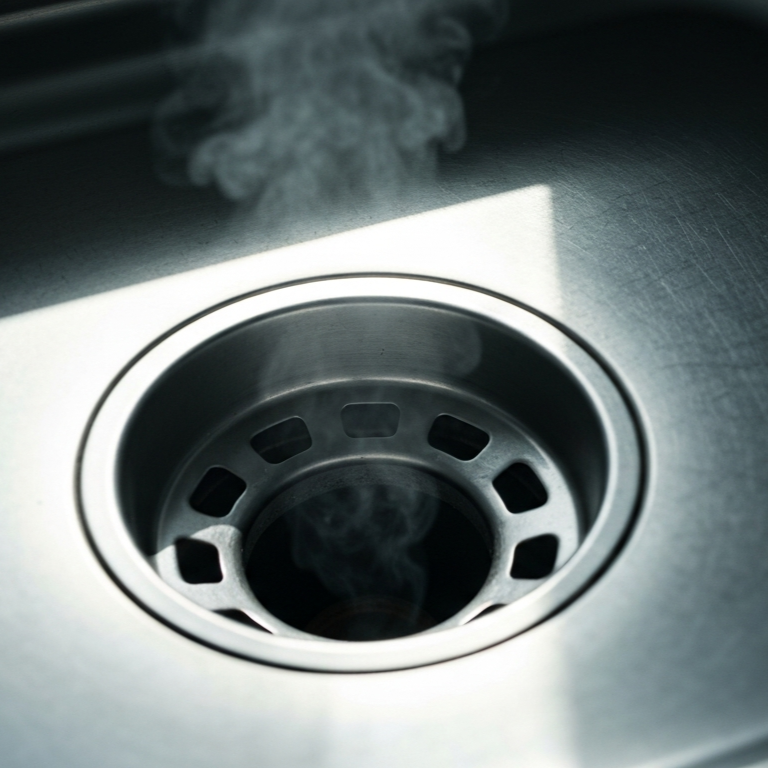
What that rotten egg smell actually is
Hydrogen sulfide is a colorless gas that sulfate-reducing bacteria produce when they break down organic material in an oxygen-starved environment. Your drain pipe — dark, damp, and fed with food particles and grease daily — fits that description almost perfectly.
The amount it takes to register is surprisingly small. Human noses pick up hydrogen sulfide at concentrations of a few parts per billion. A modest colony of bacteria sitting in a partial clog can make your whole kitchen smell like a sewer before you'd ever notice anything wrong with the drain itself. The gas rises through the drain opening once it builds up near the waterline in the trap.
The smell is information. It tells you bacteria are active somewhere in the drain system. Where they're active tells you what to do about it.
A dried-out P-trap is the simplest fix
The P-trap is the curved section of pipe directly under your sink — the U-shape you can see when you open the cabinet doors. It holds a few inches of standing water by design, and that water does one job: it physically blocks sewer gas from traveling up through the drain and into the room.
When a sink sits unused for a few weeks — a guest bathroom nobody touches, a basement utility sink — the water in the P-trap evaporates. Once it's gone, it takes the seal with it. Gas from the drain line rises freely, and without water in that trap, nothing stops it.
The fix is almost too simple: run the water for 30 seconds. That refills the trap. If the smell clears in a day or two, the P-trap was the whole story.
But if it comes back quickly after you've refilled it, the trap may have a slow leak, letting water escape faster than normal. Look for dampness at the compression fittings on either side of the U-bend. That's a straightforward repair — tightening or replacing the fittings — but it does need to happen, or the seal never holds.
Organic buildup and biofilm in the drain
A kitchen sink in daily use has the opposite problem. The drain handles grease, food scraps, soap residue, and hot water dozens of times a day. Cooking fat enters as a liquid and cools against the pipe wall, where it hardens into a sticky layer that catches every food particle following behind it. Think of the inside of an old teakettle that's never been descaled — scale builds ring by ring until the passage narrows. The grease layer works exactly the same way, except instead of mineral deposits, you're building a food-and-fat matrix that bacteria colonize and never leave.
When the bacteria fully move in, that buildup becomes biofilm. It's not just residue — it's a physical structure, a slick film of bacteria and their waste products coating the pipe wall. It processes organic matter continuously and releases hydrogen sulfide as a byproduct.
Enzyme cleaners are the right tool. They introduce bacteria that out-compete the odor-causing strains and digest grease without harsh chemistry. They're slower than chemical drain cleaners, but they actually remove the food source instead of just burning through the top layer.
One thing to know about baking soda and vinegar: it gets recommended constantly, and the fizzing looks satisfying, but it doesn't penetrate biofilm or dissolve grease. And in older cast-iron or galvanized steel pipes — common in pre-1980 homes across southeastern Pennsylvania — the acidic vinegar can accelerate corrosion at already-weakened spots. For older plumbing, enzyme cleaners are the safer call.
The garbage disposal: a built-in odor source
Garbage disposals are one of the most common sources of kitchen drain odor, and the reason is structural. The inside of a disposal has dozens of places where food can lodge — under the rubber splash guard, around the grind ring, in the housing cavity below the impeller plates. That food doesn't sit still. It decomposes, and the warm enclosed space speeds everything up.
The splash guard is the usual suspect. The rubber flap covering the drain opening traps food debris on its underside, which almost nobody cleans because it's out of sight. Lift it and you'll often find a film of decomposing matter you've been looking right past every time you do dishes.
To clean it properly: scrub the splash guard underside with a long-handled brush and dish soap, then grind a handful of ice cubes with cold water running to knock debris off the grind ring. Follow with lemon or orange peels to cut through the odor.
If the disposal isn't draining correctly — water backs up into the housing rather than moving through — the discharge line may be partially blocked. Cleaning alone won't fix that.
When the smell only happens with hot water
If the rotten egg smell is strongest when you run hot water but disappears with cold, the water heater is likely the source — not the drain itself.
Here's what happens: most tank water heaters contain a magnesium anode rod that corrodes sacrificially to protect the tank walls from rust. When water carries elevated sulfate levels, certain bacteria react with the anode rod and produce hydrogen sulfide. The hot water coming out of your tap carries that gas, and it smells like rotten eggs wherever the hot water exits — including your kitchen sink.
You can confirm this quickly. Fill a glass with cold water from the kitchen faucet and smell it outside, away from the house. Then do the same with hot water from the same faucet. If only the hot water smells like sulfur, the water heater is the source. Eastern Pennsylvania water, particularly in Berks and Montgomery Counties, tends to be mineral-heavy, and well water in those areas can carry enough sulfate to trigger this reaction. Switching from a magnesium anode to an aluminum-zinc anode rod often resolves it.
Blocked plumbing vents and sewer line problems
Every drain in your house connects to a vent stack — a pipe running through the roof that lets sewer gas escape outside while letting air in so water flows freely through the drain system. When that vent gets blocked by a bird's nest, ice, or debris, the gas has nowhere to go. It backs up through the P-traps throughout the house.
The giveaway is the smell showing up at multiple drains at once, not just the kitchen sink. You may also hear gurgling after water drains, notice a toilet that bubbles when the sink runs nearby, or find drainage slowing across all fixtures at the same time. Those are pressure signals — the system is trying to equalize through whatever opening it can find.
And a sewer line problem looks nearly identical. In established neighborhoods with older clay-tile sewer laterals, tree roots find the mortar joints between pipe sections, push through hairline cracks, and fan out inside the pipe. The root mass doesn't have to be severe enough to cause a backup before it starts generating sewer gas. Even a partial intrusion creates a spot where sewage pools and produces hydrogen sulfide around the clock.
If you've cleaned the drain and disposal and the smell has persisted for several weeks, a sewer camera inspection is the right next step. It rules out root intrusion, partial blockages, and cracked pipe sections — none of which are visible from the drain opening, and none of which cleaning products will fix.
Frequently Asked Questions
At concentrations typical of a kitchen drain, hydrogen sulfide is unpleasant but not a health risk. It signals a plumbing problem worth fixing, but it won't make you sick. The exception is a severe sewer backup or vent failure that allows gas to accumulate at high levels indoors — that needs ventilation and a plumber, promptly.
Clean the disposal and drain thoroughly, then give it a few days. If the smell clears and stays gone for a few weeks, it was surface-level. If it returns within a few days or never fully clears, the buildup is too far down the line for cleaning products to reach. That's when a camera inspection or hydro jetting makes sense.
For newer PVC drain lines, it's harmless — though it doesn't do much on grease or biofilm. For older cast-iron or galvanized steel pipes, which are common in pre-1980 homes across this part of Pennsylvania, the vinegar can accelerate corrosion at already weak spots. Enzyme cleaners are the safer, more effective choice for older plumbing.
If cold water smells fine but hot water carries a sulfur odor, the water heater is almost certainly the source. Heat activates a reaction between the magnesium anode rod inside the tank and sulfate-reducing bacteria in the water supply. The gas travels with the hot water and exits at the sink, making the drain look like the problem when the real source is down the hall.
Running an enzyme drain cleaner monthly — poured in before bed and left overnight — handles it for most households. If you cook frequently or put a lot of scraps through the drain, every two to three weeks is reasonable. A mesh drain strainer that catches food particles before they enter the pipe cuts down on buildup considerably.
If you have cleaned the disposal and drain, confirmed the P-trap isn't dry, and the smell persists across several weeks of cleaning attempts, a camera is the right call. It's the only way to rule out root intrusion, partial blockages further down the line, and cracked pipe sections — none of which you can see from the drain opening, and none of which cleaning products will fix.
A rotten egg smell from a kitchen sink drain is almost always solvable — but what solves it depends on whether you're dealing with surface buildup in the disposal or drain, a water heater anode reaction, or something further down the line in Montgomery, Bucks, Berks, or Lehigh County.
