
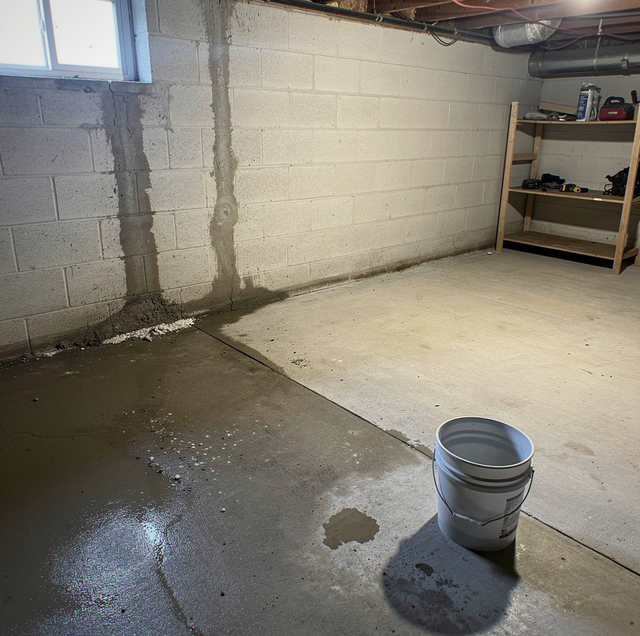
The morning after, the water has drained away, and the evidence it left is still there. Cardboard on the floor has wicked a dark band up its sides, level all the way around the room, and a thin gray silt line tracks that height across the block. That records the depth. What records where it came from sits lower: a stain running downward from one spot high on the wall, a fan of silt spreading outward from the floor drain, or a dark seam along the wall-to-floor joint, still damp while the middle of the floor has dried.
Heavy rain has more than one way into a basement, and the route it took is legible from two things: where the water first appeared, and when. High on the wall, during the rain, is surface water that never got away from the house. Low at the wall-to-floor joint, starting hours in and continuing after the sky clears, is groundwater under pressure. Up out of a floor drain is the sanitary system pushing back, and that one changes what you do in the room before it changes what anyone repairs. Underneath the second of those sits a set of sump-system failures that put water on your floor on a schedule imitating the ground.
Surface Water Arrives During the Rain, High on the Wall
One inch of rain on a thousand square feet of roof is about 620 gallons, since a cubic foot of water holds 7.48 gallons and an inch of depth over that area is 83 cubic feet. Split among four downspouts, one emptying at a corner delivers roughly 155 gallons per inch into the soil beside the wall.
That soil matters. A foundation is built in a trench dug wider than the wall, and then refilled with the excavated dirt. Backfill goes in loose and settles under its own weight rather than reaching the density of the undisturbed ground beside it, so it drains faster and holds more water. Whatever lands inside that footprint ends up against the concrete.
Surface water inside that footprint has three ways in, ranked by height. The highest is a window well, a pit below grade drained only by the stone at its base; once silt closes the voids in that stone, the well holds what falls into it, and the window at the bottom is the lowest opening in your wall. Without a well, the top of the foundation is only as far above the dirt as the dirt allows, so mulch beds and a patio over the old grade lift finish grade to the seam where concrete meets framing, and nothing on the framing side of that seam is waterproofed. With neither, saturated backfill still works water down the outside of the wall to the joint where the wall meets the floor.
That third route is why height alone does not settle it. The clock separates them: water that starts with the rain and stops soon after it does came off the surface, and water still running when you go down the next morning came from below.
Groundwater Arrives After the Rain, Low at the Floor
Below some depth, the soil around your house is saturated, and the top of that zone is the water table. Rain has to soak through everything above first, so the table climbs during the storm and keeps climbing after the sky clears. That lag is this source's signature.
Water standing in the ground presses by weight. Water weighs 62.4 pounds per cubic foot, so a saturated column three feet above your slab bears on the wall at roughly 187 pounds per square foot at that depth, and works upward under the floor. That is hydrostatic pressure, and concrete need not crack for it to matter: the wall-to-floor joint is a seam by construction, since the walls go up first and the floor is placed afterward as a separate slab. Water arrives through that seam, through shrinkage cracks, and around pipe penetrations.
That load is what the sump system carries. A perforated line in stone at the footing intercepts water before pressure builds and slopes to the pit, and the pump lifts what the line delivers. The system shows its failures in five ways, and they sort in the order the water travels. A dry pit over a wet floor means water never reached the pit, so the fault is in the perforated line rather than the pump you are standing over. Water that does arrive still needs the motor to start, and a full pit under a silent pump is power or the float: a tripped breaker, a cord pulled for a shop vacuum, a seized motor, or a float pinned under the discharge pipe. A pump running over a level that will not drop has cleared both of those and still moves nothing, because an impeller only pushes water into a line that will accept it. A pump restarting every few seconds is drawing back the standing column in its discharge pipe, which then drops into the pit each time the motor stops. And a pump cycling on a steady interval hours after the sky cleared, with soil washed out where the line ends, is putting water into the backfill and getting it back at the footing drain, a lag that breaks the timing rule above.
What the pump is built from and how it was sized sit outside this diagnosis.
Water Rising From a Floor Drain Changes What You Do
A sewer backup arrives out of the plumbing itself, at the lowest openings in the house: the floor drain, a shower on that level, the laundry standpipe, a toilet on the lowest floor. Water appears at those points and spreads outward while your walls stay dry.
What comes up out of a floor drain is not rain. It is what the sanitary line was already carrying, thinned by stormwater that found the same pipe. Stop running water anywhere in the house, since the fixtures on that lateral feed the pipe that is backing up, and keep people and pets out. Carpet, pad, cardboard and the bottom few inches of drywall hold contamination a mop does not lift, and that cleanup belongs to people equipped for it.
Electricity is the other thing that changes, and it applies to standing water from any of these sources. Once water reaches a receptacle, a plugged-in appliance, or the base of the furnace, the floor is an electrical hazard, and a cord lying on that floor gets there sooner. Opening the main breaker de-energizes every branch circuit in the house, the flooded receptacle included. The utility's service conductors land on the line side of that main and stay energized in any breaker position, but those lugs sit inside the enclosure behind the dead front and have nothing to do with the water on the floor. So the deciding factor is reach, and it gets settled before anyone goes in.
Open the main breaker only if the panel is dry and reachable: dry floor in front of it, water short of your shoes. A panel at the foot of the basement stairs will not be. Otherwise call an electrician.
A backwater valve is a flap in the building drain that hangs open for outflow and swings shut when flow reverses. Whether a house may have one, and where responsibility for the lateral shifts from the utility to you, differs by jurisdiction, so that question goes to the local authority.
When the Public System Runs Out of Capacity
A pipe carries only so much, and once the flow arriving exceeds that, the level inside it rises. In an older combined system, one pipe carries sanitary flow and street runoff together, so rain loads the same line your house drains into. A separated sanitary system still takes rain two ways. Inflow is a direct connection: a downspout or sump discharge plumbed into the sanitary line, a cleanout with a missing cap in a yard that ponds, a manhole cover in a street that floods. Infiltration is slower, rain soaking the ground and seeping into pipe joints and cracked laterals.
When flow exceeds capacity, the pipe surcharges: it runs full and under pressure, and the level inside climbs up the manholes and up every lateral tied to it. What matters, then, is the elevation of your basement floor relative to that rising level. Anything below it becomes a relief point for the street, and the floor drain, set at the low point of the slab, is first in line. That is why several houses on a block flood the same night, and why a lateral in sound condition is no protection.
Frequently Asked Questions
Watch the drain rather than the floor. If the level in your floor drain rises while someone upstairs runs a sink or a shower, that drain is tied to whatever is backing up. Stop all water use, and treat anything porous it touched as contaminated.
A footing drain sits in stone at the bottom of the wall, at or just under the slab, and relieves only what reaches that elevation. Water entering above it, at a mid-wall crack or an open mortar joint, never reaches your pump. Silt is the second limit: a line laid in silty backfill can blind off at its perforations long before the pipe itself fails.
Time your pump, not the storm. The interval between cycles is what you are reading: one that stretches out steadily across a day is a water table receding under you. Write each start time on the pit lid in pencil and check twice an hour, since the trend over six or eight cycles tells you more than any single run does.
No. The standpipe your washer drains into sits only a little above the floor drain, so it is the next opening to overflow once that drain is at capacity. Your washer also discharges under pump pressure, which can push water past a partial blockage, then come straight back once the machine stops.
Each house was cut into the ground where it stands, so basement floors on one block can differ by several feet, and the lower floor takes what the lots above it shed. Your downspouts count for as much: a buried line daylighting at the back of a yard puts roof water tens of feet farther from the wall than a splash block at your foundation does.
Mark the high-water line on your wall in pencil or tape, write the date and time beside it, and photograph it with a tape measure in the frame so the height stays measurable after the wall dries. Then photograph the debris line outside on grass and mulch before it is mowed away, since that line records where surface water pooled in your yard.
A wet line high on the wall and a full pit are two different repairs — a check of the pump, pit, float, and discharge line tells you which one your basement needs. East Coast Plumbing serves Barto, Boyertown, and Pottstown. Call (610) 944-2998.