
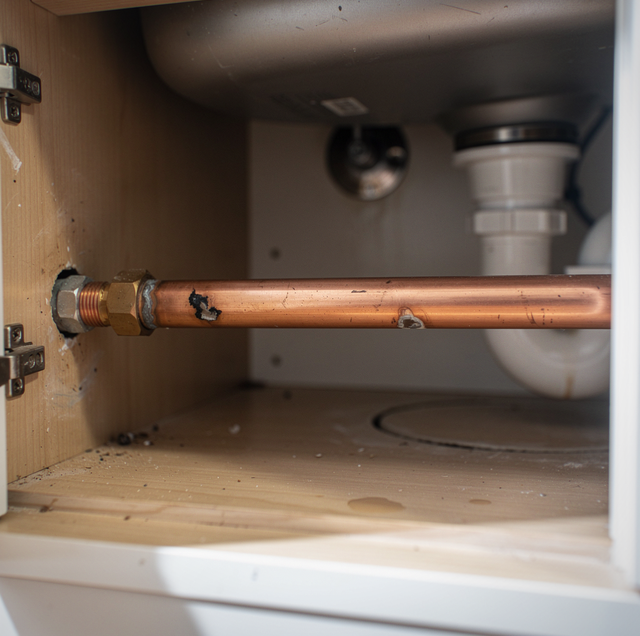
Three leaks in one year, in three different spots, and each fix looked the same: cut out the bad section, sweat or crimp in a new fitting, pressure-test it, done. Every single repair worked, and yet another leak turned up in another spot, as if the house were simply unlucky. It isn't luck. When leaks keep showing up in a home's supply lines, the pattern itself is information, and reading it as a string of separate bad breaks instead of one story is how a homeowner ends up fixing the same problem again and again instead of solving it once.
A Spot Repair Fixes Only the Joint It Touches
A repair fixes exactly what it touches: the section of pipe or fitting that failed, and nothing upstream or downstream of it. That's not a criticism of the repair, since cutting out a failed joint and replacing it is the correct response to a single leak in a pipe that's otherwise sound. The trouble starts when the pipe on either side of that repair is in the same condition the failed section was in right before it let go. A plumber who solders in a new coupling has restored that one joint to like-new condition. Nothing about that work changes the state of the pipe six feet away, which was made from the same material, run in the same year, exposed to the same water, and is aging on the same timeline. The repair and the pipe around it are no longer at the same point in their service life, which is exactly why the next failure tends to show up somewhere else in the same run rather than at the spot that was just fixed.
The Wear Behind One Leak Is Already Working on the Rest of the Run
Pipe doesn't fail because one random inch of it drew the short straw. Where the material itself is the problem — galvanized steel corroding from the inside, polybutylene breaking down under chlorine — that wear has been acting on the whole run since installation, not just on the section that happened to let go first. A section behind the water heater and a section under a bathroom sink, if they came from the same original installation, have absorbed roughly the same years of exposure to the same water. One of them failing first doesn't mean the other is sound; the same wear has been working on both the whole time, and the leak just marks whichever point reached its limit first.
The repair itself leaves behind a clue worth reading. When a section of pipe is cut out to fix a leak, that cut-out piece is evidence: its wall thickness, interior scale, and brittleness show roughly how far the surrounding pipe has aged, since nearby pipe from the same installation is typically in a similar condition. That inspection doesn't replace a full evaluation of the whole system, but it can be the first concrete sign that a leak isn't an isolated event.
What points at the pipe itself is the pattern: leaks arriving closer together in time, at spots unrelated to each other, on a supply system that's been mostly untouched for decades.
Reading Your Own Leak History
The material behind the wall changes what a repeat-leak pattern should tell you. In a home still carrying its original galvanized steel or polybutylene supply lines, a run of leaks in different places over a short span points to the material itself giving out across the system, because that's exactly the kind of pipe that ages throughout the run and fails at its weakest points one after another. In a home that's already plumbed in copper or PEX, that same pattern can trace back to something narrower, such as a bad batch of fittings, a water-hammer problem stressing one section of the line, or high water velocity eroding one run near a pump or elbow, rather than the entire supply system reaching the end of its life at once. Aggressive water, the kind that pits copper from the inside, sits on the whole-system side instead: it reaches every copper run the water travels through, so the pinholes it causes show up in more than one place rather than in a single isolated section. The material era doesn't just describe what's in the walls; it changes which explanation a repeating pattern actually points to, and a plumber tracing a leak's history should ask what's actually running through the house before assuming either story.
To confirm a hidden leak is active right now, stop any running toilet, shut off every faucet, then watch the water meter's small leak-indicator dial for about fifteen minutes; movement means water is still moving in the line.
Beyond material, look at three things: how many separate leak events you've had, how much time separates them, and whether they're clustered on the same section of pipe or scattered across the house. Leaks years apart in a large house weigh less than a cluster of leaks close together in different rooms. Leaks that keep landing on the same run, or that are arriving closer together each time, are the pattern that shifts the conversation from "repair this one" to "what's happening to the whole line."
Replacing the Whole Run Resets the Starting Point
Repiping doesn't just fix more leaks at once; it changes what kind of problem you have going forward. Instead of a supply system with pipe at various stages of the same decline, you have pipe that's all at the same starting point again, installed under current standards and inspected as a whole rather than patched piece by piece. That matters because it removes the shared vulnerability that was producing the pattern in the first place: there's no more "next weakest section" waiting its turn, because the material that was aging out has been taken out entirely rather than trimmed back one leak at a time. A repipe is also the point where a plumber can correct anything the original installation got wrong along the way: an undersized branch line, a section routed through an unusually cold space, a run with more joints than it needed, problems a spot repair has no reason to touch because they aren't why that particular leak happened.
When the Repair Count Stops Making Sense
There's no fixed number of leaks that flips a repair into a repipe for every house, but the math changes as the count climbs. Each additional repair carries its own disruption: opening a wall, shutting off water to part of the house, drying out whatever the leak reached before it was caught.
A wall that already absorbed a hidden leak can hide soaked framing or early mold behind intact drywall. Have a plumber confirm it with a moisture meter, and open drywall only where the testing shows real damage.
A homeowner weighing "repair the fourth leak" against "replace the run" is really weighing continued exposure to that same disruption, on an unpredictable schedule, against doing the work once on your own timeline. A pipe that's already produced three or four failures in a short window is not a system that's finished producing them: where the material itself is driving the failures, it doesn't stop degrading on its own, and the run keeps producing leaks until that material is replaced. Recognizing that shift early, rather than after a leak causes real damage, is what turns a difficult decision into an easy one.
Frequently Asked Questions
Ask for the date, the location, and either the cut-out section of pipe or a photo of its interior each time a leak gets fixed. A single record doesn't tell you much on its own, but a home with several of them lets a plumber compare the pieces instead of relying on memory.
A repipe typically comes with a warranty on the new work. Ask what it covers and for how long before the job starts. A spot repair can only be supported by the joint it touches, which is the full extent of fixing one leak at a time.
A fair amount, even without paperwork. Mismatched pipe materials or fitting types at different repair points, newer PEX crimped into an old galvanized run, for instance, are themselves a record of separate repairs done at different times, and a plumber can read that history in the walls even when nobody kept notes. It won't give exact dates, but it shows how many distinct repair events the system has already been through.
It can often be staged by zone rather than done as a single continuous project, particularly in a larger home. A plumber might prioritize the section with the worst leak history first, then schedule the remaining zones over following visits. Staging spreads out the disruption but means the home will run on a mix of old and new piping for longer, so it's a trade-off worth discussing rather than assuming it's always the better route.
It depends on the home's layout, but a repipe is not a demolition project. A plumber lays out the route beforehand, then walks the homeowner through the plan and marks each planned opening before any cutting starts, so the number and location of access points are agreed on rather than discovered partway through the job.
It can be either, and the difference matters for what happens next. A joint that was just soldered or crimped can fail at that new connection if it was stressed during the work or wasn't seated correctly, which shows up quickly and is a workmanship issue with that specific fitting. A leak that appears nearby but not exactly at the repaired joint, especially weeks or months later, is more likely to be the surrounding pipe reaching its own failure point rather than anything to do with the repair itself.
Bring your leak dates and locations to the call — a licensed master plumber reads the pattern and tells you whether the next fix is a joint or the whole run. East Coast Plumbing serves Barto, Boyertown, and Pottstown. Call (610) 944-2998.