
The call comes from the tenant in unit 2B: pressure's weak again at the kitchen faucet, and the water running cold has that faint rust-brown tint. You've heard it before — from 1A last spring, from 3C the winter before that. A plumber scopes the system. Now you are looking at a repipe recommendation and trying to figure out how much of your building actually has to go.
It's a real decision with real money behind it. Full stack replacement is the right call in some buildings. Targeted riser replacement is the right call in others. Plenty of property owners end up doing one when they should've done the other — spending more than the situation required, or making piecemeal repairs on a system that was failing throughout. Here's how to tell the difference.
What "the stack" and "risers" mean in a multi-story building
Get these terms mixed up, and you'll have a very expensive conversation with a plumber that ends in confusion. They're two completely different systems.
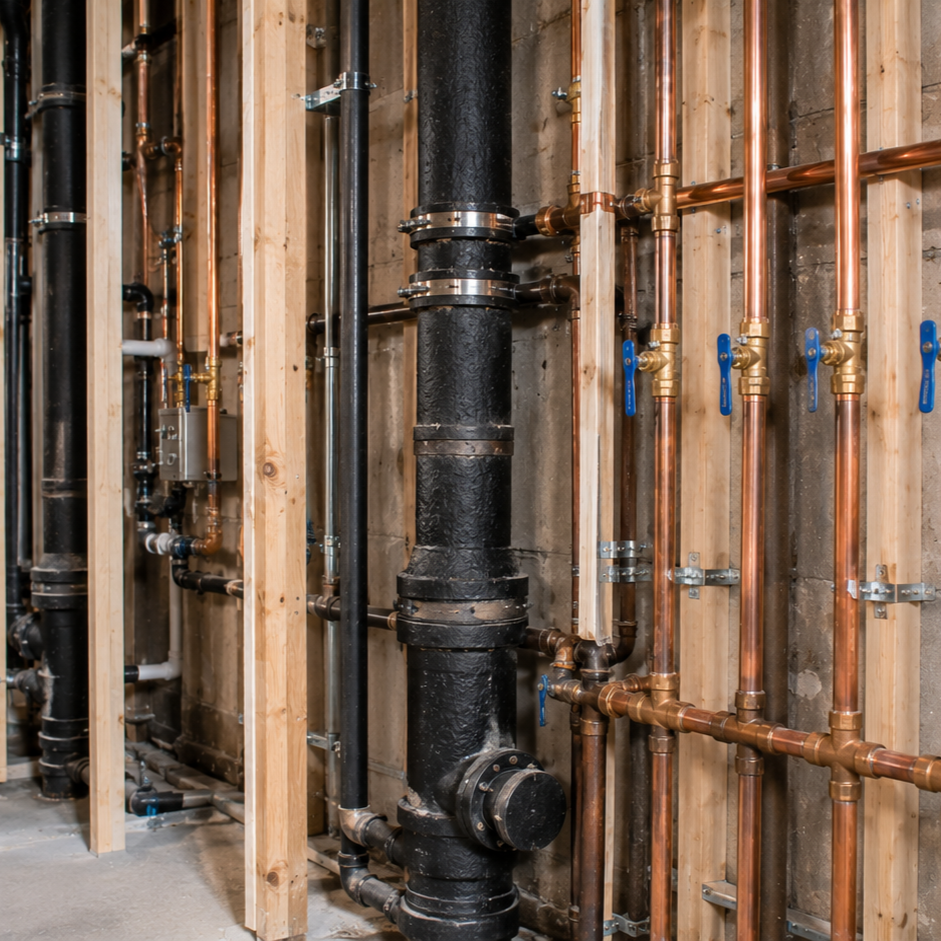
The stack — also called the main stack, soil stack, or vent stack — is the big-diameter vertical pipe, typically 3 or 4 inches, running the full height of the building from the basement cleanout up through the roof. Every toilet, tub, and sink in the building drains into horizontal branch lines that connect to it. It's also the vent pathway, which is why it exits above the roofline rather than somewhere inside. A 4-story apartment building typically has two or three of these, depending on the layout.
Risers are the vertical supply-line pipes — copper or galvanized steel in most older buildings — that carry pressurized hot and cold water up through each floor to serve individual units. These have nothing to do with the drain stack. They're pressurized lines, not gravity-drain lines. The failure modes are different. The diagnostic methods are different. And replacing one has nothing to do with replacing the other.
When a property owner says "the risers are failing," they usually mean supply lines. When a plumber says "the stack needs to come out," they mean drain-waste-vent piping. Both can fail — but at different rates, for different reasons, and the replacement scope for each is entirely its own project.
The case for replacing failing risers only
There are building conditions where targeted riser replacement is clearly the right scope. Not every problem needs a full solution.
If a camera inspection and pressure test reveal a single corroded section — one riser on the second floor, weeping rust at a threaded joint — and the rest of the system's flowing with decent pressure, there's no technical reason to pull everything out. The repair is scoped. The cost is proportional. You fix what's failing.
Occupied buildings make targeted repairs far more practical. A single-riser replacement in one vertical zone typically means a staged shutoff lasting a few hours, walls opened in one or two locations. Tenants in the affected unit are back to normal that evening. That's a completely different disruption level from opening walls on every floor simultaneously.
And there is another scenario where targeted work makes sense: when the two systems are in different conditions. If your cast iron main drain stack is intact and scoping cleanly, but your galvanized supply risers are running at a trickle from decades of scale buildup, you can address the supply side without touching the drain side. They don't share a timeline.
The risk with partial repairs is real, though. Galvanized supply systems don't fail in one isolated spot. The corrosion is happening inside every section of the same material at the same age. Patch the riser that went this year, and the next call is probably coming within a year or two — different unit, same wall access, same staged shutoff. You haven't fixed the system. You've bought time.
The case for repiping the entire stack
Full stack replacement is harder to schedule and harder on tenants. But there are situations where doing it in pieces costs more — in total labor, in repeat disruption, in emergency risk.
A building that's had three or four patched leaks on the same drain stack in the past two years is sending a clear message. Each patch means opening walls. Each repair costs labor. None of those patches addresses the sections in between — the ones that haven't cracked yet but are in identical condition to the ones that did. If a camera inspection shows the stack thinning along multiple sections, the system is near the end of its service life, whether it's actively leaking everywhere or not.
Buildings going through major renovation are the clearest case for doing the full replacement. When walls are already open for a gut rehab of a kitchen or bathroom, replacing the stack section running through that wall costs a fraction of what it would if you came back later and opened everything again. The access is there. The labor is mobilized. Coming back for it in two years means you pay for the wall twice.
For galvanized supply risers specifically, by the time you're seeing rust-tinted water and pressure drops across multiple units, the entire galvanized system is degraded. The zinc coating that protected the steel has been gone for decades in most pre-1970 buildings. What's left is bare steel, narrowing from scale and weakening from the inside. Replacing all the galvanized risers at once — while access is open and the contractor is already there — is almost always the lower total cost versus a series of targeted repairs spread across the next several years.
How pipe material changes the equation
This is probably the single biggest variable in how you frame the decision.
Galvanized steel supply risers past 50 years old should be evaluated for full replacement, not repeated patching. The failure pattern for galvanized is systemic — it's not random bad luck when one section goes. The interior corrodes uniformly across the entire run. Patching the worst section buys time. It doesn't change what's happening in the rest.
Cast iron drain stacks are a different story. Cast iron has a genuinely wide service life — anywhere from 50 to 100-plus years, and that range isn't rough approximation. It's real. A well-made cast iron stack from the 1920s often scopes cleaner than a mid-century stack from the 1960s, even in the same building. Think of it like old-growth timber versus second-growth lumber: same species, completely different density. The exterior surface tells you almost nothing about what's happening inside the pipe wall. Camera inspection is the only way to actually know.
Copper supply lines, where they're original, are generally in better shape at the same age than galvanized. But hard water accelerates internal pitting corrosion, particularly on the hot-water side. Buildings supplied by hard well water — common across Berks and Montgomery Counties — should have copper risers inspected for pinhole leaks even when the exterior looks fine. Internal pitting isn't visible until it's already leaking.
| Factor | Supports risers-only replacement | Supports full stack replacement |
|---|---|---|
| Failure pattern | Single isolated section | Multiple sections, or repeat failures |
| Camera inspection result | Interior wall intact, good flow | Thinning walls, heavy scale, multiple weak points |
| Building condition | Occupied, ongoing operations | Vacant or under gut renovation |
| Pipe material | Cast iron stack, galvanized supply risers in different condition | All galvanized supply throughout; aging cast iron with confirmed damage |
| Prior repair history | No prior patches | Two or more patches on same stack in past 3 years |
Why a camera inspection matters before either decision
Don't commit to a scope before you've actually looked inside the pipe. That sounds obvious. But plenty of building owners skip it and end up either replacing a system that had years left in it, or patching a system that was failing in four places they didn't check.
A visual inspection of the basement section tells you what the bottom of the stack looks like. That's it. The sections running through second and third floor walls may be in completely different conditions. Camera runs through cleanout access points on each floor give a far more complete picture. What a camera shows: pipe wall thickness, interior scale buildup, active thinning or cracking, and whether prior patches are holding or starting to separate. What a pressure and flow test of the supply risers shows: whether the restriction is building-wide or limited to specific zones.
Running the camera from the basement only and calling the stack intact is one of the more common ways a property owner ends up back in the same conversation six months later, with a crack two floors up and walls to open again.
What disruption looks like in an occupied building
Neither scope is invisible to tenants. But the scale of disruption is genuinely different, and it matters for how you plan the project and communicate with the people living there.
Targeted riser replacement in a single vertical zone typically requires opening the wall in one or two locations, a water shutoff for the affected run, and work completed over one to two days. Tenants in the directly affected unit may need to be out for a day. Adjacent units aren't usually touched. A competent contractor can restore water each evening.
Full drain stack replacement requires opening walls or ceilings at multiple floors to access the stack at each level. Shutoffs are staged — a full stack can't come out in a single day without significant multi-unit disruption. Experienced contractors working a 4-story building can typically complete one stack in two to three days, with water restored each evening. It's disruptive. But it's manageable with advance notice and clear communication to tenants about what day their zone is being worked.
The practical approach in occupied buildings: full riser or stack replacement often goes zone by zone, starting with the most compromised runs and working across the building in stages. It extends the overall timeline but keeps any single tenant's disruption short — a building with three vertical zones might run the project over two to three weeks, each zone completed before moving to the next.
Frequently Asked Questions
Yes. A single failing riser — supply or drain — can be isolated and replaced without touching anything else. Whether that's the right long-term call depends on what a full inspection of the remaining risers shows. If the rest are in similar condition, a single repair is an interim measure, not a final solution.
Somewhere between 50 and 100-plus years, and that range is real — not a way of avoiding the question. The difference comes down to alloy quality, installation, and how the building's drain load has run over the decades. A camera inspection is the only reliable way to assess where a specific stack sits within that range. Age alone isn't a useful diagnostic here.
It depends on building size, number of stories, number of units, and what's being replaced — supply risers only, drain stack only, or both. A 4-unit, 3-story building's supply riser replacement is a fraction of the scope and cost of repiping the drain stack in a 12-unit building. A plumber needs to walk the building and assess access before any real number can be given.
For targeted riser repairs on a single vertical zone: a few hours per work day, across one to two days. For full-stack replacement staged by zone in an occupied building: water is typically restored each evening, with total project duration depending on how many zones the building has. A vacant building can move faster — no evening restoration requirement, no tenant coordination.
Sometimes. Cured-in-place pipe lining can extend the service life of a drain stack that's corroded but still structurally intact — it's less invasive and faster than physical replacement. It doesn't work for pipes with severe structural damage or active cracks, and it's not used on pressurized supply risers. Camera inspection first. If the pipe wall can support lining, it's worth evaluating as an option. If the damage is too advanced, physical replacement is the only path.
Not automatically. They're separate systems with separate failure timelines. If one needs replacement now and the other is in good shape, doing both creates unnecessary cost and disruption. But if both are at the end of life and the building is going through a major repipe anyway, consolidating the work into a single project saves mobilization cost and cuts the total disruption window.
A camera inspection of the drain stack and a flow test of the supply risers — not a visual check of the basement section — is the right starting point before either decision. Buildings with 50-plus-year-old galvanized supply lines and aging cast iron drain stacks often have problems the exterior doesn't show. An emergency repair on your timeline is a lot more expensive than a planned one on yours.
