
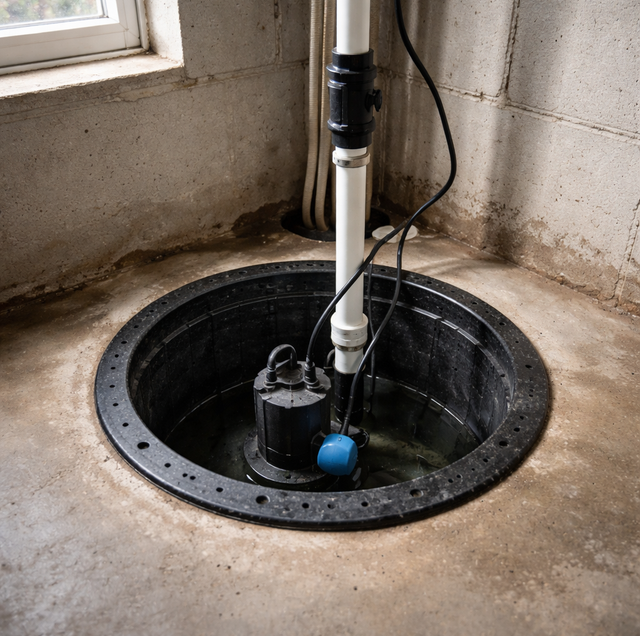
Quick Answer: A sump pump lives in a pit at the lowest point of a basement or crawlspace. Groundwater drains into that pit, a float switch senses the rising level, and the pump switches on to push the water out through a discharge pipe that carries it away from the foundation before it can flood the floor.
A sump pump is one of those pieces of equipment most homeowners never think about until the day water is climbing the basement steps. It sits out of sight, does its job quietly, and only makes itself known when it fails. Understanding what it does, how the parts fit together, and whether your home is a candidate for one puts you ahead of the flooding instead of reacting to it.
The Pit, the Float, and the Discharge Line
Before the types and the accessories make sense, it helps to see the system as three connected parts working in sequence.
The first part is the pit, also called the sump basin. It is a lined hole, usually 18 to 24 inches deep, set into the lowest point of the floor. Water follows gravity, so groundwater that builds up under and around the foundation travels toward that low point and collects in the basin. Many homes route a perimeter drain, sometimes called a French drain or drain tile, straight into the pit so water is delivered there on purpose rather than seeping through the slab.
The second part is the float switch. As water fills the basin, a float rises to the surface. Once it reaches a set height, it trips a switch and tells the pump to start. When the water drops back down, the float falls, the switch opens, and the pump shuts off. The whole cycle runs on its own with no one watching.
The third part is the discharge line, the pipe that carries pumped water up and out of the basin. Water leaves the pump, travels up through this pipe, passes a one-way check valve, and exits the house, moving to a spot where it can drain away safely rather than come back to the foundation.
With those three pieces in mind, the operating sequence is easy to follow.
How a Sump Pump Actually Works
Here is the cycle from start to finish.
Water collects in the pit as groundwater rises or as the perimeter drain feeds it in. The float rises with the water level and, at its trip point, closes the switch. The motor starts, and an impeller spins, pulling water into the pump housing and forcing it up the discharge pipe under pressure.
At the top of that pipe sits the check valve, a spring- or flap-style one-way gate. When the pump stops, the column of water still standing in the vertical pipe wants to fall back down into the basin. The check valve slams shut and blocks that backflow, so the pump does not have to re-pump the same water on its next cycle. Without a working check valve, the pump short-cycles, wears out early, and struggles to keep up during heavy inflow.
The discharge line then carries the water outside and releases it far enough from the house that it drains away instead of soaking back into the ground next to the foundation. Get that routing wrong, and the pump ends up moving the same water in a loop, which is a common reason a basement stays damp even with a working pump.
A sump system behaves a lot like the bilge pump on a boat: water is going to find its way into the low spot no matter what, so the smart move is not to fight the leak but to collect it in one place and pump it overboard before it rises.
Submersible vs Pedestal Pumps
Sump pumps come in two basic builds, and the difference is where the motor lives.
Submersible pumps sit down inside the basin, fully sealed and designed to run underwater. The motor and pump are one unit at the bottom of the pit, usually under a lid. Being submerged keeps them quieter and lets them move a lot of water fast, which suits basins that fill quickly. The sealed housing also keeps debris out. Because they live in water, their working life tends to be shorter than a pump kept dry, though many run for years.
Pedestal pumps keep the motor up on a shaft above the pit, with only the intake down in the water. The motor stays dry and cool, which often means a longer service life, and it is easier to reach for service without pulling the whole unit. The trade-offs are that pedestal pumps are louder, take up more vertical room, and generally move less water per minute than a comparable submersible. In a tight or shallow pit, or where noise is not a concern, they earn their keep.
Neither is better. The right pick depends on how fast the pit fills, how much headroom the space allows, and how much noise is acceptable.
Float Switch Types
The float switch is the part that decides when the pump runs, and a few designs are common.
A tethered float hangs on a cord and swings up as the water rises, tripping at the top of its arc. It needs a wider basin to swing freely and has a bigger gap between on and off levels, so the pump runs less often but moves more each time.
A vertical float rides straight up and down a rod. It fits narrow pits and triggers within a tighter water range, which keeps levels more consistent but cycles the pump more frequently.
An electronic or diaphragm switch uses pressure or a sensor rather than a floating ball, with no moving arm to snag on the pit wall or the pump cord. Snagging is one of the most common failure modes for float switches, so a design with fewer moving parts can be worth it in a cramped basin.
The Check Valve and Discharge Routing
The check valve and the discharge routing deserve their own attention because they cause a large share of the problems people blame on the pump itself.
The check valve belongs on the vertical discharge pipe, typically a foot or two above the pump. Mounted there, it holds back the standing water column and cuts down on short-cycling. A valve installed backward, or one whose internal flap has worn out, lets water fall straight back into the pit, and the pump keeps kicking on for no reason.
Routing matters just as much. The discharge should daylight, meaning it should open to the outside, well away from the foundation, releasing onto a slope or into a drainage area that carries water downhill and off the property. Two failures show up over and over: a line that dumps water right at the foundation, where it seeps back down to the pit, and a line that loops back into the basin, so the pump never truly empties. Where the pipe exits above ground, it also has to be kept clear of the ground itself, because a discharge that gets buried in mud or blocked by ice sends water backing up the pipe and into the basement. Local rules on where discharge water may go vary from place to place, so it is worth confirming the routing is allowed before it is set.
Backup Power for Outages
A hard truth about sump pumps is that they need most exactly when they are most likely to fail. A heavy storm that overwhelms the ground with water is also the storm most likely to knock out the power, and a primary pump plugged into a dead outlet does nothing while water rises.
A battery backup pump is a second pump, on its own float, wired to a deep-cycle battery. When the power drops or the main pump cannot keep up, the backup takes over and runs off the battery until utility power returns. Run time depends on battery size and how hard the pump works, so it buys hours, not days, but those hours often cover the worst of a storm.
A water-powered backup uses household water pressure to drive an ejector that pulls sump water out, with no battery to charge or replace. It only works where the home has strong municipal water pressure, since it draws on that supply to operate, and it does use water while running. For a home on a well, this option usually is not viable because the well pump also depends on electricity.
For any home where a flooded basement would be a real loss, a backup is worthwhile protection against the one night the power and the pump both quit at once.
Signs Something Is Wrong
A sump pump gives warnings before it fails outright, and knowing them buys time to act.
A pump that runs constantly may be facing a truly high water table, but it can also mean a stuck float, a failed check valve letting water fall back in, or a discharge line that returns water to the pit. A pump that never turns on during heavy rain points to a tripped breaker, a snagged or dead float, or a seized motor. Rapid cycling, switching on and off every few seconds, usually means the on and off levels are set too close together, or the check valve is gone. New or louder noises, grinding, rattling, or gurgling, suggest a worn impeller, loose plumbing, or debris in the basin. And a musty, damp, or humid basement even when the pump seems to run is a sign water is not actually leaving the house, often a discharge problem rather than a pump problem.
Because the pump runs on electricity in a wet pit, it should be on a GFCI-protected circuit. Never reach into the water or handle the pump while it is plugged in or while you are standing in water, since that combination is a real shock hazard. When troubleshooting means touching the unit, cut power first.
Basic Maintenance
A little routine attention keeps a sump pump ready for the day it counts.
Test the pump by pouring a bucket of water into the basin slowly until the float rises. It should switch on, empty the pit, and shut off cleanly. Doing this a couple of times a year, and before any stretch of heavy rain, surfaces a problem on your schedule instead of during a storm.
Clean the pit periodically. Gravel, silt, and grit settle to the bottom and can clog the intake or jam the float. Scoop out debris and wipe down the float and its travel path so nothing catches. Check the check valve for smooth one-way action and confirm the discharge line outside is clear and still pointed away from the house. Also glance at the power cord and the outlet to be sure the GFCI has not tripped and been left off.
Any electrical or plumbing work beyond testing and cleaning, replacing the pump, rewiring, or re-routing the discharge, is work for a licensed plumber. The mix of water and power in a confined space is exactly where a professional install matters most.
Who Actually Needs One
Not every home needs a sump pump, and the honest answer depends on the ground and the history.
A home with a high water table, where groundwater naturally sits close to the surface, is a strong candidate, since water pressure pushes moisture toward the basement year-round. A basement or crawlspace below grade with any history of dampness, seepage at the walls, or efflorescence on the concrete is another. And a home with past flooding, even once, has already shown that water can get in, which is the clearest signal of all.
The triggers are not seasonal, which is why a sump pump earns its place year-round. Spring melt can flood a pit as frozen ground thaws and releases water, but a summer downpour saturates the soil just as fast, and in many homes the water table keeps groundwater trickling into the pit steadily regardless of the month. A pump sized and maintained for the worst case handles the everyday case without a thought.
If your basement stays dry through every storm and the ground around the house drains well on its own, you may not need one at all. If any of the signals above sound familiar, an assessment is the way to know for sure rather than guessing.
Frequently Asked Questions
Most sump pumps run about 7 to 10 years, though the number varies with how often the pump cycles and the quality of the unit. A pump in a pit that fills constantly wears faster than one that runs only during storms. The float switch and check valve often fail before the motor does, so replacing those parts can extend the life of an otherwise sound pump.
In most areas, no. Routing sump water into a sanitary sewer or septic system can overload it and is prohibited by many local codes, since the goal is to keep clean groundwater out of the wastewater stream. Discharge is meant to daylight outside instead. Rules differ from one municipality to the next, so the correct routing should be confirmed locally before the line is run.
A sulfur or sewer-like odor usually comes from stagnant water sitting in the pit between cycles, where bacteria grow, or from a pit that has dried out and let sewer gas rise if it connects to a drain. Flushing the basin with a mix of water and a small amount of bleach, then letting the pump clear it, often resolves it. A pit lid with a sealed gasket cuts down on both odor and evaporation.
It can play a role. Because a sump pit connects to the soil under the slab, an uncovered pit can be a pathway for radon gas to enter the basement. Fitting the pit with a sealed, airtight lid, sometimes tied into a radon mitigation system, closes that pathway while still letting the pump work. Radon testing is a separate step and is worth doing regardless of the pump.
Sizing is based on how much water the pit takes on, measured by how fast the level rises, not on the size of the basement. Pump capacity is rated in gallons per hour at a given lift height, and a pump that has to push water higher moves less of it. A pit that refills quickly during a test points to a higher-capacity pump, which is a measurement a plumber can take during an assessment rather than a guess.
Not always. A sump pump handles water that reaches the pit, but it does nothing about water entering higher up, through a cracked wall, a failed window well, or poor grading that sends rain toward the house. A dry basement usually comes from a system: proper exterior grading and gutters, sealed walls where needed, a working perimeter drain, and the pump as the last line that clears whatever still gets in.
Book a sump pump check before the next big storm — protect your basement and your foundation year-round. East Coast Plumbing serves Boyertown, Pottstown, and Reading. Call (610) 944-2998.
