
Why Do Apartment Units Lose Pressure When a Neighbor Runs the Faucet?
You step into the shower at 7:15 in the morning. Pressure's fine — not great, but fine. Then someone two floors down starts their day, and the water drops from a solid stream to something closer to a drizzle. You stand there waiting. Sometimes it comes back. Sometimes you rinse shampoo out under a trickle and move on.
That's not bad luck. It happens on the same mornings, at the same times, and the building across the street doesn't seem to have the same problem. The water company isn't the culprit. Almost every time this happens in a multi-unit building, the answer lives somewhere in the building's own plumbing — not outside it.
Here is what's actually going on.
How water reaches each unit in a multi-story building
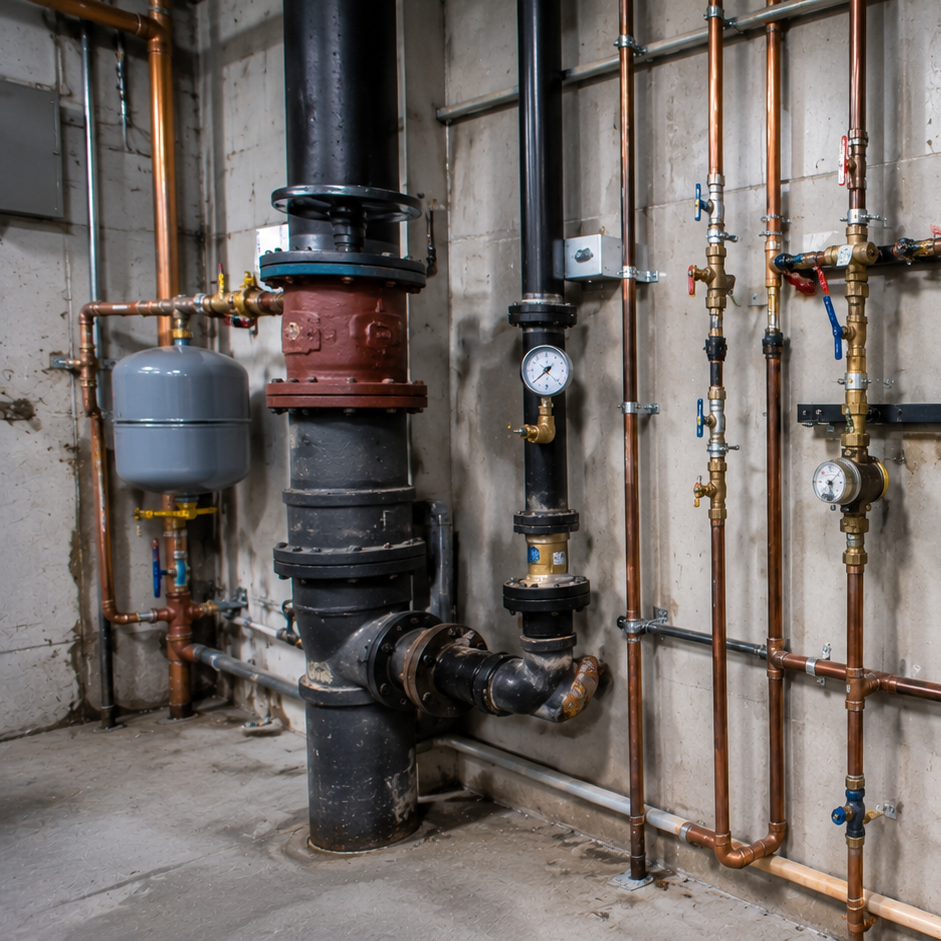
Water enters a building at one point: the service connection at ground level. From there, it travels up through vertical pipes called risers. Each riser runs the full height of the building, and branch lines peel off at each floor to feed individual units.
A shared riser works like a garden hose with a series of tees spliced into it. Every open tap cuts the flow available to all the others. Low demand? Pressure holds. Three showers and a dishwasher running at once? Everyone downstream gets noticeably less.
Cold water risers draw directly from the main supply. Hot water moves through a separate set of risers, fed by a central boiler or water heater — which is why hot and cold pressure problems don't always behave the same way. Low hot water pressure with normal cold pressure usually points to the domestic hot water system, not the supply side.
Why simultaneous use causes pressure drops
The physics is simple. Pipe capacity is finite. Every gallon per minute flowing out of one unit isn't available to another.
Older multi-unit buildings — and there are a lot of them in eastern Pennsylvania — were often piped with 3/4-inch or even 1/2-inch risers. Those diameters were sized for the building's original occupancy and fixture count. They're not always adequate now. When a building went up in the 1960s with cast-iron risers designed for a certain flow rate, adding washing machines in units or swapping old fixtures for high-flow models changes the math completely.
The problem hits hardest during peak hours: 6–9 a.m. and 6–9 p.m. During those windows, the riser is handling more simultaneous demand than it was built for. Every tenant in the building feels the pressure sag at once.
Scale and corrosion inside the risers
Demand isn't the only culprit. A lot of multi-unit buildings in eastern Pennsylvania were built before 1980 and still have their original galvanized steel risers. Galvanized pipe corrodes from the inside out. Mineral scale — especially heavy in areas with hard water — coats the pipe wall and slowly narrows the internal diameter.
The narrowing isn't dramatic at first. But over decades, a 1-inch galvanized riser can shrink internally to something closer to a 5/8-inch effective opening. That restriction works like a thumb pressed partway over the end of a garden hose: normal pressure at the source, noticeably reduced flow at the outlet.
Units at the far end of a branch from the riser feel it first. If one corner unit always has worse pressure than the unit across the hall — same floor, same riser — scale inside the branch line feeding that corner is likely what you're dealing with.
The only fix that actually solves it is replacement. Hydro jetting can knock loose soft deposits and restore some flow, and it's worth trying on a borderline line. But if the pipe has been in service since the 1960s or 1970s and it's galvanized steel, the corrosion is structural at this point. Jetting buys time. Replacement solves it. Most repipes in multi-unit buildings go to copper or PEX — both resist the internal corrosion that slowly kills galvanized lines.
Pressure-reducing valves and what happens when they fail
Buildings that receive water at high street pressure — above 80 PSI — have a pressure reducing valve, or PRV, at the service entrance. PRVs step incoming pressure down to a safe range for household fixtures, typically 50–70 PSI.
A PRV is a mechanical device. It wears out. When one starts to fail, it can stick in a partially closed position and drop building-wide pressure to 30 PSI or lower. That's low enough to make every fixture in the building feel weak — but the top floors show it first, since they're already losing pressure from vertical head loss.
PRV failure looks a lot like scale-related pressure loss, which is why a plumber checks it early when diagnosing a building-wide complaint. The repair itself is straightforward: replace the valve. Most residential PRVs can be swapped without shutting down the building's entire water supply.
Upper floors feel it worse — here's why
Water loses roughly 1 PSI of pressure for every 2.31 feet it rises. A six-story building burns about 26 PSI from elevation alone — before a single faucet opens.
If the building's incoming pressure is 55 PSI — on the lower end of normal — and vertical head loss eats 26 of those PSI, the top floor is already starting with around 29 PSI under static conditions. Turn on three showers, and pressure on the sixth floor can drop into ranges where water barely reaches the showerhead.
That's why lower-floor tenants usually have decent pressure while the people two floors up are filing complaints. The math is working against the upper floors before any demand hits the riser at all.
Buildings designed for their height have booster pump systems that compensate. Buildings that weren't — or that have aging booster pumps running at reduced capacity — show exactly this floor-by-floor pressure gradient.
Is it the building's problem or your unit's problem?
This matters because it determines who handles the fix.
If pressure loss is building-wide, or if it's isolated to a riser that serves multiple units, the problem is in the building's infrastructure. The building owner or property management is responsible for the supply riser, branch lines up to the individual unit shutoff valves, and any building-level equipment like PRVs or booster pumps.
Inside your unit — from the shutoff valve onward — the plumbing is yours to deal with. A partially closed shutoff valve under the sink, a blocked aerator, or a failing cartridge in a single-handle faucet can cause pressure loss that only shows up in one fixture or one unit. Rule those out before you involve building management.
| Symptom | Likely Cause | Who's Responsible |
|---|---|---|
| Pressure drops at peak hours, building-wide | Shared riser at capacity | Building |
| One floor has low pressure, others don't | Branch line scale or failing PRV | Building |
| One unit has low pressure, adjacent units don't | Unit-side issue (valve, aerator) | Tenant |
| Top floors always have worse pressure | Booster pump failure or vertical head loss | Building |
| Hot water pressure low, cold normal | Domestic hot water system issue | Building |
| Sudden pressure loss that doesn't recover | PRV failure or partially closed main valve | Building |
What a plumber does to diagnose the problem
A plumber diagnosing pressure complaints in a multi-unit building starts at the service entrance. Static pressure at the main gets checked first. Then the PRV. Then pressure readings at multiple floors — to map whether the drop is gradual (scale or demand) or sharp (a failed valve or major restriction).
Camera inspection of the risers can confirm scale buildup without opening walls. If scale is heavy in one section, the plumber can recommend repiping the worst segments rather than the whole system. That's usually the practical approach in an occupied building, where a full repipe would mean shutting down units for days.
For buildings where demand is the real cause, the options get narrower. Pressure boosters can be added, but they amplify pressure — they don't increase the volume of water the riser can deliver. And in a riser that's genuinely undersized, boosting pressure downstream of the bottleneck doesn't solve the actual flow problem. Upsizing the riser itself does. That's typically staged in phases.
Frequently Asked Questions
Some variation is normal in buildings with shared risers. A slight reduction during simultaneous use is expected. A dramatic drop — from a strong flow to barely usable — isn't, and usually points to an undersized riser, heavy scale, or a failing PRV.
Cold water diverts into the toilet tank during refill, which temporarily lowers cold supply pressure to the shower. The mix runs hotter until the tank fills. A pressure-balancing or thermostatic shower valve fixes this — those valves compensate automatically when one supply pressure shifts relative to the other.
Top floors, almost always. Vertical head loss reduces pressure with every foot of elevation. Upper floors are also farthest from the service entrance, which adds pipe length and friction. If the building has a booster pump, ask when it was last serviced — a degraded pump affects upper floors first.
Hydro jetting can dislodge soft mineral deposits and restore some flow, and it's worth trying on a borderline line. But if the pipe has been in service since the 1960s or 1970s and it's galvanized steel, the corrosion is structural at this point. Jetting buys time. Replacement is what actually fixes it.
If the pressure loss is happening in shared supply risers — which peak-hour drops almost always are — it's a building infrastructure problem, not something inside your unit. Document when the drops occur and whether other tenants are affected. That documentation helps the building management understand the scope and move it up the priority list.
Find the main shutoff valve for your unit — usually under the kitchen sink or in a utility closet — and confirm it's fully open. A valve that's three-quarters open cuts flow noticeably. If the valve is fully open and the pressure is still low, check the aerator on the affected faucet. A blocked aerator is one of the most common causes of single-fixture low pressure and takes about two minutes to clean.
Pressure problems in multi-unit buildings get blamed on the city water supply more than they deserve. The utility's job ends at the service connection. What happens from there — how water moves through risers, how those risers branch to each floor, how old the pipes are, whether the PRV is working — belongs to the building's own plumbing. Most of it can be identified in a single visit with a pressure gauge and a systematic check of each point in the distribution chain.
