
What a Water Softener Does and Whether You Actually Need One
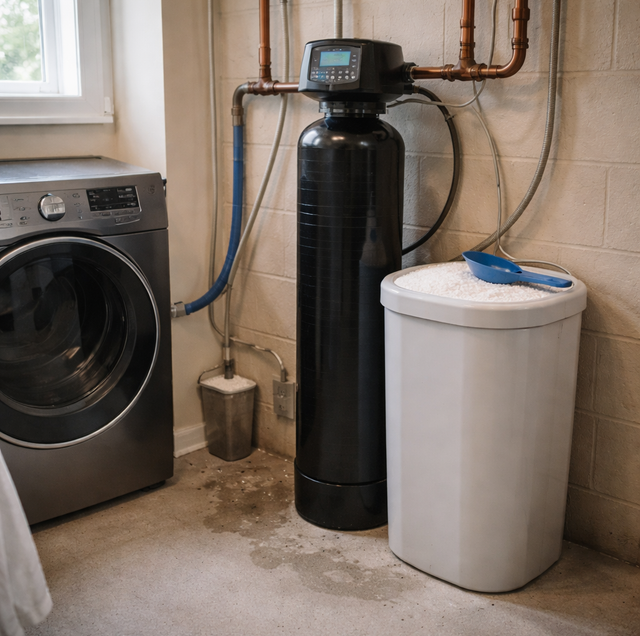
Quick Answer: A water softener removes dissolved calcium and magnesium from your water using ion exchange, swapping those hardness minerals for a small amount of sodium or potassium. That stops scale from building on fixtures, in pipes, and inside the water heater. You need one if a hardness test shows your water is meaningfully hard and you are seeing scale, spotty dishes, or soap that will not lather.
What Hard Water Actually Is
Water that falls as rain is close to pure, but the moment it moves through soil and rock, it starts dissolving minerals. The two that matter most are calcium and magnesium. When water carries enough of these, it is called hard, and the amount is measured in grains per gallon (gpg). Roughly 1 to 3.5 gpg is slightly hard, 7 to 10.5 gpg is hard, and anything above about 10.5 gpg is very hard.
Those minerals stay invisible while dissolved. The trouble begins when the water heats up or evaporates, because that is when calcium and magnesium drop out of solution and bond to whatever surface is nearby. That deposit is scale, the same chalky white crust you scrape off a showerhead or find crusted around a faucet base.
Hard water is not a health hazard. The calcium and magnesium in it are the same minerals people take as supplements. The problem is entirely mechanical: scale on surfaces, scale inside appliances, and a running fight with soap that never quite wins.
The signs you are living with hard water: Most homes show several of these at once:
- Scale on fixtures: Crusty white buildup on faucets, showerheads, and the rim of toilets and sinks.
- Spotty dishes and glassware: Even after a full wash, glasses come out cloudy or speckled because mineral residue dries on the surface.
- Soap that will not lather: Calcium and magnesium react with soap and bind it up before it can foam, so you use more shampoo, detergent, and hand soap for the same result.
- Dry, tight skin and dull hair: The film left behind, sometimes called soap curd, is the same residue that shows up as bathtub ring.
- A water heater that dies young: Scale settles at the bottom of the tank and coats the heating element or the burner surface, forcing the unit to work harder and cutting years off its life.
- Reduced flow at the tap: Scale narrows the inside of supply lines over time, and older galvanized pipe is especially prone to closing up.
If several of these match your home, a hardness test will confirm what is going on before you spend anything on a fix.
How a Water Softener Works
A softener does one job: it pulls calcium and magnesium out of the water before that water reaches your taps and appliances. The method is called ion exchange, and it is worth understanding before you shop, because it explains why some products labeled "softeners" do not actually soften.
Ion exchange in plain terms: Inside the softener sits a tank packed with thousands of tiny plastic resin beads. Each bead carries a negative charge and is loaded with sodium ions. Calcium and magnesium ions carry a stronger positive charge than sodium does, so as hard water flows through the bead bed, the resin grabs the calcium and magnesium and releases sodium in their place. Water leaves the tank soft, carrying a little sodium instead of the hardness minerals.
A useful way to see the swap: the resin bed works like a parking garage that only has room for so many cars. Sodium ions are cheap compact cars filling every space. When the bigger, higher-charge calcium and magnesium ions arrive, they push the small cars out and take the spots. Eventually every space holds a mineral ion, the garage is full, and no more swapping can happen until it is cleared out.
The three parts that make it happen: A standard salt-based system has two tanks and a control:
- The mineral tank holds the resin beads and is where the actual softening occurs as water passes through.
- The brine tank holds a reserve of salt (sodium chloride) or potassium chloride pellets mixed with water into a strong brine.
- The control valve meters water use and decides when the resin needs recharging.
Regeneration, the recharge cycle: Once the resin is loaded with calcium and magnesium, it has to be reset. That is regeneration. The control valve floods the mineral tank with concentrated brine from the brine tank. Sodium is present in such overwhelming quantity that it forces the calcium and magnesium off the beads, and the whole rinse, minerals and all, flushes out through a drain line. The beads finish loaded with fresh sodium and ready to soften again.
Older timer-based units regenerate on a fixed schedule whether you used much water or not. Metered, or demand-initiated, units track actual gallons and regenerate only when the resin is truly spent, which uses noticeably less salt and water over a year.
Salt-Based Softeners Versus Salt-Free Conditioners
This is where a lot of buyers get crossed up. Two very different products share shelf space, and only one removes hardness.
A salt-based softener does what the section above describes: it takes calcium and magnesium out of the water through ion exchange. The water that reaches your fixtures is truly soft, and scale stops forming because the minerals that create scale are gone.
A salt-free conditioner does not remove anything. It uses a process often called template-assisted crystallization, which nudges the dissolved calcium and magnesium into tiny stable crystals that are less likely to stick to surfaces. The minerals are still in the water. There is no brine tank, no regeneration, and no drain line, which appeals to people who want low maintenance or who cannot add sodium to their waste stream. The trade-off is real: a conditioner may reduce sticky scale, but it will not give you the slick lather, spot-free glasses, or lower soap use that true softening delivers, because your water is still technically hard. If your goal is to remove hardness, a conditioner is the wrong tool.
Sizing a Softener to Your Household
A softener that is too small runs out of capacity and regenerates constantly. One that is oversized wastes salt and water. Sizing comes down to two numbers multiplied together.
First, your water hardness in grains per gallon, from a test. Second, your daily water use, which is often estimated at 75 gallons per person per day. Multiply people by gallons by hardness, and you get the grains of hardness the system must handle each day. A family of four at 10 gpg, for example, needs a softener that can remove roughly 3,000 grains a day, and you size the unit's total grain capacity so it regenerates every few days rather than daily.
If your water comes from a well, add iron to the calculation. Iron fouls resin and is often counted as extra hardness (a common rule adds several grains of capacity for each part per million of iron), which is why well homes usually need a larger or specially rated unit.
Maintenance a Softener Needs
Salt-based systems are low-effort, not no-effort.
Keep salt in the brine tank at all times, since letting it run dry stops the resin from regenerating and hard water slips straight through. Once or twice a year, check for a hardened salt bridge that keeps the pellets from reaching the water below, and break it up by hand.
The resin itself lasts a long time but not forever. A well-maintained bed commonly runs 10 to 15 years; chlorinated municipal water and heavy iron both shorten that. When resin finally wears out, the unit stops softening even with plenty of salt on hand, which is one reason a hardness retest every so often is worthwhile.
So Do You Actually Need One
The honest answer starts with a test, not a purchase. Buy an inexpensive hardness test kit, or ask for a professional test, and get your number in grains per gallon. If the water reads soft to slightly hard and you are not seeing scale or lather problems, a softener may be money you do not need to spend. If it reads hard or very hard and you are already scraping fixtures, refilling soap, and nursing a scaled-up water heater, a softener pays you back in longer appliance life and less cleaning.
A few points worth weighing before you decide:
- Softened water carries a little sodium: For most people, the amount is small, but anyone on a sodium-restricted diet may want a bypass line feeding the kitchen cold tap unsoftened, a potassium chloride charge instead of salt, or a reverse osmosis unit for drinking water.
- Never drink from or dip into the brine tank: That is concentrated salt solution, not treated water.
- Installation is a plumbing job, not a weekend project. A softener ties into the main supply line, usually needs a drain connection for regeneration discharge, and requires a proper bypass valve so the house can still get water when the unit is serviced. Getting the tie-in, drain, and bypass right is where a licensed plumber earns the call.
Test first, match the unit to your hardness and household, and you end up with the right system rather than the biggest one on the shelf.
Frequently Asked Questions
A standard softener handles small amounts of dissolved (clear-water) iron as part of its hardness load, but it is not built to strip heavy iron staining or the sulfur smell of hydrogen sulfide. Those usually call for a dedicated iron filter or an aeration or oxidizing system installed ahead of the softener, so the softener is not fouled by iron it was never designed to remove.
A single regeneration typically flushes somewhere in the range of 25 to 65 gallons, depending on the unit's size and settings. That is why a metered, demand-based valve saves real money over an old-timer model: it only runs that flush when the resin is actually exhausted rather than on a fixed calendar, which over a year can be dozens of avoided cycles.
Yes. Potassium chloride pellets work in the same brine tank and regenerate resin the same way, which suits households avoiding sodium or worried about softened water reaching a septic field or garden. It is somewhat less efficient at recharging, so you may need to bump the salt-dose setting slightly to get the same softening.
Yes, that slick feeling is normal. Without calcium and magnesium to bind it, soap rinses away completely instead of leaving the faint curd film hard water creates, so your skin feels smooth rather than squeaky. People used to hard water sometimes read this as "not rinsing off," but it simply means the soap is gone.
A full regeneration cycle usually runs 90 minutes to 2 hours, and most units are set to run it overnight when demand is low. During that window, many single-tank systems send unsoftened water to the house, so it is best not to run laundry or a long shower mid-cycle; a twin-tank system avoids this by keeping one tank in service while the other recharges.
Short absences are fine, but resin left sitting unused for many weeks can grow bacteria or let iron set into the bed, which reduces its capacity. For a long trip, it is better to leave the unit running normally, or to manually trigger one regeneration when you return so the resin gets a fresh rinse before heavy use resumes.
Get your water tested and your softener sized right — protect your fixtures, pipes, and water heater from scale. East Coast Plumbing serves Boyertown, Pottstown, and Reading. Call (610) 944-2998.
