
Burst Pipe in a Rental Unit at 2 a.m.: What to Do Right Now
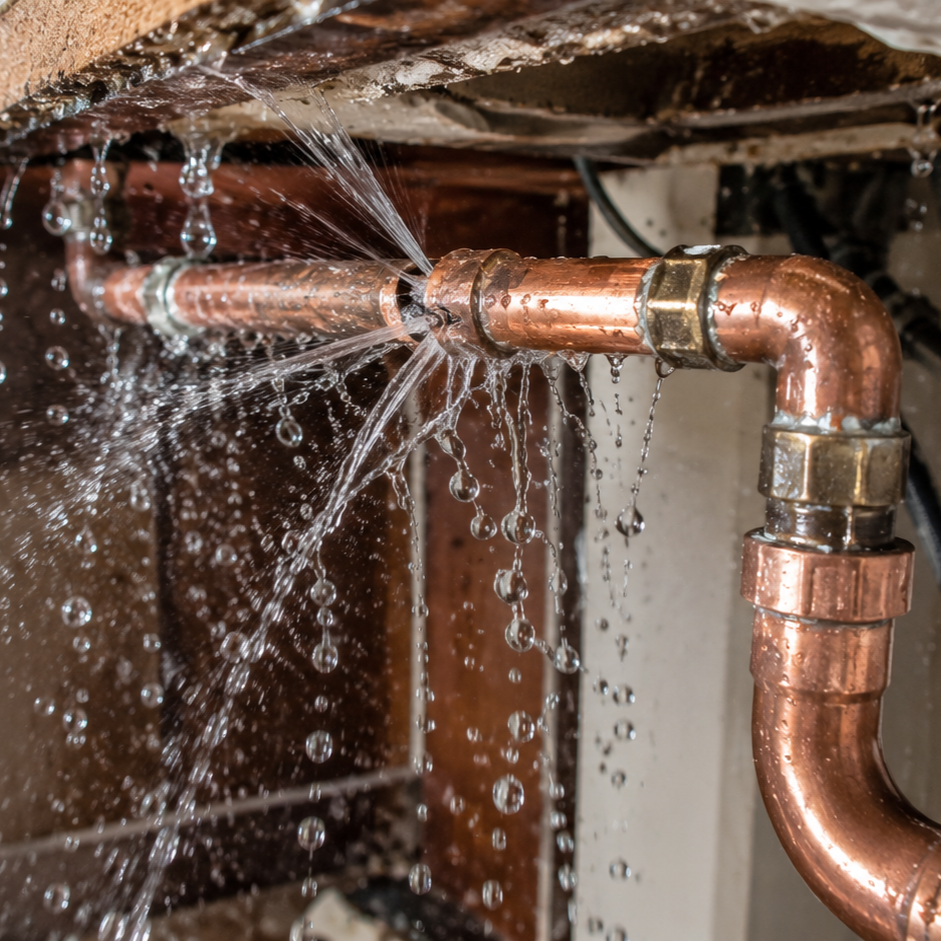
Your phone rings at 2:14 in the morning. The tenant in unit 2B is standing in an inch of water, she can hear hissing from behind the bathroom vanity, and the hallway carpet is already soaked through. She doesn't know where the main shut-off is. You're forty-five minutes away.
That's not hypothetical. It's a Tuesday in February in a house built in 1968 — original copper stub-outs, a basement that's been cold enough to sweat since October. Pipes burst in winter, but they also go in late spring when frozen ground thaws and shifts the lateral, or in summer when corrosion finally wins on a forty-year-old joint. The call comes when it comes. Being ready before the phone rings is the difference between a $900 pipe repair and a $14,000 remediation job.
This guide covers what needs to happen in the first minutes, first hours, and first few days after a pipe lets go in a rental unit overnight.
Why Pipes Tend to Let Go at Night
Pipes fail during the coldest hours because nighttime temperatures drop fastest between midnight and 4 AM. The house has been radiating heat all day. By the middle of the night, the crawlspace, the exterior wall cavities, and the uninsulated chase behind the bathroom have bled down to their lowest point in the cycle. Water expands about nine percent when it freezes. A copper pipe that looks fine at 7 PM can split at a joint by 1 AM if the temperature in that cavity drops below 28°F.
But freeze-thaw damage isn't the only overnight culprit. Corrosion failures don't announce themselves gradually — they fail at a joint, usually where two sections couple together, and they fail fast. A galvanized supply line that's been narrowing with mineral scale for a decade reaches a point where the remaining pipe wall can't hold pressure. The pressure spike that comes when the last appliance shuts off at bedtime is often what pushes it over.
In older properties — pre-1980 construction with original galvanized supply lines still in place — both failure modes are running simultaneously, all the time.
What a Tenant Should Do in the First Five Minutes
Every tenant should know one thing before they ever need it: where the water shut-off is and how to turn it. That's the whole job in the first five minutes. Stop the water from spreading.
| Step | Action | Who Does It |
|---|---|---|
| 1 | Locate and turn off the main water shut-off valve | Tenant |
| 2 | Turn off the electrical breaker if water is near outlets or panels | Tenant |
| 3 | Call the landlord emergency line or property manager | Tenant |
| 4 | Move belongings and electronics out of wet areas | Tenant |
| 5 | Photograph and video the damage before cleanup starts | Tenant |
| 6 | Do not use the bathroom or kitchen until a plumber clears it | Tenant |
Most tenants have never touched the main shut-off. It's in the basement, in the utility closet, or behind a door they have never opened in two years of renting. If they don't know where it is, they can't use it — and while they're looking, water is running. The landlord's job is to make sure that information is communicated before an emergency, not during one.
A piece of paper taped inside the electrical panel door with the valve location written on it costs nothing. A laminated card left in the kitchen drawer takes sixty seconds to make. Either one can stop three hours of water spread.
What a Landlord Needs to Have Ready Before This Happens
Being ready for an overnight burst pipe isn't about reacting faster. It's about setting things up so fast reaction is possible when the call comes at 2 AM.
Start with the emergency contact chain. The tenant needs a number that actually gets answered in the middle of the night. Whether that's your cell, a property management line, or a dedicated answering service — it has to exist and it has to work. A voicemail box that gets checked Tuesday morning is not an emergency contact.
And you need a licensed plumber who handles after-hours calls. Not every plumbing shop does overnight emergency work. The time to find out which one serves your area and what they charge for an after-hours dispatch is not 2 AM when you're on the phone with a panicked tenant. Have that number saved. Keep a backup.
The last piece is the shut-off valve location — documented, shared with the tenant, and known by you. The main water shut-off is usually in the basement or utility room, but it varies building to building. On multi-unit properties it can be locked in a mechanical room only the landlord accesses. Know where each unit's individual supply shut-off is, know where the building main is, and make sure both of those locations are communicated to the tenant before move-in.
Getting a Plumber There at 2 AM: What to Expect
After-hours emergency rates run 1.5 to 2 times the standard labor rate, plus a dispatch fee on top. That's the reality of emergency work. Fighting it wastes time you don't have.
When you call, have ready: the property address, the unit number, what the tenant can describe about the failure (where the water is coming from, whether it's been shut off, whether the shut-off is accessible), and whether the tenant can let the plumber in or if you need to arrange access separately.
A good plumber arriving at 2 AM will confirm the water is off, locate the failure point, make the repair, and tell you what needs to happen next for remediation. What they won't do is dry out the walls or assess mold. That's a separate call — and it needs to happen at first light, not days later.
The 24-48 Hour Mold Clock
The pipe repair is the beginning of the job, not the end. Once the water is stopped and the emergency work is done, the mold clock starts running. Mold spores are already present in the air of any building. They need moisture and something to grow on. Drywall, subfloor, and wood framing give them both — colonies can establish within 24 to 48 hours of water exposure in a warm building.
Think of waterlogged drywall like a wet sponge left on a counter: the surface dries within a few hours, but the core stays saturated for days. A thermal camera or moisture meter finds saturation in wall cavities that looks bone dry to the eye. If that hidden moisture isn't addressed, mold grows inside the wall while everything on the surface looks fine.
Calling a water damage restoration company the morning after a burst pipe — not waiting to see how things dry — is what keeps a one-night event from becoming a multi-week remediation. Industrial drying equipment pulls moisture from wall cavities and subfloors in ways that fans and dehumidifiers don't match. Earlier is always cheaper.
Documenting the Damage Before Anything Gets Cleaned Up
Before cleanup starts, before any remediation crew moves anything, document everything. Photographs and video are the basis for an insurance claim, for the record of what the tenant's belongings sustained, and for any later question about the extent of the damage.
Capture the failure point. Capture every affected room. Get water on floors, water lines on walls, and soaked materials on camera. If the tenant's furniture was damaged, photograph that too — even though the landlord's insurance doesn't cover personal property, the documentation establishes what happened and when.
Write down the timeline: when the pipe failed or was discovered, when the water was shut off, when the plumber arrived, what repair was made, when the restoration company was called. That written record matters when an insurance adjuster needs to establish the cause of loss.
Housing, Rent, and Insurance After the Fact
If the damage is significant enough that the tenant can't reasonably use part or all of the unit, they're entitled to a rent reduction proportional to what they've lost access to. A bathroom that's being dried out and rebuilt is a real loss. Document it, agree on a fair credit, and put it in writing before the repair work wraps up.
Landlord insurance covers sudden and accidental events like pipe bursts under most standard policies. Contact your insurer as soon as the emergency repair is complete — don't wait for the remediation estimate. The sooner the claim is open, the sooner the adjuster can be scheduled and work can move forward.
The tenant's personal belongings — furniture, electronics, clothing — aren't covered by the landlord's policy. That's what renter's insurance is for. Worth communicating at lease signing, not at 2 AM.
Frequently Asked Questions
The tenant can and should shut off the water if they know where the valve is. Getting the water off immediately limits damage. But the landlord is responsible for making sure the tenant knows the valve location before an emergency occurs. If the only person who knows where the shut-off is lives forty-five minutes away, that's a preparation failure — not a tenant failure.
Yes — licensed plumbers who offer emergency service are available 24/7. After-hours calls carry premium rates, typically 1.5 to 2 times the standard labor rate plus a dispatch fee. In an active-leak emergency, that cost is worth paying immediately. Delaying until morning adds hours to the water exposure and makes the remediation job larger.
Generally, the landlord's policy covers the structure and landlord-owned property — not the tenant's personal belongings. If the pipe failed due to deferred maintenance you knew about and ignored, that changes things, but in most burst-pipe scenarios the tenant's belongings fall under their own renter's insurance. Encouraging tenants to carry it at lease signing is worth the thirty seconds it takes to mention.
Mold can start establishing within 24 to 48 hours in a warm building with waterlogged materials. The visible signs often lag behind — you may not see mold on the surface for days, even as colonies grow inside wall cavities. Water damage restoration within the first 24 hours after a burst pipe is what keeps that risk from becoming a serious problem.
The tenant should document everything immediately — before cleanup, before moving anything. Photographs and video on a smartphone take minutes and create a permanent record. Don't wait. The landlord's arrival could be an hour away, and what the unit looked like at 2 AM matters for everything that follows.
Not automatically. If part of the unit is unusable during repair and remediation, the tenant is typically entitled to a proportional rent reduction for those days. If the whole unit is uninhabitable, a full credit is appropriate. Calculate it, agree on it, and write it down — both parties need that in writing before the repairs are finished.
When a pipe lets go at 2 AM, the situation stops being a property management problem and becomes a physical one. Water doesn't wait for business hours. Having the shut-off location communicated, the emergency plumber number saved, and a restoration company you can call at first light — that's the preparation that determines whether a burst pipe costs $900 or $14,000. Not luck.
