
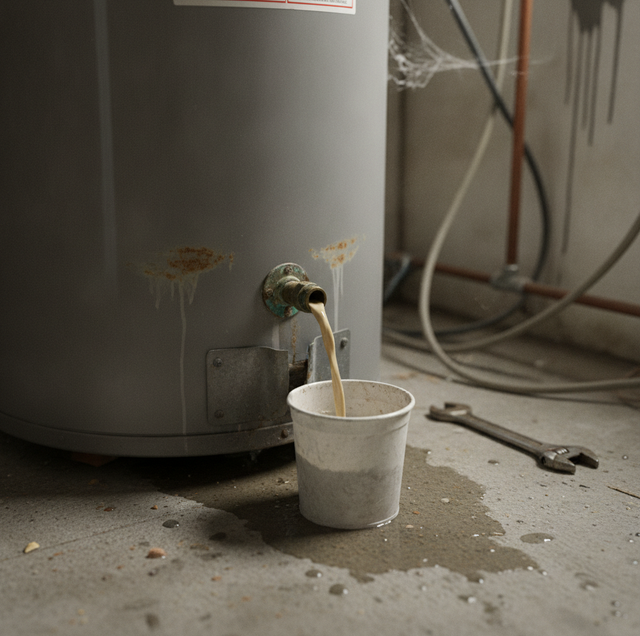
The water heater is the appliance you never think about until the morning it hands you a cold shower with no warning. It sits in a closet or the basement doing its job quietly for years, and then it fails, often at the worst possible moment and sometimes with a leak that floods the floor. The good news is that a water heater rarely dies without warning. It gives off signals for weeks or months first, if you know what to watch for.
Catching those signs means replacing the heater on your schedule, in a planned way, instead of scrambling after it has already flooded the utility room.
Age Is the First Clue
Before any symptom, look at the calendar. A conventional tank water heater generally lasts about 8 to 12 years, and once it passes that range, the odds of failure climb regardless of how it seems to be running. If you do not know its age, the serial number on the label usually encodes the date of manufacture. A heater in its second decade that starts showing any of the symptoms below is not a candidate for one more repair; it is telling you to plan its replacement. Age alone is not a reason to replace a healthy heater, but age plus symptoms is a clear signal.
The Warning Signs Worth Watching
A failing heater tends to show several of these, and together they paint a clear picture.
| Sign | What it usually means |
|---|---|
| Rusty or discolored hot water | The tank is corroding from the inside |
| Rumbling or popping from the tank | Sediment has hardened on the bottom |
| Water pooling around the base | A tank leak, often the beginning of the end |
| Not enough hot water, or lukewarm | Sediment or a failing element reducing capacity |
| Rising energy use to heat water | The heater working harder as it degrades |
| Frequent repairs | The system is nearing the end of its life |
Rusty hot water is one of the most telling, because it points to the tank corroding from the inside, and a corroding tank eventually leaks. Rumbling or popping is the sound of water bubbling up through a layer of hardened sediment on the tank bottom, which makes the heater work harder and wear faster. The most urgent sign is water pooling around the base: a leaking tank has usually failed structurally, and a small pool can become a flood, so it should be looked at right away.
Why Catching It Early Pays Off
The reason to watch for these signs is simple: a planned replacement beats an emergency one every time. When a heater fails outright, you get the cold showers, the rush to find a plumber on short notice, and, if the tank ruptures, water damage to whatever is nearby. When you catch the warning signs first, you replace them calmly, on your terms, before any of that happens. A leak in particular is not a wait-and-see sign, because a failed tank can let go and empty dozens of gallons onto the floor. Reading the early signals turns a potential emergency and a soggy floor into a scheduled, uneventful swap. A planned replacement also lets you weigh your options without pressure, choosing the right size and type for the household, including whether a higher-efficiency tank or a tankless unit makes sense, rather than grabbing whatever can be installed fastest. And it lets the work happen on a normal day, with the water shut off briefly and the new unit set before anyone misses the hot water.
Why the Local Conditions Matter
A water heater's life depends partly on what it has to deal with, and local conditions are not gentle. Mineral content in the water accelerates the buildup of sediment on the tank bottom and the corrosion that eats away at the tank from within, so heaters can age faster than the label suggests. Cold winters increase demand, making the heater work harder to raise incoming cold water to temperature, which further stresses an aging unit. In older homes with older plumbing, the heater is often another aging component, so watching for these signs and flushing the tank periodically to clear sediment both help it reach the far end of its lifespan rather than the near end.
Frequently Asked Questions
A conventional tank runs about 8 to 12 years, and the single part that decides where it lands is the anode rod, a sacrificial magnesium or aluminum rod inside the tank that corrodes on purpose so the steel does not. That rod is often used up in three to five years, and once it is gone, the tank itself starts corroding. Checking and replacing the anode before it dissolves, along with flushing out sediment, is what carries a tank to the far end of its range rather than the near one. On a unit already past a decade, a fresh rod will not reverse a tank that has begun to rust through.
Yes, the temperature and pressure relief valve (T&P valve) is the one safety device that prevents a tank from becoming dangerous if the thermostat sticks. Once a year, with a bucket under the discharge pipe, lift its lever briefly and it should release a burst of water and reseat cleanly. If nothing comes out, it is seized and needs to be replaced; if it dribbles and will not stop afterward, it is worn. A valve that is crusted shut with mineral scale is a real hazard on an aging heater, and a slow drip from its discharge pipe can also mean the tank is running too hot or the system pressure is too high.
Two cheap additions catch a leak before it becomes damage. A drain pan under the tank, piped to a floor drain or the outside, carries away a slow seep rather than letting it pool, and it is worth adding for any heater sitting above a finished space or in an attic. Pairing it with a battery water-leak sensor, a small puck that alarms the moment its contacts get wet, turns a hidden overnight drip into a warning you actually hear. On aging tanks, some homeowners go a step further with an automatic shutoff valve that closes the water supply when the sensor trips, which matters most when the heater is somewhere you rarely walk past.
The mechanism is heat that has nowhere to go. On a gas unit, the burner sits under the tank, and a hardened layer of mineral sediment on the bottom acts like a blanket between the flame and the water. The steel underneath overheats because the water can no longer carry that heat away, and the enamel lining bakes, cracks, and allows corrosion to start, which is the popping you hear as trapped water flashes to steam beneath the crust. On an electric unit, sediment buries the lower heating element, so it burns out early or runs constantly. Either way, flushing a few gallons from the drain valve once or twice a year keeps that layer from building in the first place.
If flushing does not bring it back, the fix may be sizing rather than repair. Water heaters are rated by first-hour rating, the gallons of hot water they can deliver in the busiest hour, not just tank size, and a household that has added people or a big soaking tub can simply outgrow the old unit. A worn dip tube, the plastic tube that sends incoming cold water to the bottom to be heated, is another quiet cause: when it cracks near the top, cold water short-circuits straight to the hot outlet and lukewarm water arrives sooner. Matching the first-hour rating to your real peak demand is what a planned replacement lets you get right.
It depends on age and symptoms. A younger heater with a single, fixable issue is worth repairing. A heater past about a decade that shows rust, leaks, or recurring problems is usually better replaced, because additional repairs on an aging tank tend to be money spent on borrowed time. Age plus symptoms is the signal to replace.
Replace It on Your Terms, Not Its
A water heater almost always warns you before it quits: rusty water, rumbling, a damp base, fading hot water, climbing energy use, and simple old age. Read those signs, especially past the ten-year mark, and you get to replace the heater as a planned job instead of an emergency with a cold shower and a flooded floor. Watch the warnings, act before the leak, and the appliance you never think about stays that way.
If your water heater is showing its age or leaking at the base, replacing it on your schedule beats a flooded floor. East Coast Plumbing serves Barto, Boyertown, Pottstown, and the surrounding area. Call (610) 904-9069.
