
Reverse Osmosis: What Your Filter Leaves in Drinking Water
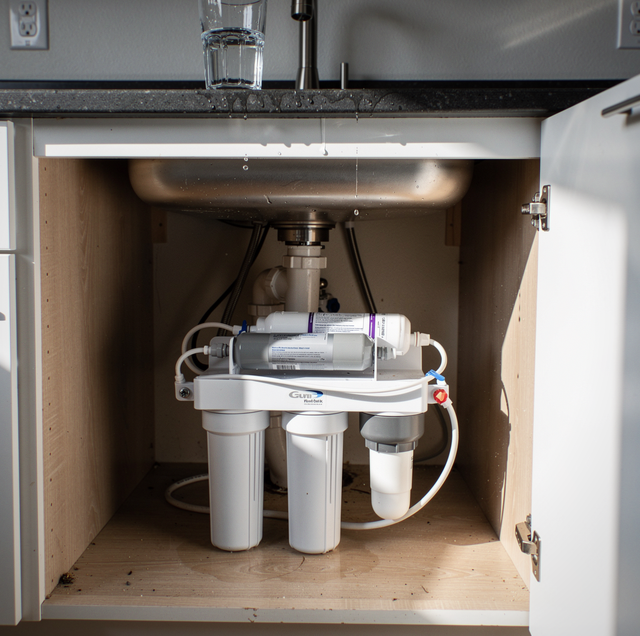
You fill a glass at the kitchen tap in a house that already has a softener in the garage and a carbon cartridge under the sink, and the water still tastes of nothing in particular, flat or faintly bitter depending on the source. A carbon filter removes chlorine and organic compounds from the water by adsorption. A softener swaps calcium and magnesium out of solution for sodium. Both are working. Neither is a barrier to dissolved ions as a class, so sodium, chloride, sulfate, nitrate, fluoride, dissolved lead, and dissolved copper travel through both and arrive at the tap at concentrations close to their starting values.
That gap is the entire argument for reverse osmosis at a drinking-water tap. It is also why the argument has limits worth understanding before a unit goes under a sink.
What Carbon and Ion Exchange Leave in the Glass
Adsorption is a surface process. Activated carbon offers an enormous internal surface area, and molecules only weakly attracted to water stick to that surface and stay behind: chlorine, chloramine (where the carbon is catalytic), many volatile organic compounds, and the compounds behind musty or chemical odors. Charged, highly soluble ions have no reason to leave water for a carbon surface, so they do not. Ion exchange is a trade rather than a removal. Hardness ions come off, sodium goes on, and the total dissolved solids number barely moves.
Point-of-entry filtration, plumbed where the service line enters the house, is a separate scope with separate goals. Rust-colored water and grit in a hot tap are their own diagnoses as well.
| Treatment | Mechanism | What it addresses | What passes through |
|---|---|---|---|
| Softener | Ion exchange: hardness out, sodium in | Calcium, magnesium, low levels of dissolved iron | Nitrate, fluoride, chloride, sulfate, dissolved metals |
| Activated carbon | Adsorption onto pore surfaces | Chlorine, chloramine, volatile organic compounds, taste and odor | Dissolved salts, nitrate, fluoride, dissolved metals |
| Reverse osmosis | Pressure-driven rejection at a membrane | Dissolved solids broadly, including nitrate, fluoride, lead, copper, chromium | Dissolved gases and some small uncharged molecules |
Rejection Is a Percentage, Not a Pass or Fail
A reverse osmosis membrane is a thin-film composite: a polyamide skin a fraction of a micron thick, bonded to a porous support layer and rolled into a spiral element. Pressure on the feed side pushes water molecules through that skin. Dissolved ions are held back by two effects working at once: their physical size and their electrical charge, and the water carrying them away leaves the housing as a concentrated stream headed for the drain.
Nothing about that is absolute. Performance is quoted as a rejection rate, the percentage of a given contaminant kept out of the finished water, and residential membranes are typically rated at 95 to 99 percent for total dissolved solids under standard test conditions. Because the figure is a percentage, the feed concentration decides the number at your tap. A 95% rejection on water carrying 400 parts per million of dissolved solids results in near 20 ppm. The same membrane fed 40 ppm finishes near 2. A national testing standard is written for these systems, and a rated unit is validated against specific contaminants rather than a general promise.
Dissolved Salts and the Total Dissolved Solids Number
Total dissolved solids is the sum of everything in solution: sodium, chloride, sulfate, bicarbonate, calcium, magnesium, silica. Rejection is not even across that list. Divalent ions, those carrying two charges, such as sulfate and calcium, are held back the most, often above 98 percent. Monovalent ions such as sodium and chloride carry a single charge, sit smaller in solution and slip through more readily, usually 90 to 96 percent.
That split explains a result homeowners find odd. Water that tastes salty or bitter usually owes it to chloride and sulfate, and a membrane takes both down sharply while leaving a trace of each behind. Carbon does nothing to either, because neither has any reason to adsorb, and a softener does nothing to either. The dissolved solids number after a softener is the same as before, rearranged.
Nitrate, Fluoride and the Small Monovalent Ions
Nitrate is the case where the monovalent penalty matters most. It is small, singly charged and highly soluble, and it moves through soil into groundwater from fertilizer, manure and failing septic systems. Carbon does not adsorb it, and softener resin will not hold it in preference to hardness. A membrane does reject it, but at the low end of the range, commonly 85 to 95 percent rather than the high nineties.
Fluoride behaves much the same way and lands in a similar band. Both carry enforceable federal limits in public water, which is why the certification standard carries named reduction claims for nitrate, nitrite, and fluoride. Look for the claim, not the category. A system certified for taste and odor was tested for taste and odor, nothing else.
Dissolved Metals, and Where Arsenic Splits in Two
Lead and copper reach drinking water at the tap end of the system, dissolved out of solder joints, brass fittings, and copper pipe wall by water that is soft, acidic, or standing still overnight. In solution, they are ions, and a membrane rejects them efficiently, typically above 95 percent, which is why the certification standard lists lead, copper, cadmium, and both chromium species among its reduction claims.
Arsenic is the exception worth knowing, because it exists in two forms and the membrane treats them very differently. Pentavalent arsenic, arsenic V, carries a charge at ordinary drinking-water pH and is rejected well. Trivalent arsenic, arsenic III, is uncharged across that same pH range, so charge exclusion contributes nothing and rejection falls off badly. The correction is chemical rather than mechanical: an oxidizing step upstream of the membrane converts arsenic III to arsenic V, allowing the membrane to act on it. Arsenic reduction claims under the certification standard are written for the pentavalent form for exactly this reason, and a raw-water test reporting total arsenic without separating the two forms will not tell you which problem you have.
What the Membrane Does Not Stop
Dissolved gases pass. Carbon dioxide, hydrogen sulfide and radon are not ionized in solution, so neither size exclusion nor charge exclusion applies and they cross the membrane with the water. A sulfur smell survives reverse osmosis; it gets handled upstream or not at all. Some small uncharged organic molecules cross for the same reason, which is why a carbon block usually sits both before and after the membrane.
More important is what a membrane must never be asked to do. Reverse osmosis is not a disinfection method. A residential unit is not certified as a microbiological purifier unless tested to that much higher bar; a membrane can develop a flaw invisible from outside; and the tank, tubing, and faucet downstream are not sterile and never were. Water of unknown bacteriological quality is disinfected first by a method chosen for that purpose. The membrane is a chemistry tool.
The Water and Pressure a Membrane Costs You
A membrane only works if the rejected ions have somewhere to go, and that somewhere is the drain. A conventional residential unit sends roughly three to four gallons to the drain for every gallon it delivers to the tank. Higher-recovery designs and a permeate pump that uses the energy of the drain flow to push against the storage tank bring that closer to 1:1. The ratio is set when the unit is specified, not adjusted later.
Pressure decides most of the rest. Net driving pressure is feed pressure minus the back-pressure of the filling storage tank, so production slows and rejection slips as the tank fills. A house on a well whose pressure switch cycles in the low forties, or one at the far end of a long municipal run, often needs a booster pump to reach the unit's rating.
Membranes are rated for roughly 50-60 psi at 77 degrees. Below about 40 psi at the unit, both output and rejection fall off, so a pressure reading at the cold supply under the sink belongs in the sizing conversation.
Recovery is the part people notice at the faucet. A tank sold as three gallons delivers roughly two-thirds of that, because part of the internal volume is the air charge that pushes the water back out. A membrane rated at 50 gallons per day produces about 2 gallons per hour under good conditions and less under poor ones, so a tank emptied by a stockpot takes hours to refill.
Never run an RO unit on water of unknown bacteriological quality. A membrane is a chemistry barrier, not a disinfection step, and a residential unit is not tested as a microbiological purifier unless it carries that specific claim. Disinfect first, then treat.
Flat Taste, Remineralization and Cartridge Life
A membrane cannot sort minerals people want from ions they do not. Calcium and magnesium leave with the sulfate and nitrate, and the water reaching the faucet is low in dissolved solids and alkalinity. Plenty of people call the result flat or thin for the first week, and coffee brewed with it tastes different because extraction shifts with mineral content. A remineralization cartridge on the outlet, usually calcite or a calcium and magnesium blend, adds a small measured amount back and lifts the pH slightly. Decide on it before the unit goes in rather than after.
Cartridge life is the standing obligation. Sediment and carbon prefilters typically run for 6 to 12 months, and they are not a courtesy stage: free chlorine attacks the polyamide skin, and a prefilter left past its capacity lets chlorine reach the membrane and quietly ruin it over a few weeks. The membrane itself lasts 2 to 5 years when fed properly. The postfilter, a small carbon polisher between tank and faucet, goes yearly. Skip the small stages and the large one fails first.
Frequently Asked Questions
Compare the dissolved solids going in with those coming out, using a handheld TDS meter at the cold supply and again at the RO faucet. Rejection is the feed reading minus the permeate reading, divided by the feed reading. Record that percentage when the system is new, then repeat the check once or twice a year. Once rejection has fallen to about three-quarters of the original figure, the membrane is finished, whatever its age.
Yes, and the reason is backflow, not preference. The concentrate line ties into the sink drain, most often through a saddle clamped above the trap arm, and it discharges through an air gap so nothing in the drain can be siphoned back toward the treated side. That air gap is either built into the RO faucet or supplied as a separate counter fitting, and getting the arrangement right on a potable supply is the plumber's part of the job.
New carbon cartridges shed fine black particles during the first several minutes of flow, and a new membrane usually ships with a food-grade preservative that has to be flushed out. Drain the storage tank and discard the first two full tank fills before anyone drinks from it. Air trapped during the change also makes the faucet sputter for a day, which clears as the tank cycles.
It is a common arrangement, and the two things to plan for are shared flow and distance. The ice maker draws from the same tank as the faucet, so a heavy ice cycle and a pitcher fill compete for the same couple of gallons. The quarter-inch tubing normally used adds friction loss over a long run, and a run beyond about 20 feet, especially with several tight bends, is where cubes start coming out hollow or undersized.
Membranes are among the treatment options studied for these compounds, and some residential systems now carry a specific certified reduction claim for PFOA and PFOS. That named claim is what to look for. PFAS covers thousands of compounds, and only a couple appear in current test protocols, so a claim for PFOA and PFOS is not a claim for the family. Ask which analytes the certificate names.
A healthy system shuts itself off. An automatic shutoff valve senses tank pressure and closes the feed once the tank reaches roughly two-thirds of incoming line pressure, and a check valve on the permeate line keeps stored water from pushing backward through the membrane. If either part fails, the unit runs continuously, and everything it makes goes to the drain, which shows up as a faint constant trickle in the sink and a jump in water use. Both are diagnosed in a single visit.
Have your water tested and your point-of-use options reviewed — get a membrane matched to what is actually in your water, not a guess. East Coast Plumbing serves Barto, Boyertown, Pottstown. Call (610) 944-2998.
