
The inspector doesn't call ahead. You get a notice — or sometimes you don't get one at all — and suddenly there's someone in your kitchen lifting the lid on your grease trap with a flashlight and a clipboard. What they find in the next five minutes determines whether you walk out with a fine, a compliance order, or a temporary closure.
Most of the violations inspectors write up aren't surprises. They're things that were visible for weeks before anyone showed up. A grease trap in trouble doesn't hide it. The signs are in your drains, in your kitchen's smell, in the trap itself — if you know what to look for.
Here's how to read those signs before someone else does it for you.
Quick Reference: What a Grease Trap Inspector Is Looking For
| What Inspectors Check | What They Want to See |
|---|---|
| FOG layer depth | Less than 25% of total trap depth |
| Effluent clarity (outlet side) | Clear or near-clear water |
| Baffle walls | Intact, properly configured, no cracks |
| Inlet/outlet fittings | Secure, correctly installed |
| Connected fixtures | Only appropriate fixtures; no high-temp bypass |
| Water temperature at inlet | Below the point that liquefies grease |
| Service records / manifest | Pumping history matches trap condition |
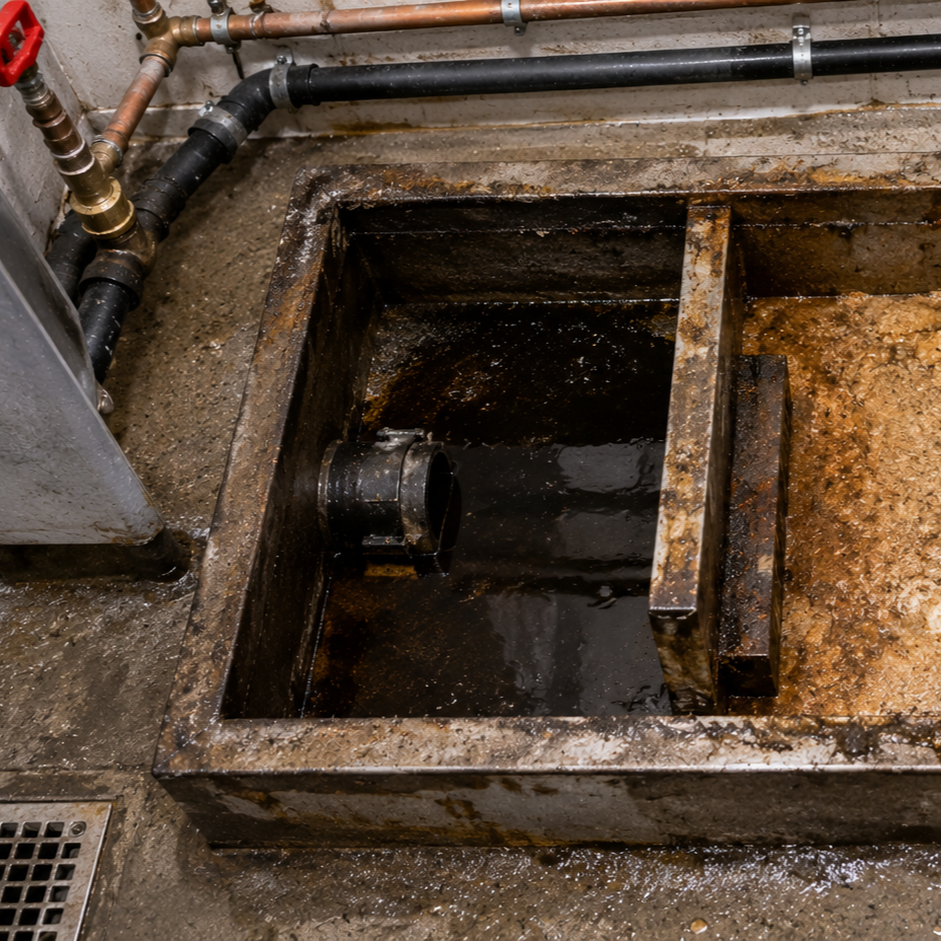
The FOG Layer Has Grown Past the 25% Threshold
A grease trap works through separation. Fats, oils, and grease — collectively called FOG — are lighter than water. When wastewater enters the trap, the FOG floats to the top and the cleaner water passes through to the sewer. That floating layer grows every day.
The standard benchmark is that the combined FOG and solid waste layer should never exceed 25% of the trap's total liquid depth. Once it crosses that line, the trap can no longer do its job. The FOG starts carrying over into the outlet and into the sewer.
You don't need an inspector to tell you when you've crossed the threshold. Open the trap yourself. Get a rod or a long stick and measure the depth of the floating layer against the total depth of liquid in the first chamber. If your numbers are at 20% or above, you're close. At 25%, you're already in violation territory in most municipalities.
The catch: most managers just glance at the surface, and the surface lies. The water layer looks relatively clear on top. The heavy accumulation is at the floating mat and at the bottom — and neither is obvious from a quick look.
The Outlet Side Is Carrying Grease into the Sewer
The inlet side of a grease trap is where dirty water comes in. The outlet side is where treated water exits toward the sewer. An inspector will look at both — and what comes out of the outlet is the real test of whether your trap is functioning.
Clean effluent on the outlet side should be close to clear. If you pull the outlet cover and see milky, cloudy, or visibly greasy water on the discharge side, grease is already making it through. That's a direct sewer violation.
This happens in a few situations: the trap is overfull, the baffle wall separating the chambers is compromised, or the water entering the trap is too hot to allow separation. Think of the separation process like letting bacon drippings sit in a pan — if you keep the heat on, the fat stays liquid and mixes with the water. Cut the heat, and it floats to the top. A grease trap works on the same principle. Hot water disrupts the whole process.
The Baffle Walls Are Cracked, Missing, or Installed Wrong
The baffle wall sits between the first and second chambers inside the trap. Its job is to force water to drop below the floating FOG layer before it passes through — preventing grease from carrying over to the clean side.
When baffle walls fail, the trap becomes a straight-through pipe with a brief stop in between. Inspectors look specifically at baffle wall condition during every visit. Cracks, corrosion, or physical damage will get flagged. So will a baffle that was installed at the wrong height — too high and water flows over the top of the grease layer instead of under it.
In older commercial buildings — and there are a lot of them in Montgomery and Berks Counties, buildings that were originally restaurants or luncheonettes in the 1950s and 1960s — the baffle walls inside original cast-iron traps are often corroded to the point where they've lost structural integrity. The trap looks intact from the outside. Open the lid and the baffles are thinned down or gone.
The Wrong Fixtures Are Connected to the Trap
Renovation work is the usual culprit here. Equipment gets added, the plumbing gets rerouted, and nobody rechecks the fixture map against what's supposed to drain into the trap.
The pre-rinse sink handles 70 to 80 percent of the FOG that moves through a commercial kitchen. It has to connect to the grease trap. So do prep sinks, floor drains under cooking equipment, and compartment sinks.
What should not connect to the grease trap: the commercial dishwasher, pasta vats, or any equipment that uses water above 140°F. High-temperature water melts FOG and turns it back into a liquid that passes straight through the trap and into the sewer. If a dishwasher is plumbed into your grease trap instead of bypassing to the main sewer line, you're in violation — and the inspector will find it.
The way inspectors confirm fixture routing is a dye test. A safe, biodegradable dye is added to each sink and drain in the kitchen. Colored water shows up in the trap for fixtures connected to it. If the dishwasher's dye shows up in the trap, there's a problem. If the pre-rinse sink's dye doesn't show up in the trap, that's also a problem. Either way, that's a citation.
The Smell Has Moved Outside the Kitchen
A grease trap has an odor. Anyone who works in a commercial kitchen knows that. When the trap is working properly and being maintained on schedule, the smell stays contained — it's a background presence when you open the clean-out lid, not something that wanders into the prep area or the dining room.
When the smell starts showing up where it shouldn't, the trap is either overdue for service or there's a structural failure allowing gases to escape. Hydrogen sulfide — the rotten-egg component of decomposing organic waste — is what you're detecting. That gas is also what inspectors and health department officials pick up on during a walkthrough before they even get to the trap itself.
A grease trap works a bit like the P-trap under a household sink. The water seal inside is what keeps sewer gases from rising back through. A trap that hasn't been pumped in months starts losing that seal as the solids build up, and the gas has nowhere to go but up and out.
If customers have commented on an odor, or your prep kitchen staff mentions it in the morning before service, that smell is a direct signal that your trap is past due.
Your Service Records Don't Match the Trap
This is the violation that catches operators off guard the most. You've had the trap pumped. You have a receipt somewhere. But the manifest — the service record that documents who pumped the trap, when, how much was removed, and where it was hauled — doesn't match what the inspector can see in the trap.
Most municipalities require grease trap service records to be kept on-site and available on request. The manifest system exists so inspectors can verify that waste was disposed of properly. If you can't produce service records on the day of an inspection, that's a documentation violation regardless of the trap's physical condition.
The inverse also happens: you have records showing four pumping visits in the past year, but the trap looks like it hasn't been touched in eighteen months. Either the documentation is incomplete, the pumping wasn't thorough, or the trap is sized too small for the volume your kitchen produces. Any of those scenarios results in a finding.
What Happens After a Failed Inspection
A failed grease trap inspection doesn't always mean a closure, but it means a clock starts. The inspector will typically issue a notice of violation with a correction window — often 30 to 60 days, depending on severity. Minor findings, like a documentation gap, may get a shorter window and a modest fine. Structural failures, confirmed FOG discharge to the sewer, or a completely overloaded trap can result in a cease-and-discharge order and steeper fines.
The sewer authority and the health department operate somewhat independently. A violation with one doesn't automatically trigger the other — but a pattern of grease trap violations can draw attention from both.
The restaurants that get through inspections without consequences are usually the ones that treat the grease trap like any other piece of kitchen equipment: they know its service interval, they have a vendor, and someone on the management team checks the trap at least monthly.
Frequently Asked Questions
The widely used threshold is 25% — meaning the combined FOG and solids layer should not exceed 25% of the total liquid depth in the trap. Some municipalities apply stricter standards. An inspector with a flashlight and a measuring rod can estimate this in seconds. A trap that hasn't been serviced in four to six months is often well past that point by the time they arrive.
Yes. Service documentation is a separate compliance requirement from the physical condition of the trap itself. If you cannot produce a pumping manifest when asked, that is a citation regardless of whether the trap is functioning properly. Some operators have a well-maintained trap and still walk away from an inspection with a fine because the records weren't on-site.
Not necessarily — but it's a serious warning sign. A strong sulfur or rotten-organic odor near floor drains or in the prep kitchen means gases are escaping, which usually means the trap is overdue for service. An inspector picking up that odor during a health walkthrough is going to open the trap. If they find it overfull, the smell becomes evidence rather than just an observation.
The general rule is to inspect every 30 days and schedule full service when the FOG layer reaches 25% of trap depth — which for a busy kitchen often means pumping every four to eight weeks. Very high-volume kitchens may need service every two to three weeks. The exact interval depends on kitchen volume, menu type (high-fat menus fill traps faster), and trap size. A trap sized for a 1960s diner that now runs a full breakfast and lunch service will fill far faster than the original equipment schedule anticipated.
A second violation in a short period typically results in higher fines, a shorter correction window, and sometimes a mandatory compliance plan — which may include more frequent inspections at the restaurant's expense. Repeated failures in the same inspection cycle can lead to a suspension of the food service permit.
Often, yes. If you receive advance notice of an inspection, a licensed plumber can assess trap condition, check the baffle walls and fittings, verify fixture routing with a dye test, and coordinate a pump-out if needed. The window before an inspection is also the right time to get your manifests in order. An inspector who arrives to find a recently serviced trap with documented records is in a very different situation than one who finds a neglected trap with no paperwork.
Grease trap inspections feel adversarial, but most inspectors are there to verify compliance rather than shut kitchens down. The operators who run into real trouble are usually the ones who haven't looked in the trap in months. The signs of a failing trap — the odor drifting out of the kitchen, the slow floor drains, the water that looks wrong on the outlet side — give you time to act before the inspector does.
