
You plunged the drain, the water finally went down, and two days later, you are standing in an inch of soapy water again. That cycle — slow drain, plunge, short-lived fix, slow drain — is one of the more frustrating things a bathroom can do to you. And it happens for a reason.
Plunging is designed to break apart or dislodge soft, localized blockages near the drain opening. When the real problem sits further down the pipe, or isn't a clog at all, a plunger can't reach it. The water clears briefly because you've moved something. You haven't removed it.
Why plunging gives temporary relief but doesn't hold
Here is the thing most people don't know about plunging a bathtub: the overflow plate is working against you.
That oval opening near the top of the tub wall connects directly to the drain line. When you plunge without sealing it first, every bit of pressure you create escapes through that opening instead of reaching the clog. You can feel resistance, pump vigorously for ten minutes, and accomplish essentially nothing — all because air is venting past you the whole time. Sealing it with duct tape or a wet rag before you plunge is not a minor detail. It's the only reason plunging works at all on a bathtub.
But even when you do seal the overflow, plunging only moves material that compresses or shifts easily. A hair-and-soap mass that's been accumulating for months — especially one with mineral deposits stiffening it — doesn't compress cleanly. Plunging pushes it slightly down the pipe and lets water pass for a few days, then it settles back. That's the cycle you're seeing.
The actual causes — and what plunging can't touch
| Cause | Why plunging fails | What actually works |
|---|---|---|
| Hair wrapped at stopper base | Plunger can't extract it | Remove the stopper, pull hair out manually |
| Hair/soap mass in trap or lateral | Compacts instead of clears | Drain snake through overflow tube |
| Stuck or partially closed stopper | Stopper is the restriction, not a clog | Adjust or replace trip-lever linkage |
| Mineral scale on pipe walls | Scale is rigid — plunger can't loosen it | Enzyme flush, or professional hydro jetting |
| Plumbing vent blockage | Not a clog problem — it's a pressure issue | Clear vent; call a plumber |
| Partial blockage in main line | Too deep for a plunger to affect | Camera inspection, snake, or hydro jetting |
Hair isn't just in the drain — it's wrapped around the stopper
Most people assume the clog is a few inches down the drain pipe. Often it's right at the stopper itself.
Pop-up stoppers and trip-lever stoppers both have a post or pivot rod that sits in the water flow. Hair coils around that post with every shower — the same way it wraps around the shaft of a drain snake when you pull one back out. It binds with soap residue and tightens into a dense cylinder that can cut drainage by half before you ever notice a problem. You can plunge around that mass all day and not move it, because you're not extracting it.
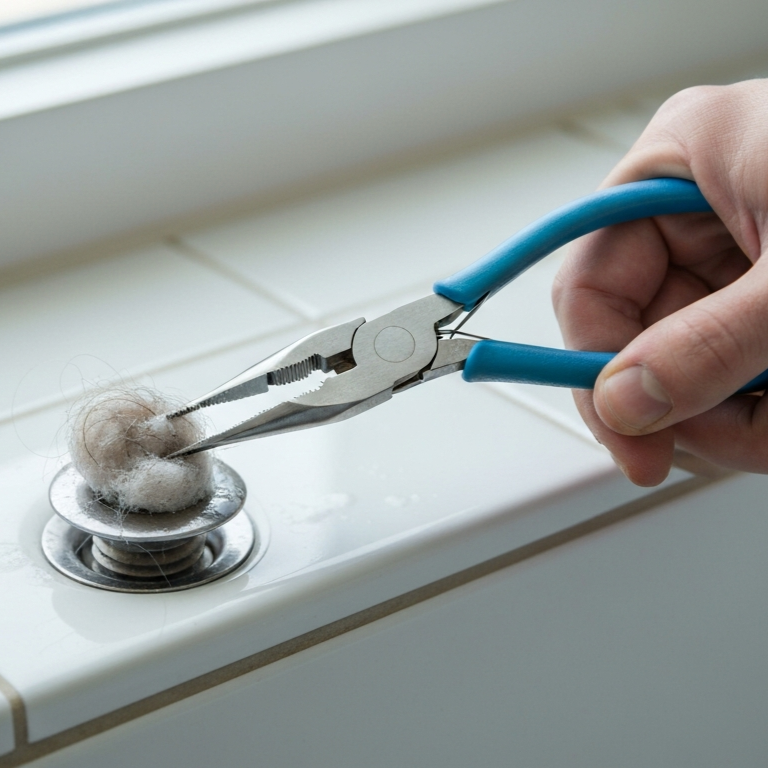
The fix is physical removal. Unscrew or lift the stopper out — most pop-up stoppers lift straight up with a slight twist — and use needle-nose pliers or your fingers to pull out whatever is wrapped around the post. What comes out is usually far larger and more compacted than you'd expect. Clear that first. In many cases, drainage returns to normal before you've touched anything else.
And yes, this comes back. A mesh hair catcher placed over the drain after cleaning will stop most of it from going down in the first place.
When the stopper mechanism is the actual problem
Trip lever stoppers work differently from pop-up stoppers. A lever on the overflow plate connects through a linkage assembly to a plunger inside the overflow tube, which raises and lowers to open and close the drain. When that linkage corrodes, bends, or stretches out of calibration, the stopper can sit in a partially closed position permanently. Not a clog. Not mineral buildup. The stopper itself is the restriction.
You can test this by removing the two screws on the overflow plate and pulling the entire trip lever assembly straight out. If the brass cylinder at the bottom of the linkage is sitting lower than it should, the mechanism needs adjustment or replacement. Hardware stores carry universal replacement kits for around $20–$40, and the job takes about 30 minutes.
Pre-1980 homes — which make up a large share of the housing stock in this part of Pennsylvania — still have original brass trip-lever assemblies in many cases. Those assemblies are often corroded enough that adjusting the linkage just buys time. Replacing the whole assembly is usually cleaner.
What hard water does inside a drain pipe
Homes in Berks and Montgomery Counties deal with moderately hard water year-round. The calcium and magnesium in that water deposit on any surface that contacts it — including the inside walls of your drain pipe — and over months those deposits build up into a rough, narrowed interior surface.
Think of the inside of a kettle that's never been descaled. The smooth metal walls eventually develop a thick, rough crust that changes the texture of the surface entirely. A drain pipe with smooth walls sheds hair-and-soap masses fairly well. The same pipe with a year's worth of mineral scale on the walls catches everything — hair snags on the rough deposits, soap binds to the hair, and the mass grows denser with each shower.
This is why some homeowners plunge successfully for years and then suddenly find the same technique stops working. The drain didn't change. The pipe surface did.
Descaling the drain periodically addresses the scale. Clearing the hair on top of it is a separate step. Both need to happen, or you're treating symptoms without the cause.
Why soap scum is worse than it looks
Bar soap and most body washes contain fats and oils that don't rinse clean. They bind with hard water minerals to form a waxy film — soap scum — that coats drain walls in a thin layer you can't see. That layer thickens slowly. Not day to day. Month to month. Which is why drain problems from soap scum seem to appear out of nowhere after years of no issues.
Unlike hair, soap scum doesn't pull out with a snake. It has to break down chemically. Enzyme-based drain treatments work specifically on organic compounds like soap residue — they're slow, but they don't damage pipe walls the way acid-based chemical cleaners do. Near-boiling water from a kettle flushed slowly down the drain helps keep fats liquid and moving. Avoid actually boiling water in cast iron or galvanized drain lines — the temperature shock stresses already-weakened metal.
Chemical drain cleaners like Drano or Liquid-Plumr are a different story. In homes with cast iron or galvanized drain pipes — common in older homes throughout this area — those acid formulations accelerate corrosion. They may clear the immediate clog, but the pipe pays for it.
When slow drainage is really a pressure problem
Some bathtubs drain slowly for a reason that has nothing to do with what's in the pipe. It's about what can't get in.
Every drain line needs air to flow. Vent pipes run up through the roof to let air into the system as water exits. When a vent gets blocked — by a bird nest, debris, or in older homes, internal corrosion that's partially closed the vent pipe from the inside — the drain can't pull water down efficiently. The result looks exactly like a clog. It doesn't respond to snaking or plunging. And it often sounds different: a sucking or gurgling noise from the drain when the tub empties, or a toilet in the next bathroom gurgling when the tub runs.
If you hear those sounds, the vent system is worth checking before spending more time on the drain itself. This isn't a DIY fix — clearing a roof vent or addressing a damaged vent stack requires access and tools most homeowners don't have on hand.
When the tub is telling you something about the main line
A slow bathtub drain on its own almost always points to the tub's own drain assembly. The stopper, the trap, the short lateral connecting to the main stack — one of those is the problem.
But when other fixtures start showing signs — the bathroom sink slowing down, the toilet flushing sluggishly, water appearing in a floor drain after the tub runs — the problem has moved past the bathtub branch and into the main sewer lateral. Clay-tile sewer lines in older neighborhoods develop hairline cracks at their joints over decades. Roots find those cracks. They push through and fan out inside the pipe into a mesh that traps debris. First sign is usually slow drainage in one or two fixtures. It gets worse from there.
A single slow tub with everything else working normally — that's a local problem. Multiple fixtures draining slowly, especially on the ground floor — that's different, and no amount of plunging at the bathtub will touch it.
Frequently Asked Questions
Plunging works on fresh, soft clogs close to the drain opening. As buildup accumulates — particularly mineral scale from hard water — clogs become denser and sit further from the surface. A hand snake fed through the overflow tube is typically the next step when a plunger stops working.
Remove the stopper completely, then seal the overflow plate with duct tape or a wet rag. Add two to three inches of water to create suction. Use a flat-cup sink plunger — not a toilet plunger — and pump in short, rapid strokes. Without that overflow seal, all the pressure you create escapes through the overflow channel, and the plunger does nothing useful.
In homes with cast iron or galvanized drain pipes, no. The acid in products like Drano accelerates corrosion and weakens pipe walls over time. In a tub with PVC plumbing, it's less damaging, but chemical cleaners don't address recurring slow drains — the problem comes back quickly. Mechanical removal or a drain snake solves more.
Mineral scale. Calcium and magnesium in hard water leave deposits on surfaces that regularly contact standing water — including around the drain opening and on the interior pipe walls. An enzyme drain treatment or citric acid flush every few months prevents it from stacking up to the point where it's trapping hair and causing slow drainage.
Only if other fixtures are also running slow. A bathtub that drains slowly on its own, with the toilet and sink working fine, points to the tub's own drain assembly. When multiple fixtures in the same bathroom or on the same floor are sluggish — especially with gurgling sounds or a sewage smell — a camera inspection of the main sewer lateral is the right next step.
Once you've pulled the stopper, cleared the hair, snaked through the overflow tube, and run an enzyme treatment — if it's still slow, you're past what a plunger or hand snake can reach. Recurring clogs in the same tub every month or two point to a structural cause worth having a plumber camera inspect. Repeated snaking without identifying the source just delays the real repair.
Slow bathtub drainage after plunging is almost always one of four things: hair tangled at the stopper post, a trip lever mechanism that's partially closed, mineral scale catching and holding buildup on the pipe walls, or a deeper clog that a plunger can't reach. Working through those in order — stopper out, inspect for hair, test stopper travel, then snake through the overflow — clears most bathtub drains without a service call.
When none of that holds, it's time to get eyes inside the pipe.
