
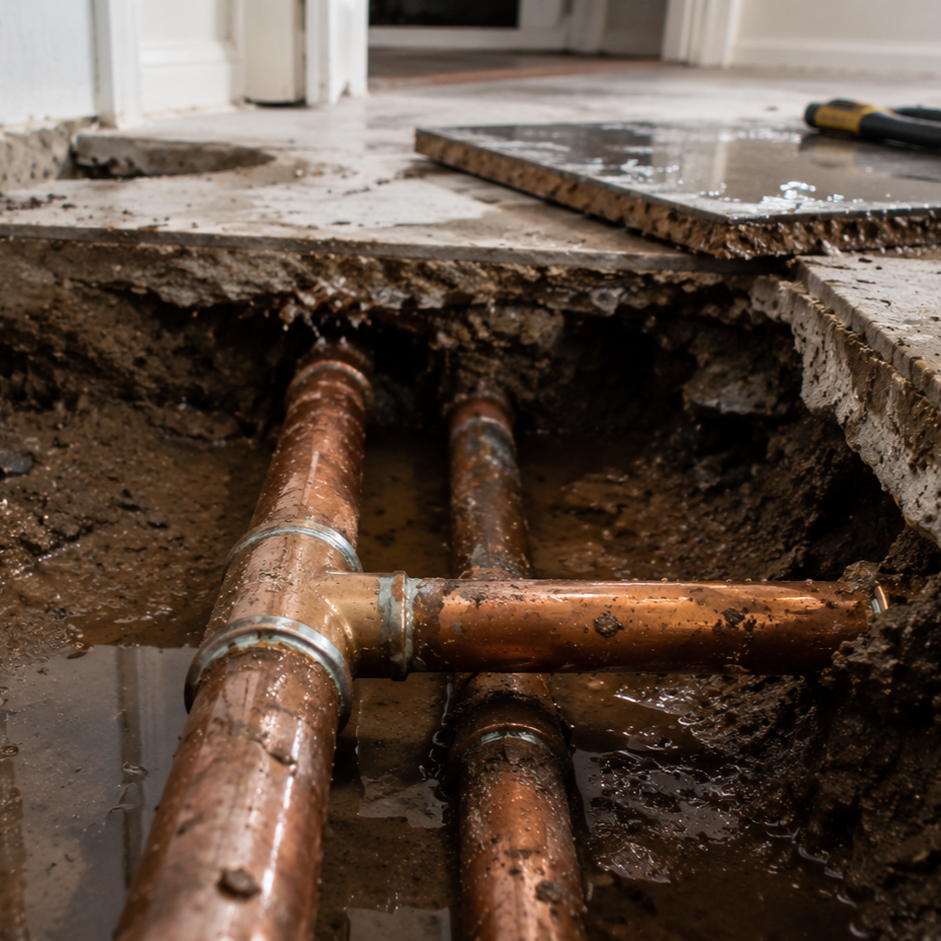
You get the call on a Thursday morning — unit 1A, wet carpet near the bathroom wall. No burst pipe, no overflowing fixture, nothing your tenant can point to. By the time you pull up the floor, the slab underneath is saturated. The building is a 1968 garden-style complex, original copper supply lines still running under four inches of concrete.
That scenario plays out in older apartment buildings far more often than in newer construction. And the answer to "why here, why now?" isn't some freak occurrence — it's physics and chemistry, working on the same buried materials for five decades straight.
What's sitting under those older slabs has been accumulating stress since the building went up. Pipe material, water chemistry, thermal cycling, the constant demand from a full building of tenants — all of it adds up on a system that wasn't designed to run indefinitely without intervention.
What a Slab Leak Is
A slab leak is a failure in one of the water supply or drain lines running beneath a building's concrete foundation. In apartment construction, plumbing gets cast directly into or beneath the slab during the pour — supply lines, drain lines, sometimes heating lines, all buried under several inches of reinforced concrete. When one of those buried pipes develops a pinhole, crack, or joint separation, water leaks into the surrounding soil and concrete before it ever shows up inside the building.
There's no visible drip. No wet ceiling under a bathroom, no obvious origin point, no clue that anything is wrong. Slab leaks can go unnoticed for weeks — and by the time you get a call about warm floors or an unexplained smell of water, the damage is already measured in square footage, not drips.
The Pipe Materials Underneath Most Older Apartment Buildings
Age is the single biggest predictor of slab leak risk in a multi-unit building. And that comes down to what's actually buried under the slab.
| Era | Common Under-Slab Material | Primary Failure Mode |
|---|---|---|
| Pre-1960 | Cast iron, galvanized steel | External corrosion, scale buildup, joint failure |
| 1960s–1980s | Copper | Pitting corrosion, galvanic corrosion, abrasion |
| 1980s–2000s | Copper, CPVC | Pitting, thermal stress cracking |
| Post-2000 | PEX, CPVC | Low slab leak risk; flexible and corrosion-resistant |
An apartment building from the late 1960s or 1970s almost certainly has copper supply lines under the slab. Copper was the code-approved standard for that era — durable, easier to work with than galvanized steel, widely trusted. The issue isn't the material itself. It's that copper buried in concrete, surrounded by soil, and carrying pressurized water for 50-plus years doesn't stay the same copper it was when the slab was poured.
How Copper Corrodes Under Concrete
Two separate corrosion processes attack copper pipes in older slab foundations. Both produce pinhole leaks — small enough to be invisible from above, large enough to saturate a slab over months.
Pitting corrosion works from the inside out. When water carries elevated mineral content — hard water, in other words — dissolved minerals attack the interior copper wall in localized spots. The attack isn't spread evenly across the pipe. It concentrates in small areas, etching progressively deeper pits until the pipe wall thins enough to fail. In eastern Pennsylvania, where water in Berks and Montgomery Counties tests in the hard-to-very-hard range, pitting is more aggressive than in regions with softer municipal supply.
Galvanic corrosion works from the outside in, driven by electrochemical differences between the copper pipe and other metals it contacts — rebar, soil minerals, fittings made from dissimilar metals. When two different metals sit in contact with moisture present (and concrete holds moisture), the reaction corrodes the less noble metal. In the wrong combination of soil chemistry and rebar contact, copper loses.
Both processes end the same way. Pinhole leaks that don't announce themselves.
Thermal Cycling and Why Apartment Buildings Are Harder on Buried Pipes
Here's something a single-family home doesn't put copper through at the same scale. A pipe expands when hot water flows through it and contracts when the flow stops. In a single-family home, that cycling happens a handful of times a day. In a 20-unit apartment building, it happens around the clock — morning showers across six units, laundry running at noon, dinner dishes in the evening, someone up late. The pipe never fully settles.
Copper has a thermal expansion coefficient of roughly 0.000017 inches per inch per degree Fahrenheit. In a straight 20-foot supply run, a 60-degree temperature swing between cold supply and hot produces close to a quarter inch of movement. That movement gets absorbed against the concrete and rebar the pipe is pressed against.
Think of a piece of copper wire bent back and forth a few thousand times over a decade. The metal fatigues at the flex point. Under a slab, that flex point is wherever the pipe contacts a hard surface — and after 50 years of that repeated stress, the failure point was being built in from day one.
Foundation Settling and Abrasion
Older buildings settle. That's not a defect — it's normal for a concrete slab to find equilibrium with the soil beneath it over the first several years. But settling in a large apartment building doesn't always happen uniformly across the full footprint. When sections of the slab shift slightly relative to each other, the pipes running through them get bent, stretched, or pinched at transition points.
Add to that the abrasion factor. When a pipe runs through a sleeve or notch in the slab and expands thermally, it pushes against the concrete edge. Do that often enough and the friction wears down the pipe wall from the outside, creating a thin spot that eventually opens.
This is why slab leaks in older apartment buildings cluster at predictable locations: pipe elbows, horizontal-to-vertical transitions, points where lines pass through partitions in the slab, and anywhere the original installation didn't leave the pipe room to move.
The Hard Water Factor in Eastern PA
Hard water isn't just a nuisance for water heaters and faucet aerators. For copper lines under a slab, it's a slow, continuous attack. Water in Berks County and parts of Montgomery County tests at 150–250 parts per million of dissolved calcium and magnesium — solidly in the hard-to-very-hard range. That mineral load is in contact with the pipe interior every minute the building is occupied.
Without a softener or acid neutralizer, mineral-laden water works on copper continuously. On a 50-year-old pipe, the result is a wall that's measurably thinner at pitting sites than its original spec. Sometimes significantly thinner.
Signs a Building Has a Slab Leak
The tricky part about slab leaks in multi-unit buildings is that the signals get diffused. In a single-family home, a 10% spike in the water bill is obvious. In a 20-unit complex where tenants run water in unpredictable patterns, that same signal disappears into the noise.
But there are things to watch for.
Unexplained spikes in the master meter reading that don't track with occupancy changes. The most reliable test: shut off the water at the main during off-hours and watch whether the utility meter still moves. Any movement means water is going somewhere it shouldn't.
Warm or hot spots on ground-floor slabs. Hot water slab leaks transfer heat through the concrete — sometimes you can find the general area with a bare foot. A plumber with thermal imaging equipment can narrow it to within inches.
Unexplained damp patches, white mineral deposits (efflorescence), or new cracks appearing in ground-floor concrete. All of those are signs of water migrating upward from below the slab. And water bills that keep climbing without new tenants, new appliances, or any visible leak anywhere else in the building — that's always worth investigating.
What Happens When You Find One
Finding a slab leak in an older apartment building immediately raises a question that matters more than the leak itself: Is this isolated, or is it the first in a series?
A single pinhole in an otherwise solid system can sometimes be handled by rerouting just that branch — running a new line through the walls or ceiling to bypass the damaged section, leaving the buried pipe in place but abandoned. No concrete work. Minimal tenant disruption.
But in a building where the under-slab copper is 50 or 60 years old, one pinhole is often a signal that the rest of the pipe is in comparable shape. Repair the detected leak, find another six months later, then another. Each repair means diagnosing, locating, and accessing the problem from scratch. Those individual costs add up faster than a planned whole-building re-pipe would have cost to begin with.
The decision usually comes down to what a camera inspection and pressure test of the full system shows. If the rest of the copper holds pressure and the camera doesn't show widespread pitting or joint corrosion, a targeted reroute of the affected run makes sense. If the system as a whole is showing its age, running new PEX lines through the walls and abandoning the under-slab copper is the sounder investment for a building that needs to keep operating for another 20 years. That call is worth making once, deliberately, rather than reactively over and over.
Frequently Asked Questions
A whole-building pressure test is the most reliable method. A plumber isolates sections of the supply system and checks whether each holds pressure. Slab leaks typically show up in the under-slab supply runs — identified by where the pressure drop occurs. Camera inspection confirms the location once the general section is found.
It depends on volume. A slow pinhole might run for months before causing any visible structural effects. A joint separation can saturate the subgrade in days. The more common concern in older buildings is the slow leak that goes undetected long enough to erode soil support under the foundation — by the time it surfaces, the damage is already done.
The methods are the same — rerouting, tunneling, or breaking through the slab for direct access — but scale and tenant occupancy change the calculus significantly. Rerouting through walls and ceilings is almost always preferred in apartment buildings because it keeps the affected unit habitable during the work.
It can slow the pitting process, particularly in hard-water areas. A softener won't reverse existing pipe deterioration, but it reduces the mineral load attacking the pipe interior going forward. Paired with a pressure regulator set below 60 PSI, it's a reasonable preventive measure for older buildings that haven't yet had slab problems.
Copper under a slab starts to enter meaningful risk territory around 40–50 years, depending on water chemistry, installation quality, and demand patterns. Buildings from the late 1960s and 1970s are in that window right now. A building on untreated well water in a hard-water county can get there faster — sometimes in 30 years.
Running new PEX through the walls and abandoning the old under-slab copper removes the failure mechanism entirely. PEX is flexible, corrosion-resistant, and handles thermal cycling without the fatigue issues rigid copper develops after decades. A re-pipe that bypasses the slab completely takes slab leaks off the table as an ongoing risk for the building.
Older apartment slab foundations don't develop slab leaks because the original construction was poor. They develop them because the materials hit their expected service life around the same time the building is being asked to keep running indefinitely. If you manage a building from the 1960s or 1970s, knowing what's under your slab, reading the early warning signs, and having a plan before the first tenant call is worth far more than scrambling after the third one.
