
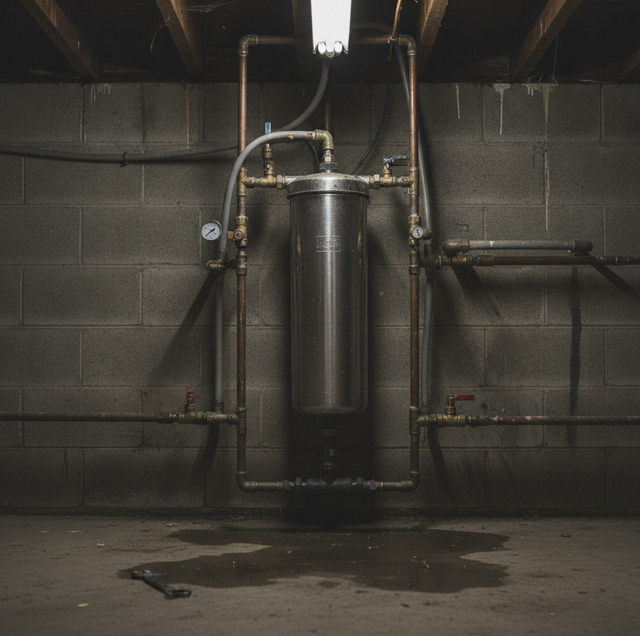
Quick Answer: A whole-house water filter sits where the main water line enters your home and treats every gallon before it splits off to your taps, showers, and appliances. What it actually removes depends on the media inside it: a sediment stage catches grit, a carbon stage handles chlorine and odors, and specialty stages target problems like iron or a sulfur smell. It is not a softener or a drinking-water purifier, so matching it to your water test results is what makes it work.
You turn on the kitchen faucet, and the water looks a little cloudy. The shower has a faint chlorine smell. Fine grit is collecting in the aerator screens. A whole-house filter is often proposed as the fix, but it helps to know what the equipment does before you decide whether it solves the problem you have. The short version: it cleans the water once, at the front door, so everything downstream runs cleaner. The longer version depends entirely on what is inside the tank.
Where a Whole-House Filter Sits and Why That Matters
The defining trait of a whole-house filter is its location. It installs on the main water line right after it enters the house, which is why the industry calls it a point-of-entry system. Because it treats water before the plumbing branches off, every fixture past that point receives filtered water: the kitchen sink, every bathroom, the washing machine, the water heater, the hose bibs, all of it.
That is the opposite of a point-of-use filter, which treats water at a single spot. A faucet-mounted filter, an under-sink cartridge, or a pitcher in the fridge each cleans the water for one tap or one pour, leaving the rest of the house untouched. There is nothing wrong with point-of-use gear, and for drinking water, it is often the smarter choice. But it does nothing for the water hitting your skin in the shower or the sediment reaching your water heater. Point of entry versus point of use is the first fork in the road, and it comes down to whether you want one clean tap or a whole clean house.
Think of it like the difference between filtering the air in one room with a small purifier versus putting a filter on the furnace that feeds the whole building. Same idea, wider reach.
What the Media Stages Actually Do
A whole-house filter is a housing that holds one or more beds of filtration media, and the media does the work. Most systems stack stages in a deliberate order, so each one handles what the next one cannot.
Sediment pre-filter- This is usually the first stage and is mechanical. It physically strains out the solid particles suspended in the water: sand, silt, rust flakes, and grit. Sediment clogs aerator screens and wears out fixture cartridges, so catching it first also protects everything downstream, including the more expensive media stages.
Carbon stage- After the water is clear of grit, it passes through activated carbon. Carbon works by adsorption, meaning contaminants stick to the enormous surface area inside the carbon granules. This is the stage that reduces chlorine, knocks down the chemical taste and swimming-pool odor that comes with municipal water, and captures a range of other organic compounds. When people say their filtered water simply tastes and smells better, the carbon stage is usually the reason.
Specialty media- Beyond sediment and carbon, systems can carry media chosen for a specific problem. Some beds are built to oxidize and trap iron and manganese, the culprits behind rusty staining and metallic taste. Others target the rotten-egg sulfur smell that comes from hydrogen sulfide. An acid-neutralizing bed raises the pH of water that runs corrosively, which quietly eats at copper pipe and leaves blue-green staining behind. These stages only earn their place when your water actually has the problem they solve, which is exactly why testing comes first.
What a Whole-House Filter Is Not
This is where a lot of confusion lives, because three very different pieces of equipment get lumped together.
A filter is not a water softener. A softener does one job: it removes the dissolved calcium and magnesium that make water hard and leave chalky scale on fixtures and inside the water heater. It does this through ion exchange, swapping those hardness minerals for sodium or potassium as the water passes through a resin bed. A standard filter improves taste, clarity, and chemistry, but it leaves hardness minerals in place. If your real complaint is crusty scale and spotty glassware, a filter alone will not touch it. Plenty of homes end up running both a filter and a softener in sequence, because they solve different problems.
A filter is also not a reverse-osmosis system. Reverse osmosis pushes water through a very fine membrane that removes dissolved solids to a microscopic level. It produces extremely clean water, but it works slowly and sends some water down the drain as reject, so it is almost always installed at a single drinking tap rather than for the whole house. A whole-house filter is built for volume and full flow, cleaning general-use water everywhere at once rather than polishing a small amount for drinking.
Keeping these three straight, filter, softener, and reverse osmosis, saves you from buying the wrong box for your problem.
The Payoff, and the Upkeep
When a whole-house filter is matched to the water, the benefits show up everywhere. Showers lose the chlorine smell and are gentler on skin and hair. The grit stops collecting in aerators and appliance inlet screens. The water heater and washing machine draw in clean water, so sediment does not accumulate in the tank or foul the valves. And the water simply tastes and looks better at every tap, not just one.
None of that lasts without maintenance, though. Filter media is a consumable. A sediment cartridge fills up with the particles it strains out; carbon slowly loses its capacity as its surface area saturates. As the media loads up, it restricts the flow, so the warning sign is usually a drop in water pressure across the house. Cartridge-style stages get swapped on a schedule, and tank-style media beds get replaced at longer intervals. Skip the replacements and you get the worst of both: weaker pressure and contaminants slipping through spent media as if the filter were not there.
Choosing the Right System Starts With a Test
The single most useful step happens before you buy anything: test the water. A test tells you what is actually in your supply, and the results dictate which media you need. Chlorine points to carbon. Grit and rust flakes point to a sediment stage. Iron, a sulfur smell, or low pH each calls for its own specialty bed. Buy a filter blind, and you can easily end up with a system that does not address your real problem while missing the one that does.
Where your water comes from shapes the answer, too. City water arrives already disinfected, so the job is usually chlorine, taste, and whatever sediment the mains pick up along the way. A private well is a different animal. It can carry iron, hydrogen sulfide, bacteria, or acidity, and none of that is regulated on its way to your tap, so well systems generally need more stages built around what the specific well test reveals. Two houses on the same road can need very different equipment depending on which source they draw from.
One more practical note: a whole-house filter installs on the main line, which means cutting into your incoming plumbing, setting the system with proper shutoffs and a bypass, and confirming there are no leaks under pressure. That is a plumbing job, not a fixture swap, and it is worth having done by someone who works on water lines regularly.
Frequently Asked Questions
A softener needs periodic regeneration with salt or potassium and a drain connection, which a plain filter does not require, so it carries ongoing salt costs and upkeep that a filter avoids. The regeneration cycle flushes the resin bed on a timer or a metered gallon count, and that backwash water has to go somewhere, which is why a nearby drain is part of the installation. A filter has no resin to recharge, so once its media is in place, there is nothing to top up between cartridge or bed changes. That difference in running cost is often the deciding factor when a home only has one of the two problems.
If you want scale control without adding sodium, a salt-free conditioner using template-assisted crystallization changes the minerals into a form that will not stick, which sits between a plain filter and a full softener. It does not strip calcium and magnesium from the water, so a hardness test still reads high afterward, but the minerals pass through as tiny, stable crystals instead of bonding to pipe walls and heating elements. That makes it a fit for people on sodium-restricted diets or on a septic system that a softener's brine discharge could disrupt. It needs no drain and no salt refills, though it also will not give you the slick, soft water feel a true softener does.
Reverse osmosis wastes several gallons of reject water for every gallon it produces and requires a small storage tank, which is exactly why it is installed at a single drinking tap rather than treating the whole house. The reject water carries away the dissolved solids the membrane rejects, and the tank exists because the membrane produces treated water too slowly to keep up with an open faucet on its own. Run that same technology for every fixture in a home, and the waste ratio and slow output become impractical. A whole-house filter, by contrast, is sized to pass full household flow without a holding tank.
A sediment pre-filter is chosen by its micron rating: a finer micron catches smaller particles but clogs faster, so the rating is a trade-off between how much it strains and how often it loads up. Carbon comes either as a replaceable cartridge or a larger backwashing tank, and which one fits depends on the home's flow rate and how much chlorine the water carries. A high-flow home that would starve a small cartridge is usually better served by a tank that can be backwashed and hold more media. The water test result indicates the media type, and the household's peak demand indicates the size and format.
As a rough guide, a sediment cartridge lasts a few months, a carbon cartridge six months to a year, and a tank-based carbon bed several years, so the replacement clock depends on which format you run. The actual interval shifts with how dirty the incoming water is and how much the house uses, so a well with heavy sediment burns through a cartridge faster than a clean municipal supply. Skipping replacement drops water pressure and lets contaminants pass untreated, because saturated media stops adsorbing and simply channels water around the spent granules. Tracking pressure at a gauge or just noticing weaker flow is the practical cue that a change is overdue.
Yes, and one key limit matters: a carbon-and-sediment whole-house filter does NOT kill bacteria, so a well that tests positive for bacteria needs a UV disinfection system or chlorination in addition to the filter, since the media alone cannot disinfect. A UV unit passes the water past an ultraviolet lamp that inactivates microorganisms, and it works only on water already clear of sediment, so it sits after the filter stages rather than before them. Municipal supplies arrive already disinfected, so that extra barrier is usually unnecessary on city water. This is the one gap where relying on a filter alone can leave a real health risk in place on a private well.
Get your water tested and matched to the right filter — clean, better-tasting water at every tap in the house. East Coast Plumbing serves Barto, Boyertown, Pottstown, and the surrounding area. Call (610) 904-9069.
