
How Long Do Water Heaters Last in Apartment Buildings?
The call came in on a Wednesday morning. Your tenants on the second and third floors have no hot water. When the plumber gets into the utility room, the commercial tank unit is 13 years old — still on its original anode rod, still on its original elements, with a drain valve so crusted with scale it hasn't moved in years. The building manager knew the boiler age to the month. He had no idea about the water heater.
That story repeats in multi-unit buildings more than you'd think. Water heaters are easy to ignore when they're running. But in an apartment building, when one fails, it fails for everyone at once. Knowing how long these units actually last — and what shortens that lifespan — puts you in control of timing the replacement before the emergency call comes.
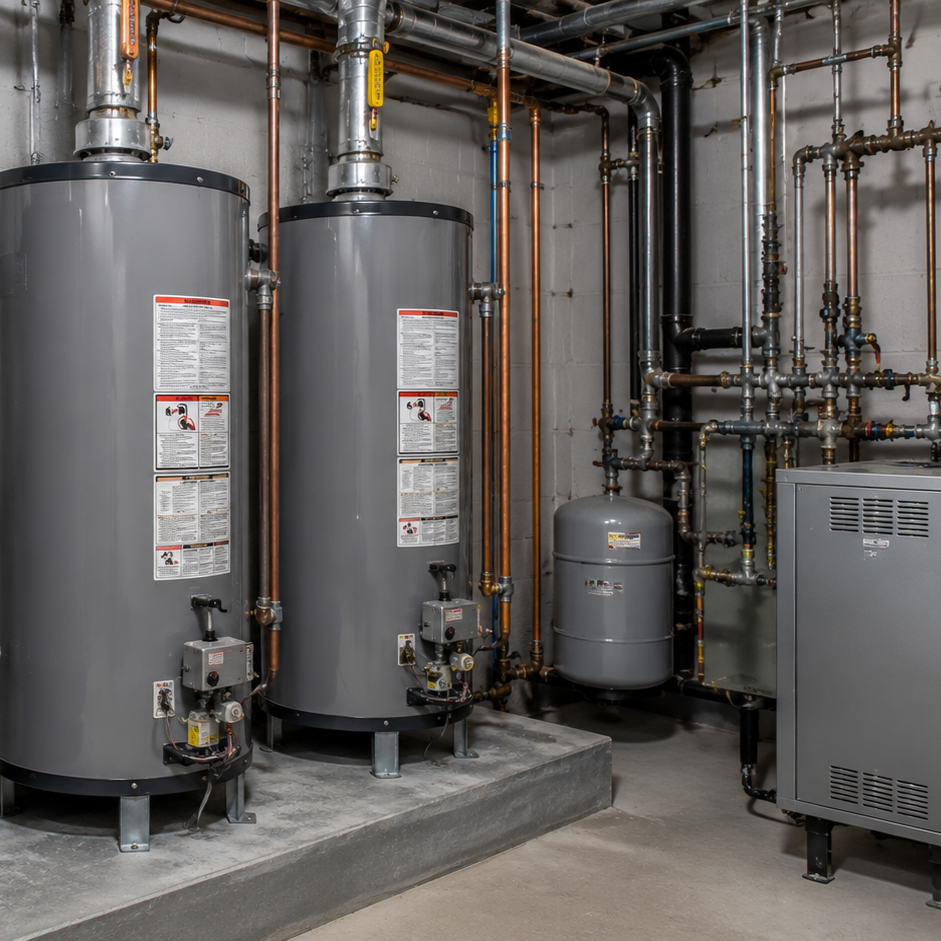
How long a commercial water heater typically lasts
The numbers depend on the type of unit.
A tank type commercial water heater — storage tank, insulated shell, gas burner or electric elements — typically runs 10 to 15 years. That's the realistic range with reasonable maintenance. Buildings running heavy demand with minimal upkeep tend toward the low end of that window.
Tankless commercial systems last longer. A well-maintained gas tankless unit can run 15 to 20 years. The tradeoff is higher upfront cost and more involved servicing, including annual descaling of the heat exchanger to keep mineral buildup from choking flow.
| Water heater type | Expected lifespan (multi-unit/commercial) |
|---|---|
| Storage tank, gas | 10–14 years |
| Storage tank, electric | 8–12 years |
| Tankless, gas | 15–20 years |
| Heat pump water heater | 12–18 years |
Those are averages. Actual lifespan in an apartment building depends on demand volume, water quality, and whether anyone has been doing the maintenance.
Why apartment buildings are harder on water heaters
A water heater in a single-family house sees one household's demand. It fires, heats water, sits, fires again. There are quiet stretches — overnight, during work hours — where the tank just holds temperature.
An apartment building doesn't work that way. The third-floor tenant showers at 6 a.m. The couple on two runs the dishwasher at 10 p.m. The ground-floor unit does laundry at noon. A commercial water heater serving multiple units fires more often, holds temperature against steady withdrawal, and rarely gets the recovery time a residential unit does.
That cycle stress builds up. Tank linings expand and contract with every heat cycle, and the more cycles, the faster the interior coating fatigues. Sediment settling at the bottom gets baked by constant heat — hardening into a layer the burner has to push through. Think of it like the residue that builds up at the bottom of a stockpot that's never quite cleaned, except instead of flavor, it's trapping heat and forcing the unit to work harder than it was designed to.
What hard water does to apartment water heaters in eastern PA
In Berks and Montgomery Counties, water hardness commonly runs 15 to 25 grains per gallon. That mineral load doesn't disappear when water enters the heater. It precipitates out as the water heats and settles. In a residential setting, a homeowner who flushes the tank annually can clear most of it before it hardens. In an apartment building's water heater that hasn't been flushed in three or four years, the sediment has often turned into a solid mass.
Hard water shortens lifespan two ways. First, scale insulates the tank bottom from the burner, which means the burner runs longer and hotter to reach temperature — extra thermal stress that ages the tank shell faster. Second, scale attacks the anode rod. That rod is a sacrificial magnesium or aluminum element designed to corrode so the tank doesn't. In hard water, it depletes in roughly half the time it would in softer water. And when it's gone, the tank becomes the sacrificial element.
A central water heater serving a six-unit building with untreated hard water and no maintenance schedule can realistically fail in 7 or 8 years. Well short of its rated lifespan.
How to find out how old your building's water heater is
Most commercial water heaters encode their manufacture date in the serial number. A common format uses the first letter for the month — A for January, B for February, and so on through L for December — and the next two digits for the year. On that system, "C18" means March 2018.
Other brands use four digits at the start: the first two for the year and the next two for the week. "2011" would mean the 11th week of 2020. When the format isn't obvious, the manufacturer's website typically has a decoder.
But if the data plate is unreadable — scale-covered, label peeled, plate corroded — don't guess. Have a plumber assess the unit directly. Age isn't the only factor; condition tells you more than numbers.
The signs that a building's water heater is approaching the end
The unit usually shows you before it quits completely. The problem is that building managers miss the signals because no one is standing next to it watching it run.
Sediment noise is one of the first. If tenants start reporting rumbling, popping, or banging from the utility room, that's sediment being superheated — not a quirk to ignore. The layer is thick enough to trap water beneath it, and that water flashes to steam against the tank bottom.
Temperature inconsistency follows. If units that used to have plenty of hot water are running lukewarm by late afternoon, the heater's recovery rate is dropping. That can mean a failing element, a scaled heat exchanger, or a unit that simply can't keep up anymore.
Discolored hot water — reddish-brown, slightly murky, faintly metallic — points to internal corrosion. Once you are seeing rust in the water, the tank liner has failed. That's not repairable. It's a replacement job.
Moisture around the base of the unit, or a wet floor beneath it, is a late-stage warning. A commercial tank with internal corrosion will eventually seep. In a utility room nobody checks, a slow leak can go on for weeks before anyone sees the damage piling up.
Why property managers tend to replace too late
The pattern is predictable. A commercial water heater runs without maintenance for a decade, shows no obvious problems, then fails completely — significant leak, total loss of hot water, or the unit that just stops. Emergency replacement on a Friday afternoon costs more than a planned replacement scheduled during a slow week. In an apartment building, a full hot water failure hits every tenant at once, which turns a maintenance issue into a habitability one.
Planning a replacement before the unit enters its final years — around year 10 for a tank-type commercial unit — gives you time to get multiple bids, evaluate whether upgrading to tankless makes sense for the building's gas line, and schedule the work without pressure. You get to make the call instead of reacting to the failure.
What actually extends the lifespan
Two things matter more than anything else: flushing and the anode rod.
Annual flushing clears sediment before it becomes solid. On a commercial unit serving multiple apartments, once a year is the minimum. In a hard-water area, twice a year is worth it. The cost is modest.
Anode rod inspection every 2 to 3 years. The rod must be pulled to check it — there's no external indicator. A depleted rod isn't visible from the outside, and building owners often don't know it's gone until the tank starts showing rust.
And keep the temperature at 120°F. Higher settings accelerate scale buildup and stress the tank. At 120°F the unit cycles less aggressively, scale builds more slowly, and energy use drops. A service call to flush a commercial tank, inspect the anode rod, and test the pressure-relief valve runs a few hundred dollars — well under what emergency replacement costs.
Repair vs. replace: where the line is
Under 7 years old with a component failure — bad heating element, stuck pressure-relief valve, faulty thermostat — repair makes sense. Those are serviceable parts on a unit that still has life ahead of it.
Between 7 and 10 years, it depends on what's wrong. An element failure on a maintained unit is still reasonable to fix. Internal corrosion, rusty water, or weeping from the tank base means replace, not repair. Patching a corroding tank doesn't hold.
Past 10 years on a tank-type commercial unit, the math shifts. A unit that needed a thermostat last year and an element this year is cycling through parts faster than a healthy one should. The general rule: when repair cost reaches half the replacement cost on a unit past its midpoint, replace it. The next breakdown is never far behind.
Frequently Asked Questions
Tank type commercial units last 10 to 15 years under normal conditions. Buildings with high demand, hard water, and no maintenance history tend to see 8 to 12 years before serious problems develop. Tankless commercial units last 15 to 20 years with proper heat-exchanger maintenance.
Yes. In high-hardness areas, scale depletes the anode rod faster and builds up on tank interiors and heating elements. Without water treatment and a maintenance schedule, a commercial tank unit can fail 3 to 5 years before its rated lifespan — sometimes more.
Tankless units typically outlast tank units by 5 to 7 years because there's no standing water corroding a tank interior. But that advantage disappears without annual heat-exchanger descaling, which is often the first thing skipped when budgets tighten.
Rumbling or popping from the utility room, tenant complaints about temperature inconsistency, any rust or discoloration in hot water, or moisture at the base of the unit. These signs often appear a year or two before a full failure — early enough to plan if you're looking.
Check the serial number on the data plate. Most brands encode the manufacture date — often using the first letter for the month and the next two digits for the year. If the plate is unreadable, a plumber can assess the unit's condition directly. Age matters less than how the unit is presenting.
At 10 years, it depends on the failure. Component issues — an element, a thermostat — on a maintained unit can still be worth fixing. Rust in the water, weeping from the tank, or two repairs in the same year are signals to replace. When the repair cost reaches half the replacement cost on a unit past its midpoint, stop repairing.
A planned replacement is always less expensive and less disruptive than an emergency one. Knowing where your unit stands gives you control over timing — control that a surprise failure takes away completely.
