
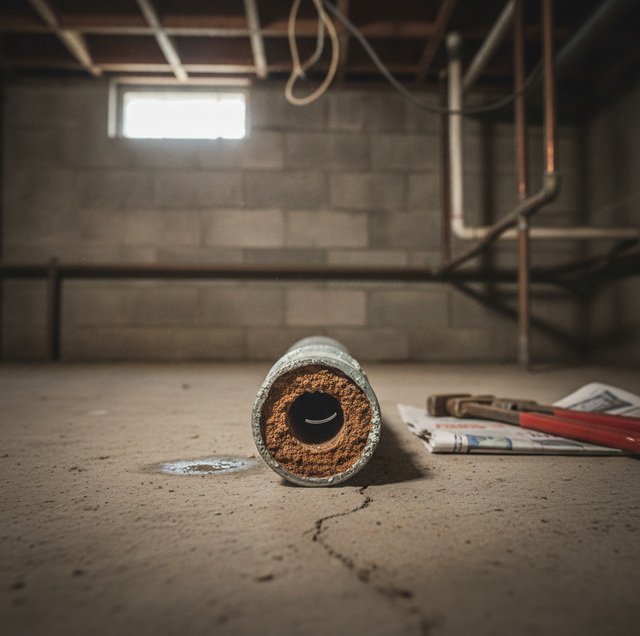
Quick Answer: In older homes, weak water pressure usually traces to the pipes themselves. Galvanized steel corrodes and scales from the inside, slowly choking the flow. Other common causes are a failing pressure-reducing valve, a partly closed or seized main shut-off, clogged aerators, or a hidden leak. The pattern of the problem, whole-house or one fixture, hot-only or both, gradual or sudden, tells you where to look.
If the shower upstairs has slowed to a dribble while the kitchen sink downstairs still runs fine, the house is telling you something. Water pressure that fades in an older home rarely comes from the street. Far more often, the trouble is inside the walls, in the pipes and valves that have been quietly aging since the place was built. Understanding what actually restricts the flow makes the difference between chasing the wrong fix and solving the real one.
How Water Pressure Actually Works in Your House
Water arrives from the municipal main or a well at a certain pressure, usually in the 40-80 psi range for a healthy system. From there, it has to travel through your service line, past the main shut-off, sometimes through a pressure-reducing valve, and then out through a branching maze of pipes to every fixture. Pressure is what pushes the water; volume, or flow, is how much actually reaches the tap.
Here is the part that trips people up: you can have decent pressure at the meter and still get a weak stream at the faucet. Think of it like a crowded highway. The speed limit might be fine, but if three or four lanes are blocked off, traffic still crawls. In old plumbing, the "lanes" narrow over time, and the fixtures farthest from the source feel it first.
The Number One Old-House Cause: Corroded Galvanized Pipe
Homes built before the mid-1960s were commonly plumbed with galvanized steel, and plenty of homes in older neighborhoods still have it running behind the plaster. Galvanized pipe is steel coated with zinc. The zinc protects the steel for a few decades, but eventually it wears through, and the steel underneath begins to rust.
That rust does not just sit there. It builds up in rough, mineral-crusted layers on the inside wall of the pipe, a process called tuberculation. Over the years, those deposits shrink the usable bore of a pipe until a line that started at a three-quarters inch inside diameter is passing water through an opening closer to a pencil. The flow chokes down. Because the buildup grows slowly, the pressure loss creeps in over years rather than arriving overnight, which is exactly why so many people assume it is normal or blame the town.
The tell is in the pattern. Restriction shows up worst at the fixtures that are hardest to reach, meaning the upstairs bathrooms and anything at the far end of the run. Hot lines often clog faster than cold lines because heat accelerates the mineral scaling. If your oldest, farthest, and highest fixtures are the weakest, corroded galvanized pipe is the leading suspect.
Polybutylene: The Gray Plastic Problem
If your house was built or replumbed roughly between 1978 and 1995, you may have polybutylene instead. It is usually a dull gray plastic pipe, sometimes blue or black, joined with plastic or metal fittings. Polybutylene was cheap and easy to install, but it has a reputation for becoming brittle and failing over time, often at the fittings. While it is better known for leaks than for slow flow, degraded fittings and interior flaking can still restrict pressure. If you spot gray plastic supply lines in the basement or at the water heater, it is worth having them evaluated, regardless of your current pressure.
A Failing or Mis-Set Pressure-Reducing Valve
Many homes have a pressure-reducing valve (PRV), usually a bell-shaped brass fitting located near where the main line enters the house. Its job is to reduce higher-street pressure to a safe household level. PRVs do not last forever. When one begins to fail or drift out of adjustment, it can quietly put pressure on the entire house.
The signature here is different from the corroded pipe. A PRV problem tends to affect everything at once, hot and cold, upstairs and down, and it can appear more suddenly than the slow fade of scaling pipe. A worn PRV can also cause pressure that swings, strong at times and weak at others. Adjusting or replacing a PRV is work for a licensed plumber, since setting it wrong can send damaging high pressure through the house.
Partly Closed or Seized Shut-Off Valves
Sometimes the answer is almost embarrassingly simple: a valve that is not fully open. The main shut-off, or an older gate valve somewhere in the line, may have been left partly closed after a repair. Worse, old gate valves are notorious for seizing. The internal gate can corrode or break loose from its stem, so the handle turns freely while the valve stays half-shut, permanently choking the flow to part or all of the house.
If your pressure dropped right after some plumbing work, or after the water was shut off and turned back on, check that every valve in the path is fully open before assuming the worst. A gate valve that will not fully open, or that spins with no resistance, has usually failed internally and needs replacing.
Clogged Aerators, Showerheads, and Cartridges
Not every pressure complaint is a whole-house problem. When only one fixture is weak, the cause is usually local. Aerators, the little screened tips that thread onto faucet spouts, catch sediment, rust flakes, and mineral scale, and they clog easily, especially in a house with older pipes shedding debris into the water. Showerheads do the same. In single-handle faucets, the cartridge and its small inlet screens can also clog.
This is the one category most homeowners can safely check themselves. Unthread the aerator or showerhead, look for grit and white scale, and clean or replace it. If that fixes it, the problem was local. If every fixture in the house is weak, cleaning aerators will not solve it, and you are back to looking at pipes and valves.
When Only the Hot Water Is Weak
Weak flow on the hot side alone points to the water heater or the hot piping. Many heaters use heat-trap nipples at the hot and cold connections, small fittings with an internal flap that prevents heat from traveling up the pipes. Sediment and scale can partially block these, throttling the hot outlet. Beyond that, hot lines tend to scale faster than cold in galvanized systems, so a house with a corroding pipe often loses hot-side pressure first. If cold runs strong everywhere and only hot is weak, start at the water heater.
Do Not Overlook a Hidden Leak
A drop in pressure can also mean water is escaping before it reaches your fixtures. A leak inside a wall, under a slab, or in the underground service line bleeds off pressure and volume, and it can cause real damage while it goes unnoticed. Warning signs include a water meter that keeps creeping even when every fixture is off, a sudden, unexplained pressure drop, damp spots, or a section of the floor or foundation that is oddly warm or always wet. A hidden leak is not just a pressure nuisance; it is water working on your structure every hour it runs, so it is worth tracking down promptly.
How to Narrow It Down Yourself
A few checks will point you toward the real cause before anyone opens a wall:
- Whole-house or one fixture? One weak faucet means a local clog. Everything weak means pipes, a valve, or the supply.
- Hot only, or both? Hot-only points at the water heater or hot piping. Both sides point at the main, a valve, or whole-house pipe restriction.
- Gradual or sudden? A slow fade over the years fits the scaling pipe. An overnight change fits a valve, a leak, or recent work on the system.
- Where is it worst? Upstairs and far-end fixtures are experiencing most of the fits due to the interior pipe restriction.
- What does a gauge say? A screw-on pressure gauge at an outside hose bib costs little and reads static pressure directly. A reading well under 40 psi suggests an issue with the supply, PRV, or main valve; a healthy reading at the bib with weak flow inside points back to your interior pipes.
Why Cleaning Aerators Often Is Not the Real Fix
In an old house with original galvanized plumbing, cleaning aerators buys a little relief and then the flow fades again, because the restriction is in the pipe walls, not the faucet tips. When corrosion has narrowed the lines throughout the house, the lasting solution is repiping, replacing the old galvanized runs with copper or PEX. That restores full bore to the system rather than clearing one bottleneck while the rest stay choked. It is a bigger job, but for a home that has been losing pressure for years, it is frequently the fix that actually holds.
Frequently Asked Questions
Find an exposed supply line, often in the basement or near the water heater, and look at it. Galvanized pipe is dull silver-gray steel with threaded joints, and a magnet will stick to it, unlike copper or brass. Age is a strong clue: a house built before the mid-1960s with original plumbing is a prime candidate. You cannot see the interior tuberculation without cutting the pipe, but if the metal is galvanized, the fixtures worst affected are the highest and farthest, and the decline has been gradual; the inside is very likely scaled.
Timing and spread are the giveaways. Pipe restriction from corrosion builds slowly over the years and hits the far and upper fixtures hardest, while nearer ones stay usable. A valve problem, whether a failing PRV or a seized shut-off, tends to arrive more suddenly and drags down the whole house at once, hot and cold alike. A hose-bib pressure gauge settles it fast: low static pressure everywhere points to a valve or supply issue, while a healthy gauge reading paired with weak indoor flow points back to the interior pipes.
The problem is on the hot side only, so focus on the water heater and hot lines rather than the whole system. Heat-trap nipples at the heater's hot and cold ports have a small internal flap that sediment can partially block, and mineral buildup inside the tank can migrate into the outlet. Galvanized hot lines also scale faster than cold ones because heat speeds mineral deposition. If cold water runs strongly at every tap and only hot water is weak, the water heater and its connections are the place to begin.
Yes, but only when the weak flow is limited to one or two fixtures. Aerators and showerheads trap sediment, rust flakes, and scale at their screens, and unthreading and cleaning them restores a single fixture that had slowed while its neighbors ran fine. What it will not do is fix a whole-house pressure loss because, in that case, the restriction is upstream in the piping or in a valve, not at the faucet tip. Use the aerator test as a quick way to separate a local clog from a system-wide problem.
Not always, but often it is the only lasting one once corrosion is widespread. If just a single accessible section is badly clogged, replacing that run can help. When tuberculation has narrowed the lines throughout the house, though, clearing or swapping one segment simply moves the bottleneck, and pressure stays poor. At that point, replacing the galvanized system with copper or PEX is what restores full flow for good. A plumber can assess how far the corrosion has spread and whether a partial repair is realistic or a full repipe is the honest answer.
It can, and that is the reason not to ignore a pressure drop. Water escaping through a leak in a wall, under a slab, or in a buried service line reduces the amount that reaches your fixtures. A simple check: turn off every fixture and watch the water meter. If it keeps moving, water is going somewhere it should not. This matters because a hidden leak is not just a comfort problem; it is soaking framing, foundation, or soil the entire time it runs, and the repair bill grows the longer it goes unfound.
Have your pressure diagnosed by a licensed master plumber — pinpoint the real cause instead of guessing. East Coast Plumbing serves Barto, Boyertown, Pottstown. Call (610) 904-9069.
