
Your water bill has been creeping up for three months. Not alarmingly — maybe twenty or thirty dollars a month more than usual. You finally have someone in to look, and they find it: a copper supply line under the slab, bleeding water into the soil beneath your foundation. The plumber hands you a range. Somewhere between $2,500 and $8,000, depending on what they find when the job starts.
That's not evasion. It's just the truth. Slab leak repairs really are that variable, and most of the factors driving the price aren't visible until work begins — the depth of the pipe, what the flooring above it looks like, whether there's a structural beam running right over the leak, how old the rest of that line is. The method the plumber chooses to reach and fix the pipe accounts for more of the cost swing than almost anything else.
Here's what actually moves the number.
| Cost Component | Typical Range |
|---|---|
| Leak detection | $150–$600 |
| Spot repair (break slab, patch pipe section) | $1,500–$3,500 |
| Epoxy pipe lining | $1,500–$3,500 |
| Rerouting water lines through walls/attic | $2,000–$5,000 |
| Tunneling under the foundation | $3,000–$8,000+ |
| Flooring and drywall restoration | $500–$3,000 (varies widely) |
| Full repipe (when warranted) | $4,000–$15,000 |
The repair method is the single biggest cost driver
Most plumbing repairs have a clear path: find the break, fix it, move on. Slab leaks don't work that way. There are four fundamentally different approaches to fixing a pipe under concrete, and they're not even in the same ballpark when it comes to labor, disruption, and price.
The options are breaking through the floor above the leak (spot repair), rerouting the line entirely through walls and the attic, tunneling under the foundation from outside, or lining the pipe from the inside with epoxy. Each one fits a different set of conditions, and each has its own variables that can push the cost up or down from the starting estimate.
Spot repair: breaking through the slab
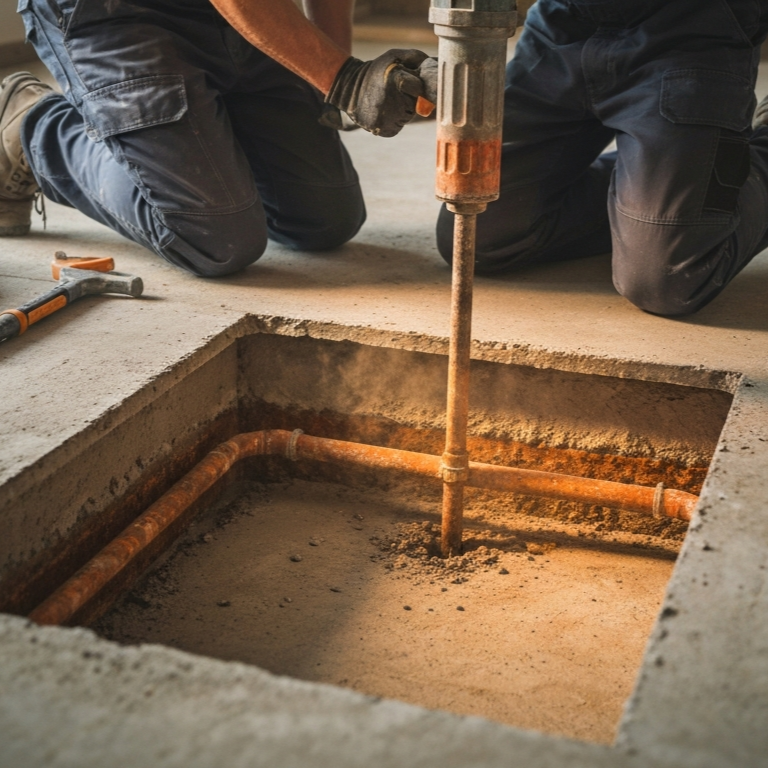
When a leak is isolated to a single short section of pipe, a plumber might go straight through the floor above it — break the slab, cut out the damaged segment, replace it. It's the most direct fix, and in the right situation, it costs the least.
But what's above the leak matters a lot. Carpet in a hallway or laundry room is easy to work around — pull it back, do the repair, have it restretched. Continuous hardwood flooring is a different problem entirely. You can't match existing grain and stain, which means cutting into it often means replacing more than just the section you opened. Large-format tile runs the same direction. The penetration size shifts things too. Most leaks can be reached through an opening roughly two feet square, but if the pipe runs under a concrete grade beam — the thickened structural sections that form a grid under the slab, sometimes four or five times as thick as the standard slab — cutting through it takes longer and leaves a bigger gap to restore afterward.
Spot repair makes sense when the pipe is in reasonable shape, the failure is clearly isolated to one section, and the floor above it isn't expensive to put back. It's a harder call in finished living spaces, and it doesn't address the rest of that aging copper line under the slab.
Rerouting: usually the best long-term value
A reroute skips the slab entirely. Instead of going down to the damaged pipe, the plumber runs new supply lines through the walls and attic, bypassing the problem section completely. Think of it like a road detour — you're not fixing the underground route, you're redirecting flow through a new path that never touches the foundation.
This typically costs more upfront than a spot repair. But for homes where the copper under the slab has started failing at multiple points, fixing one location doesn't buy much time. That pipe is running under the same water chemistry and wear conditions along its entire length. A reroute on a compromised line often prevents the next repair call in eighteen months.
The biggest variable in a reroute is the house itself. A single-story ranch with open attic access is a relatively quick job. A two-story colonial where new lines need to run from the lower level up through interior walls is considerably more involved. Attic quality changes the cost too — a clear, well-sized attic is quick to work in; a cramped, packed attic slows everything down. And every interior wall manifold point that has to be opened adds drywall patching and paint work to the invoice. Whether the affected line is hot or cold water matters as well. Hot water lines have more branch connections and appliance tie-ins throughout the house, which means more access points during a reroute.
What tunneling under the foundation actually costs
In some situations, rerouting isn't practical — the home's layout won't support it, or only a short section of pipe needs replacement. That's when a plumber tunnels under the slab from outside, excavating a trench roughly three feet wide and three feet tall from the foundation's edge inward to the leak.
That work is entirely by hand. A 15-foot tunnel moves more than 10,000 pounds of soil before any plumbing work starts. That labor explains why tunneling usually ends up being the most expensive repair option. Tunnel length drives the base cost, but complications raise it further: if the pipe passes under a grade beam rather than through the standard thin-slab section, that beam may need to be partially cut away to expose the line. And if the surrounding copper is corroded along the entire accessible section, replacing the full length while they're already in there adds material cost — but it also prevents a second tunnel job on the same path in a few years.
How leak detection fits into the starting price
Before any repair begins, the leak has to be found precisely. Plumbers use acoustic sensors, thermal imaging cameras, and pressure testing to pinpoint the source without tearing up large sections of floor. A skilled technician can usually narrow it down to within a foot or two.
Detection runs $150 to $600, billed before repair work starts. It's worth paying for. Accurate location means a smaller floor opening, less guesswork, and less restoration work after the fact. Some plumbers fold detection into the overall estimate; others bill it separately. Either way, it's part of the real cost of the job. Leaks under bathrooms or kitchens are harder to pinpoint — dense pipe runs in those areas mean longer detection time and sometimes higher fees.
What restoration work adds to the final bill
The pipe is only half the job. After any repair that enters the slab or opens walls, there's finish work: concrete patching, flooring replacement, drywall repair, and often paint. These costs are real, and they're consistently underestimated on initial estimates.
A floor penetration through carpet might run a few hundred dollars to patch and restretch. That same penetration through tile running continuously across a first-floor living area can add $1,500 to $2,500 for flooring work — and only if matching material is available. Hardwood is the worst situation. Matching grain and stain is rarely possible, so cutting into a wood floor means replacing a wider section than the opening itself required.
Drywall work comes with reroutes. Each manifold access point needs to be patched, taped, and painted. In older homes with original plaster walls — still common in the established neighborhoods around here — matching the texture adds another layer of difficulty and cost.
Before you sign an estimate, ask whether restoration is included or whether that work gets handed off to you to arrange separately.
Why older homes often cost more
A lot of homes in Montgomery, Bucks, and Berks Counties were built between the 1950s and 1980s with copper supply lines run under the slab during original construction. Those pipes are now 40 to 70 years old. Hard water common in this region accelerates the deterioration. Mineral scale deposits inside the copper, and where it concentrates, corrosion moves faster. The result is a pipe that springs pinhole leaks at irregular intervals along its entire length — not a single clean failure, but a slow pattern.
A spot repair fixes the one leak that was found. It doesn't fix the rest of that line. The adjacent section is running under identical conditions — same age, same water chemistry, same stress. That's why plumbers often push toward a reroute or full repipe on older homes rather than a cycle of spot fixes. Fixing the same type of failure twice on the same line in three years costs more in total than doing the full job once.
The decision between a targeted fix and a full-system solution comes down to how long you plan to stay in the house, the current condition of the rest of the plumbing, and what a follow-up repair would cost compared to doing the complete job now.
Frequently Asked Questions
Most single-line spot repairs or reroutes run between $1,500 and $5,000, when the leak is accessible and the home's layout cooperates. Tunneling jobs, older homes with extensive corrosion, or leaks under expensive finished floors can push that significantly higher. Detection adds $150 to $600 before repair work begins.
Not always. But it's often the smarter long-term call — particularly when the pipe is old or has failed at more than one point, when the flooring above the leak is expensive to restore, or when the home's attic and wall layout allows the new line to run without major complications. Spot repair is the right move for an isolated failure on relatively young plumbing where the rest of the line is in solid shape.
Sometimes, partially. Most policies cover sudden and accidental damage — a pipe that burst unexpectedly may qualify. Gradual leaks from corrosion or wear typically don't. Coverage for water damage to floors and walls is more common than coverage for the plumbing repair itself. Read your policy before assuming anything applies.
Yes, and it's a real factor in this part of Pennsylvania. The hard water in Berks and Montgomery Counties deposits mineral scale inside copper pipes over time. That scale creates zones where corrosion accelerates and pinhole leaks start. Homes on well water with high mineral content are at elevated risk for this failure pattern.
Pressure testing after the initial repair tells you. A plumber who tests system pressure before and after isolating a fixed section can tell whether the line holds steady or drops again — which points to a second failure somewhere else. This matters a lot for the method decision. One spot fix on a line with two or three failures is poor value.
A simple spot repair runs one to two days, including basic patching. A reroute on a single-story home is usually two to three days. Tunneling jobs run longer — two to four days for the excavation and pipe work alone, before any exterior restoration. Flooring and drywall work, if subcontracted separately, adds scheduling time after the plumbing is finished.
There is no single price for this kind of repair because there's no single way to do it. The method, the pipe location, the home's age and layout, and what needs to be restored afterward all factor in. A plumber who walks the house, runs diagnostics, and explains what they found before naming a number is giving you something more useful than an estimate over the phone before they've seen what they're working with.
